
Company Z has identified four potential acquisition targets: companies A, B, C and D.
Company Z has a current equity market value of $590 million.
The price it would have to pay for the equity of each company is as follows:

Only one of the target companies can be acquired and the consideration will be paid in cash.
The following estimations of the new combined value of Company Z have been prepared for each acquisition before deduction of the cash consideration:

Ignoring any premium paid on acquisition, which acquisition should the directors pursue?
Which THREE of the following long term changes are most likely to increase the credit rating of a company?
A company needs to raise $20 million to finance a project.
It has decided on a rights issue at a discount of 20% to its current market share price.
There are currently 20 million shares in issue with a nominal value of $1 and a market price of $5 per share.
Calculate the terms of the rights issue.
A listed company plans to raise $350 million to finance a major expansion programme.
The cash flow projections for the programme are subject to considerable variability.
Brief details of the programme have been public knowledge for a few weeks.
The directors are considering two financing options, either a rights issue at a 20% discount to current share price or a long term bond.
The following data is relevant:
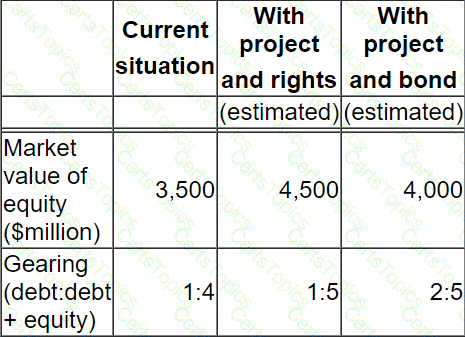
The company's share price has fallen by 5% over the past 3 months compared with a fall in the market of 3% over the same period.
The directors favour the bond option.
However, the Chief Accountant has provided arguments for a rights issue.
Which TWO of the following arguments in favour of a right issue are correct?
Copyright © 2021-2026 CertsTopics. All Rights Reserved
