
Company J plans to acquire Company K, an unlisted company whose equity is to be valued using a P/E ratio approach.
A listed company has been identified which is very similar to Company K and which can be used as a proxy.
However, the growth prospects of Company K are higher than those of the proxy.
The Directors of Company J are aware that certain adjustments will be necessary to the proxy company's P/E ratio in order to obtain a more reliable valuation.
The following adjustments have been agreed:
• 20% due to Company K being unlisted.
• 15% to allow for the growth rate difference.
The total adjustment to the proxy p/e ratio is:
A company has 8% convertible bonds in issue. The bonds are convertible in 3 years time at a ratio of 20 ordinary shares per $100 nominal value bond.
Each share:
• has a current market value of $5.60
• is expected to grow at 5% each year
What is the expected conversion value of each $100 nominal value bond in 3 years' time?
Company Z has identified four potential acquisition targets: companies A, B. C and D.
Company Z has a current equity market value of S590 million.
The price it would have to pay for the equity of each company is as follows:

Only one of the target companies can be acquired and the consideration will be paid in cash.
The following estimations of the new combined value of Company Z have been prepared for each acquisition before deduction of the cash consideration:

Ignoring any premium paid on acquisition, which acquisition should the directors pursue?
A company generates and distributes electricity and gas to households and businesses.
Forecast results for the next financial year are as follows:
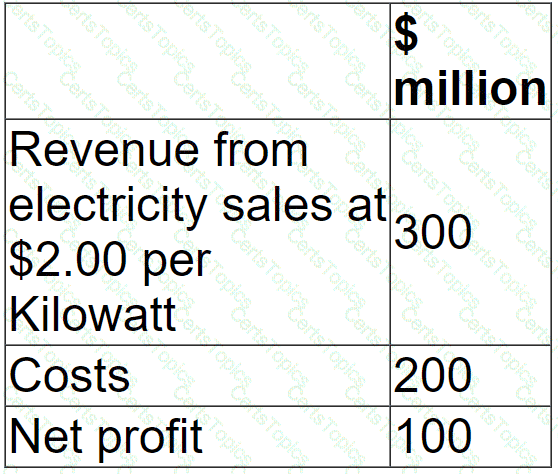
The Industry Regulator has announced a new price cap of $1.50 per Kilowatt.
The company expects this to cause consumption to rise by 10% but costs would remained unaltered.
The price cap is expected to cause the company's net profit to fall to:
Copyright © 2021-2026 CertsTopics. All Rights Reserved
