Spring Sale 70% Discount Offer - Ends in 0d 00h 00m 00s - Coupon code: save70

L4M5 Premium Exam Questions

Page: 28 / 30
Total 395 questions

Commercial Negotiation Questions and Answers

Question 109

An organization should develop different relationships which are appropriate to each supplier situation. Which ONE of the following analysis methods could help to identify these?

Options:

A.

Resources and cost spectrum

B.

The relationship spectrum

C.

The color spectrum

D.

A spectrum of non-critical items

Question 110

When engaging in commercial negotiations, it is important to bear in mind that the suppliers need to make a reasonable profit to maintain continuity of supply. It is therefore necessary for the buyer to have a clear understanding of the break-even analysis concept which relates to cost, volume, and profit.

What is 'contribution' in relation to break-even analysis?

Options:

A.

The gains that the supplier receives when the sales revenue exceeds fixed costs

B.

The gains from sales revenue that the supplier is willing to contribute in a profit-sharing contractual arrangement

C.

The gains that the supplier receives when the sales revenue exceeds variable costs

D.

The gains from sales revenue which the supplier retains as reserves to contribute to future development projects

Question 111

In a commercial negotiation, a procurement professional believe that the larger the order quantity from buyer, the lower the supplier's average costs. Is this assumption true?

Options:

A.

No, because supplier's average costs will rise as the buyer's demand increases

B.

No, because the supplier may need to invest in new facility to meet buyer's demand

C.

Yes, because larger order quantity will bring a considerable profit to supplier

D.

Yes, because larger order quantity will always enable the supplier to reach its economy of scale

Question 112

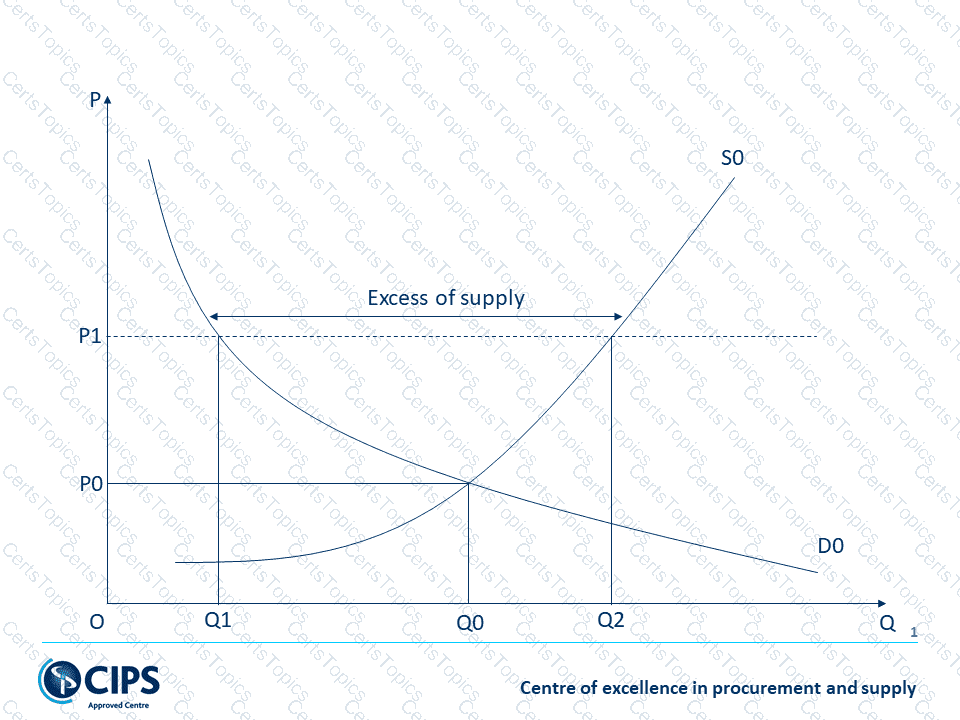
If the price of a good is above the equilibrium price, which of the following will happen?

Options:

A.

The quantity demanded is equal to the quantity supplied and the price remains unchanged

B.

There is a shortage (i.e. an excess demand) and the price will fall

C.

There is a surplus (i.e. an excess supply) and the price will rise

D.

There is a surplus (i.e. an excess supply) and the price will fall

Page: 28 / 30
Total 395 questions