

Month End Sale 70% Discount Offer - Ends in 0d 00h 00m 00s - Coupon code: save70

350-501 Questions Bank

Page: 6 / 41
Total 547 questions

Implementing and Operating Cisco Service Provider Network Core Technologies (350-501 SPCOR) Questions and Answers

Question 21

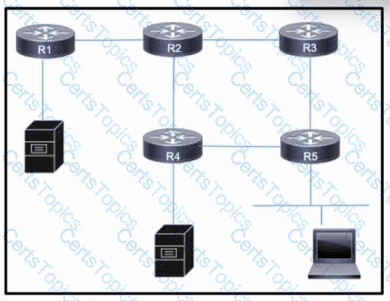
Refer to the exhibit. An engineer is scripting ACLs to handle traffic on the given network. The engineer must block users on the network between R1 and R2 from leaving the network through R5. but these users must still be able to access all resources within the administrative domain. How must the engineer implement the ACL configuration?

Options:

A.

Configure an ACL that permits traffic to any internal address, and apply it to the R5 interfaces to R3 and R4 in the egress direction

B.

Configure a permit any ACL on the R1 interface to R2 in the egress direction, and a deny any ACL on the interface in the ingress direction

C.

Configure an ACL that permits traffic to all internal networks and denies traffic to any external address, and apply it to the R2 interface to R1 in the ingress direction.

D.

Configure an ACL that denies traffic to any internal address and denies traffic to any external address, and apply it to the R5 interfaces to R3 and R4 in the ingress direction

Question 22

Which two actions describe ISP delegation to PCE servers? (Choose two)
Options:

A.

adding a new PCE server with lower precedence than the primary PCE

B.

changing the precedence of any of the PCE servers

C.

removing TE re-optimization timer timeouts

D.

entering the mpls traffic-eng reoptimize command

E.

adding a new PCE server with higher precedence than the primary PCE

Question 23

Refer to the exhibit. Users on a LAN connected to router R5 frequently open high-traffic connections with servers connected to R1 and R4. Users on R2 also require access to the servers, but performance is not a major concern and their traffic can be treated as secondary. As traffic on all links grows, the network architect wants to mitigate the potential for congestion on the link between R2 and R4.

Which action must the engineering team take to improve performance on the R2-R4 link for users on R5 while still allowing other traffic to flow?

Options:

A.

Implement traffic policing on R2 to drop unnecessary traffic from secondary users when that traffic exceeds a given threshold.

B.

Implement traffic shaping on R2 to control transmission between R1 and R4 for traffic identified in a class map.

C.

Implement LLQ for the whole network with a strict policy to ensure that all traffic from the servers is sent to priority users without interruption.

D.

Implement FIFO on R1, R2, and R4 to queue traffic so that all traffic can pass with maximum efficiency.

Question 24

What is the difference between SNMP and model-driven telemetry?

Options:

A.

Telemetry allows for modeled network data to be pushed to the network administrator on an as-needed basis

B.

Telemetry uses traps and inform messages to deliver data to a network administrator on a polling basis

C.

SNMP uses the YANG data modeling language

D.

SNMP pushes network data to the network administrator whenever it is queried

Page: 6 / 41
Total 547 questions
