Which of the following three options could be considered potential threats to impartiality in an audit context?
You, as auditor, are in dialogue with the quality lead and managing director of a small business that supplies
specialist laboratory equipment and furniture.
You: " I ' d like to look at how you manage change in the organisation. What changes have you made as a
business, say, over the last 12 months? "
Auditee: " We have made some strategic changes, the main one being that we no longer manufacture our
own products in house. "
You: " That sounds like quite a significant change. What has been the impact of that? "
Auditee: " We now mainly sell other manufacturers ' products, under their brand names, and have outsourced
manufacture of our own brand products to one of our suppliers. Unfortunately, we had to make six members
of our staff redundant. This represents about 20% of our workforce, so this has been quite a challenging
time. "
You: " I ' m sure. What were the reasons for making the change? "
Auditee: " Our manufacturing section was a small operation, and we struggled to cope with fluctuations in
demand. During busy periods, we found it hard to meet lead times, and in quiet periods we had staff with
little to do. This was having an impact on customer satisfaction and meant we had to charge premium prices
that made our product uncompetitive. "
You: " How did you go about the change? "
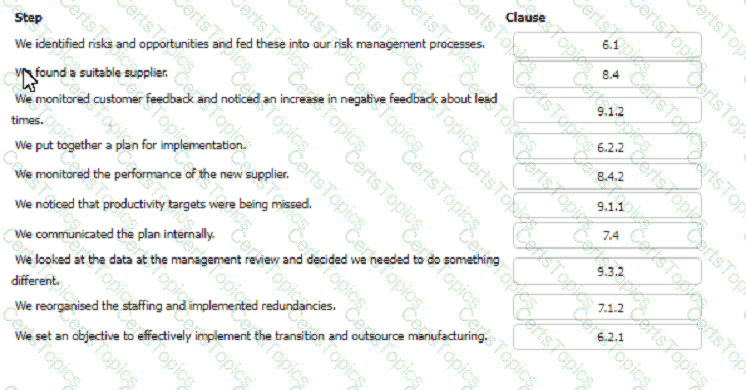
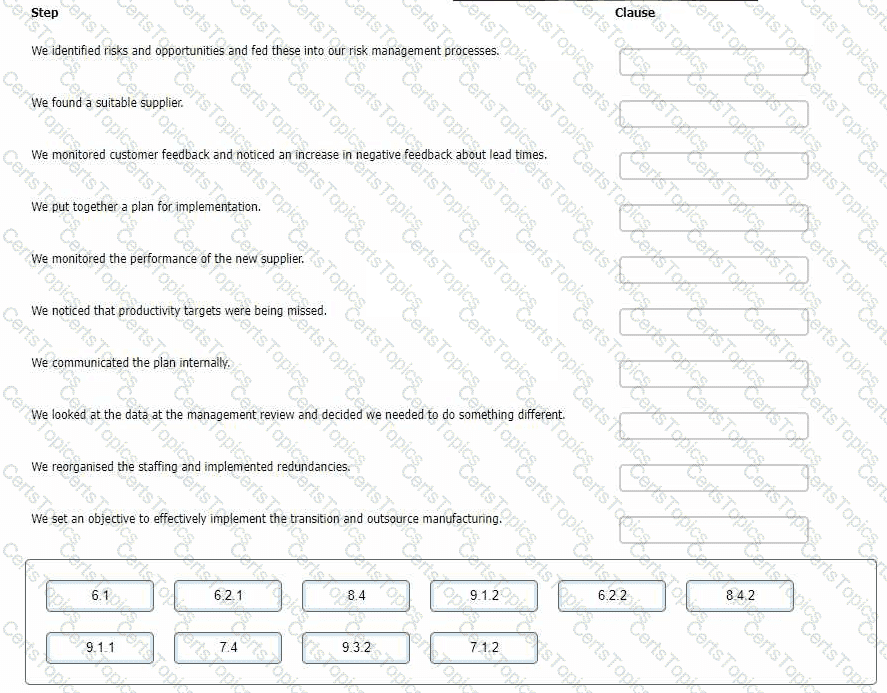
In relation to the auditor ' s question about how the change was managed, the auditee mentions the steps
listed below. Match the ISO 9001 clauses to the steps.
To complete the table, click on the blank section you want to complete so it is highlighted in red and then
click on the ISO 9001 clauses listed below. Alternatively, drag and drop each clause to show which step the
requirement applies to.
You are carrying out an audit at an organisation seeking certification to ISO 9001 for the first time. The organisation offers health and safety training to customers. Training courses are offered either as open courses, delivered at a public venue, or online, or as courses that are tailored to meet specific requirements. The business operates from a single office and those who deliver the training are either full-time employees or subcontractors.
You are interviewing the Training Manager (TM).
You: " What quality objectives apply to the training process? "
TM: " One of the quality objectives we aim for is a 90% minimum exam pass rate for all open training courses. "
You: " How do you measure this objective? "
The Training Manager shows you a record on her computer and you see the following:
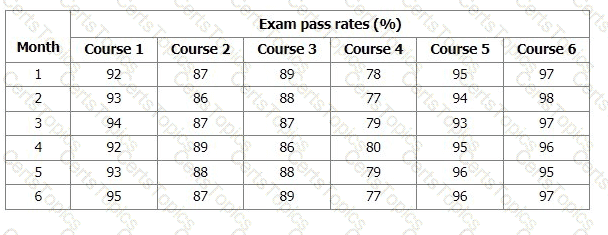
Which two of the following statements are true?
Scenario 2:
Bell is a Canadian food manufacturing company that operates globally. Their main products include nuts, dried fruits, and confections. Bell has always prioritized product quality and has maintained a good reputation for many years. However, the company ' s production error rate increased significantly, leading to more customer complaints.
To increase efficiency and customer satisfaction, Bell implemented a Quality Management System (QMS) based on ISO 9001. The top management established a QMS implementation team comprising five middle managers from various departments, including Leslie, the quality manager.
Leslie was responsible for assigning responsibilities and authorities for QMS-related roles. He also suggested including a top management representative in the QMS team, but top management declined due to other priorities.
The team defined the QMS scope as:
" The scope of the QMS includes all activities related to food processing. "
Leslie established a quality policy and presented it to the team for review before top management approval. Top management also proposed a new strategy for handling customer complaints, requiring biweekly customer surveys to monitor customer perceptions.
The quality policy was established by Leslie and approved by top management. Is this acceptable? Please refer to scenario 2.
Copyright © 2021-2026 CertsTopics. All Rights Reserved