Select one option that must be considered when determining the scope of a QMS to ISO 9001.
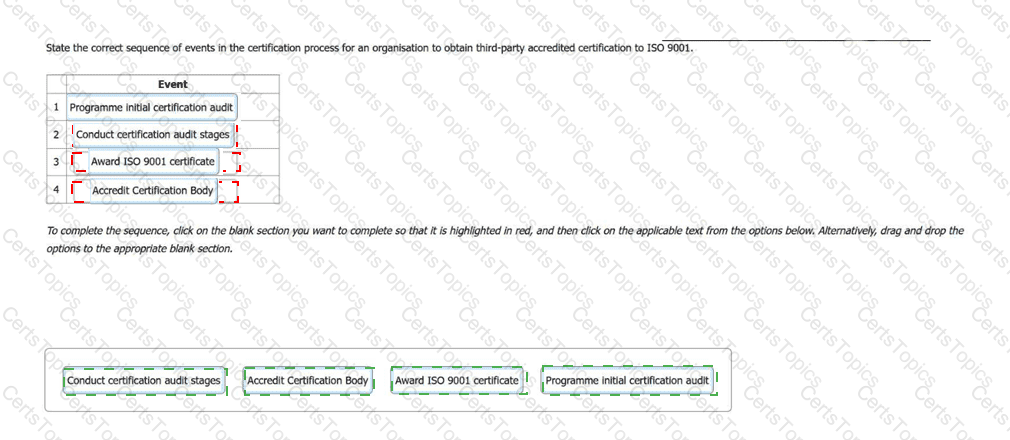
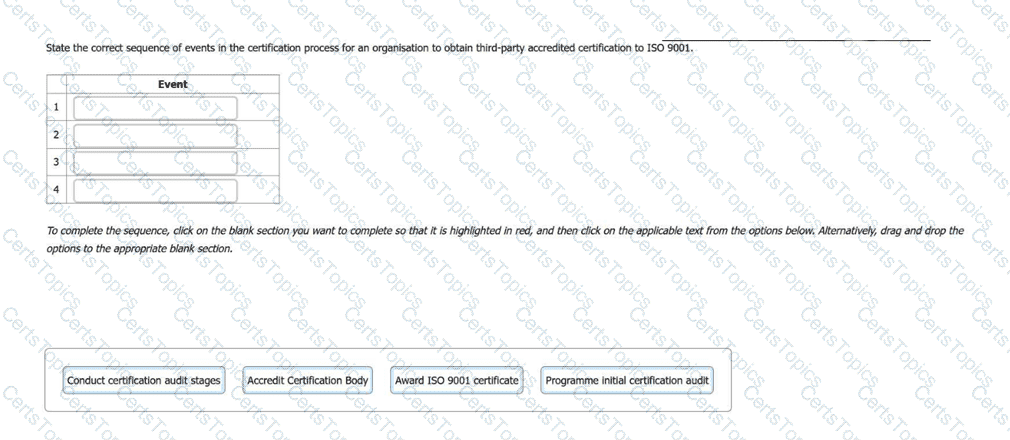
State the correct sequence of events in the certification process for an organisation to obtain third-party accredited certification to ISO 9001.
Scenario 1: AL-TAX is a company located in California which provides financial and accounting services. The company manages the finances of 17 companies and now is seeking to expand their business even more The CEO of AL-TAX, Liam Durham, claims that the company seeks to provide top-notch services to their clients Recently, there were a number of new companies interested in the services provided by AL-TAX.
In order to fulfill the requirements of new clients and further improve quality, Liam discussed with other top management members the idea of implementing a quality management system (QMS) based on ISO 9001. During the discussion, one of the members of the top management claimed that the size of the company was not large enough to implement a QMS. In addition, another member claimed that a QMS is not applicable for the industry in which AL TAX operates. However, as the majority of the members voted for implementing the QMS. Liam initiated the project.
Initially, Liam hired an experienced consultant to help AL-TAX with the implementation of the QMS. They started by planning and developing processes and methods for the establishment of a QMS based on ISO 9001. Furthermore, they ensured that the quality policy is appropriate to the purpose and context of AL TAX and communicated to all employees. In addition, they also tried to follow a process that enables the company to ensure that its processes are adequately resourced and managed, and that improvement opportunities are determined.
During the implementation process, Liam and the consultant focused on determining the factors that could hinder their processes from achieving the planned results and implemented some preventive actions in order to avoid potential nonconformities Six months after the implementation of the QMS. AL-TAX conducted an internal audit. The results of the internal audit revealed that the QMS was not fulfilling all requirements of ISO 9001. A serious issue was that the QMS was not fulfilling the requirements of clause 5.1.2 Customer focus and had also not ensured clear and open communication channels with suppliers.
Throughout the next three years, the company worked on improving its QMS through the PDCA cycle in the respective areas. To assess the effectiveness of the intended actions while causing minimal disruptions, they tested changes that need to be made on a smaller scale. After taking necessary actions, AL-TAX decided to apply for certification against ISO 9001.
Based on the scenario above, answer the following question:
The CEO of AL-TAX hired an experienced consultant to help with the implementation of the QMS. Is this required from ISO 9001?
You work for an organisation, ' ABC ' , which provides packaged food to the public. You are asked to lead a team (you as the leader and two other
auditors) to audit an external provider, ' XYZ ' , which provides packaging materials to your organisation. It is 4 pm, and the audit is dlose to an end;
you are having an internal meeting with the team to decide what will be presented to the auditee during the Closing meeting. The Closing meeting
was scheduled for 5 pm.
' XYZ ' has two manufacturing lines: M1 is a clean room for primary packaging materials (i.e. will be in direct contact with the food), and M2 is for
secondary materials (i.e. will not be in direct contact with food).
Auditor 1 audited the two manufacturing lines.
You: " What findings would you report? "
Auditor 1: " I have one issue. Earlier today in the morning I saw some secondary material stocked in the clean room. I would propose raising a
nonconformity. "
You: " How would you write the nonconformity? "
Auditor 1: " In the clean room, there was a pallet with secondary materials. "
What additional information would you add to this text to complete the nonconformity report? Select six.
Copyright © 2021-2026 CertsTopics. All Rights Reserved