
An audit team of three people is conducting a Stage 2 audit to ISO 9001 of an engineering organisation which manufactures sacrificial anodes for the
oil and gas industry in marine environments. These are aluminium products designed to prevent corrosion of submerged steel structures. As one of
the auditors, you find that the organisation has shipped anodes for Project DK in the Gulf of Mexico before the galvanic efficiency test results for the
anodes have been fully analysed and reported as required by the customer. The Quality Manager explains that the Managing Director authorised the
release of the anodes to avoid late delivery as penalties would be imposed. The customer was not informed since the tests rarely fall below the
required efficiency. You raise a nonconformity against clause 8.6 of ISO 9001.
During the audit team meeting in preparation for the Closing meeting, the second auditor disagreed with the clause of ISO 9001 selected for the
above nonconformity. He thinks it should be clause 9.1.1.
Choose three options for how the audit team leader should best respond to the situation:
Consultancy ABC, which is a subsidiary of a certification body called ABC-CERT, provided consultancy services regarding the implementation of a QMS based on ISO 9001 to an organization. Considering this, can ABC-CERT provide certification services to the organization which obtained consultancy services from Consultancy ABC?
During a second-party audit, the auditor examines the records that are available for the external provider, ABC Forgings, to whom manufacturing has recently been outsourced.
There are standard external provider checklists for three competitors for the contract and there are inspection records from the trial manufacturing batches produced by ABC Forgings. There is no documented evidence of the criteria used to confirm the appointment of ABC Forgings, and no contract or terms and conditions. Ongoing monitoring indicates that external provider performance is satisfactory, but no documented information has been retained.
Select two options for the evidence which demonstrates a nonconformity with clause 8.4 of ISO 9001.
You are carrying out an audit at a single-site organisation seeking certification to ISO 9001 for the first time. The
organisation manufactures cosmetics for major retailers and the name of the retailer supplied appears on the product
packaging. Sales turnover has increased significantly over the past five years. The organisation uses a software programme called SWIFT, which is used to record sales, plan production, purchase supplies, print despatch notes, track new product development, perform traceability exercises, carry out mass balance checks, raise invoices, create budgets, and support financial control.
You are nearing the end of the audit and you are reviewing your audit notes. You notice a recurring trend concerning the SWIFT database as shown below:
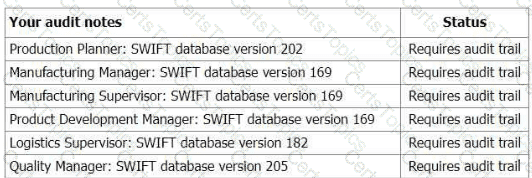
You ask the Quality Manager to explain how the SWIFT database is controlled. You learn that the Operations Director is
responsible for determining and progressing SWIFT software updates. You decide to meet the Operations Director (OD).
You: " Good afternoon. "
OD: " Good afternoon. "
You: " What responsibility do you have concerning the SWIFT database? "
OD: " I maintain it. If anyone wishes to propose an update to the database, they send me an email with
details of their proposal. I then either process the database update myself, or I send the request to the
consultant who designed the database 20 years ago. The necessary software changes are made, and the
amended software is immediately released to users. "
You: " Would you explain how the software amendments are controlled? "
OD: " Of course. I personally update every computer myself. "
You: " Do you inform the database users of the changes? "
OD: " No I don ' t. They find out for themselves by using the software, or they come to see me if they have
any questions. "
You: " How do you ensure that the database users use the latest version? "
OD: " That ' s easy, I update every computer myself. "
You: " During the audit, I noted there were several versions of SWIFT in use (you refer to your audit
notes). "
OD: " I know. That ' s because some versions work better than others, and depending on user needs and
experiences, we allow users to revert to using an earlier version if they find it works better for them. "
Based on the scenario, which two of the following statements are true? There is evidence of
nonconformity with a requirement defined in ...
Copyright © 2021-2026 CertsTopics. All Rights Reserved
