
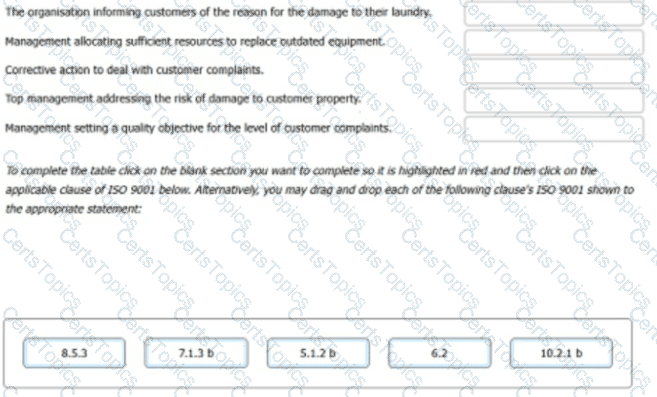
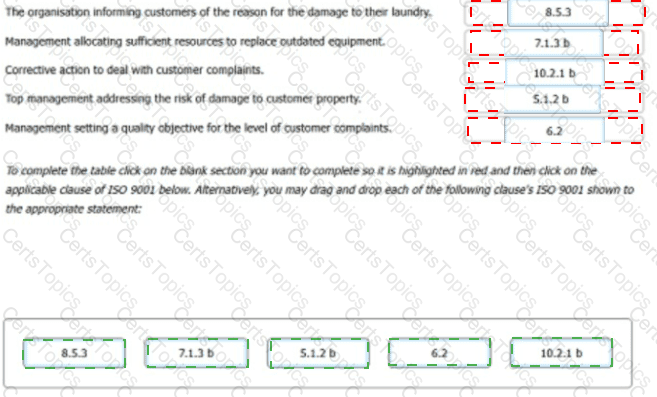
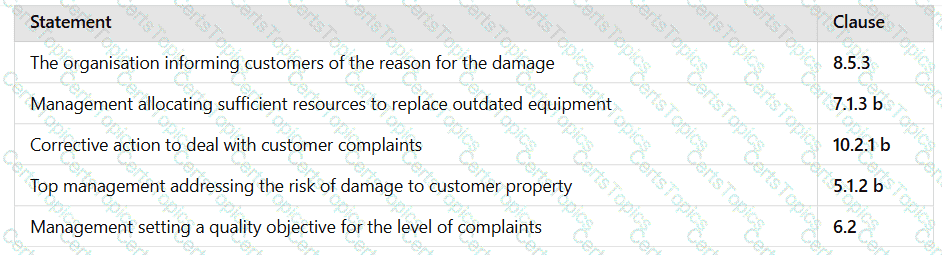
Whistiekleen is a national dry cleaning and laundry organisation with 50 shops. You are conducting a surveillance audit of the Head Office and are sampling customer complaints. You find that 80% of complaints originate from five shops in the same region. Most of these complaints relate to damage to customer laundry. The Quality Manager tells you that these are the oldest shops in the organisation. The deaning equipment needs replacing but the organisation cannot afford it now. You learn that the shop managers were told to dismiss most of the claims based on the poor quality of the laundered materials.
On raising the matter with senior management, you are told that there are plans to replace the equipment in these shops over the next five years.
Match the ISO 9001 Clauses to the statements.
What are the objectives of the Stage 2 audit?
(Select the six statements that are required as part of a second-party audit to ISO 9001 carried out by an organisation to a key supplier (ABC), taking into account recommendations from ISO 19011.)
Noitol is an organisation specialising in the design and production of e-learning training materials for the insurance market. During an ISO 9001 audit
of the development department, the auditor asks the Head of Development about the process used for validation of the final course design. She states that they usually ask customers to validate the product with volunteers. She says that the feedback received often leads to key improvements.
The auditor samples the design records for a recently completed course for the 247 Insurance organisation. Design verification was carried out but there was no validation report. The Head of Development advises that this customer required the product on an urgent basis, so the validation stage
was omitted. When asked, the Head estimates that this occurs about 50% of the time. She confirms that they always ask for feedback and often make changes. There is no record of feedback in the design file for the course.
The auditor raises a nonconformity against ISO 9001. Which one of the following options is the basis for the nonconformity?
Copyright © 2021-2026 CertsTopics. All Rights Reserved

 A screenshot of a computer AI-generated content may be incorrect.