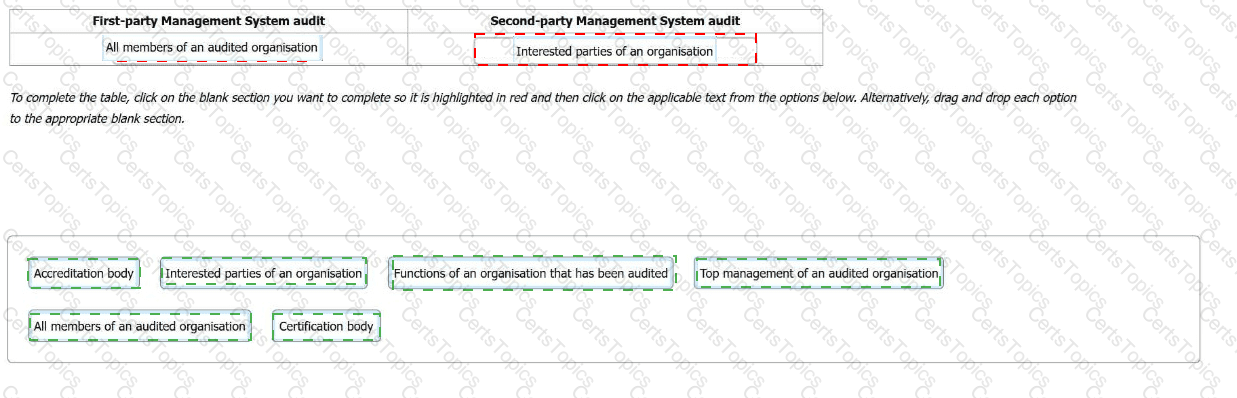
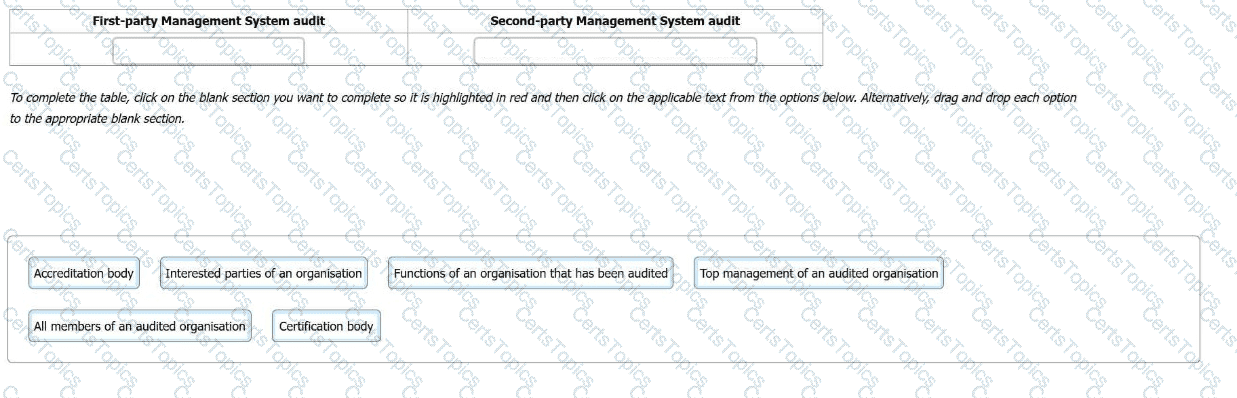
Match the following potential audit client options to the type of audit.
Which quality management principle does an organization fulfill when it assesses risks, consequences, and impacts before taking action?
You are conducting a third-party audit to ISO 9001 and interviewing the Training Manager. She explains that training is more
important than ever because the organisation has had to reduce the number of staff employed. Many of the remaining staff
are now required to be ' multi-skilled ' . You ask to see plans for the multi-skilling training and are shown plans that look
comprehensive, and include both ' on the job " training and internal and external training courses.
The records indicate that several staff required parts of their training to be repeated one month after the first training was
provided. You ask why this was needed and are told that an investigation of customer complaints identified that several staff
members did not complete certain tasks in the correct manner. The extra training was therefore recommended as a
corrective action.
Based on this interview, which two of the tollowing audit trails would be the most appropriate to follow?
Select the two most appropriate audit trails from the following.
A small cleaning services organisation is about to start work on a hospital cleaning contract for the local Health Trust. You,
as auditor, are conducting a Stage 2 audit to ISO 9001 and review the contract with the Service Manager. The contract
requires that a cleaning plan is produced.
You: " How was the cleaning plan for the contract developed? "
Service Manager: " We have a basic template that covers the materials, labour requirements and cleaning methods to be
employed. Some of that is specified by the customer. "
You: " How does the plan deal with locations like the intensive care wards and the operating theatres, which are included
in the contract? "
Service Manager: " The basic plan covers general wards, but we will do more frequent cleaning in those areas if the
hospital requests it. "
You: " Are you aware of the regulatory requirements for cleaning standards in hospitals? "
Service Manager: " No. We depend on the hospital to look after that side of things in the contract. "
You decide to raise a non-conformity against section 8.2.2.a.1 of ISO 9001.
You decide to raise another non-conformity against section 8.2.4 of ISO 9001 when finding that the
cleaning plan was amended without the agreement of the Health Trust. A different cleaning chemical was
substituted to that specified in the contract. At the follow-up audit, the corrective action proposed was to
" obtain a concession from the Health Trust for use of the new chemical. "
Which one of the following options is the reason why you did not accept this action taken?
Copyright © 2021-2026 CertsTopics. All Rights Reserved