
New Year Sale 70% Discount Offer - Ends in 0d 00h 00m 00s - Coupon code: save70

Free and Premium HRCI SPHR Dumps Questions Answers

Page: 1 / 21
Total 280 questions

Senior Professional in Human Resources Questions and Answers

Question 1

Which of the following agreements is most likely to protect trade secrets when a key employee is recruited by a competitor?

Options:

A.

Privacy

B.

Non-solicitation

C.

Non-disclosure

D.

Proprietary

Buy Now
Question 2

An international union has represented employees of a small manufacturing plant for 25 years. Ninety-six employees cast ballots in a representation election.

Which of the following is the minimum number of votes required for either union to prevail?

Options:

A.

48

B.

49

C.

52

D.

53

Question 3

An employer's best legal protection with regard to electronic surveillance of employees is to:

Options:

A.

Require workers’ written consent for surveillance

B.

Establish criteria for monitoring personal devices

C.

Review monitoring data quarterly

D.

Prohibit surveillance in certain areas

Question 4

After an election is ordered by the NLRB, which of the following management efforts could constitute an unfair labor practice by the employer?

Options:

A.

Comments by front-line supervisors to individual employees that the union will be costly since its only source of funds will be union members

B.

Small group meetings held immediately after the beginning of the work shift on election day in which supervisors discuss why employees should vote “no”

C.

Department meetings during working hours where the plant manager states that all promises are subject to negotiation

D.

Written fact sheets distributed weekly comparing wages to those of another plant that voted the union out

Question 5

To analyze the financial impact of HR's business contribution, the best indicator of success is a:

Options:

A.

delivery on key performance indicators (KPIs)

B.

balanced scorecard

C.

cost-benefit analysis

Question 6

Which of the following is the greatest advantage of workforce diversity in an organization?

Options:

A.

Protects an organization from discrimination claims

B.

Allows recruiters access to a larger pool of candidates

C.

Provides employees with additional career advancement opportunities

D.

Enhances an organization’s ability to maintain a competitive advantage

Question 7

Which group is ultimately responsible for carrying out a successful crisis management plan?

Options:

A.

Emergency response team

B.

Senior leadership

C.

Managers at all levels

D.

Internal safety department

Question 8

Which of the following performance appraisal techniques includes written statements about an employee's effective and ineffective behaviors?

Options:

A.

Graphic rating

B.

Critical incident

C.

Forced distribution

D.

Anchored scale

Question 9

A large organization will most effectively increase peer-to-peer recognition by:

Options:

A.

training leaders to provide public recognition.

B.

awarding those who provide feedback.

C.

utilizing a real-time vendor platform.

D.

encouraging participation in current efforts.

Question 10

An organization allows employees to access the Internet on their workstations for limited personal use. An employee is suspected of excessive Internet use during work hours, including reading personal email. The best course of action for the employer is to:

Options:

A.

Monitor the employee's personal email

B.

Review the employee's Internet history

C.

Restrict Internet access

D.

Terminate the employee

Question 11

Based on the results of a general abilities test below, which of the following decisions should the organization make"?
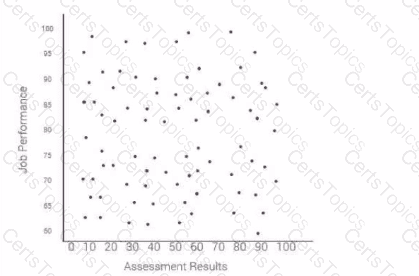
Options:

A.

Use the test for skills assessments.

B.

Avoid using the test for all positions.

C.

Use the test for performance reviews.

D.

Avoid using the test for leadership positions

Question 12

When designing a training evaluation form, it is important to:

Options:

A.

limit the length to one page

B.

make the questions unambiguous

C.

use numeric ratings

D.

use comparative analysis

Question 13

A successful talent management program begins with a(n):

Options:

A.

evaluation of annual performance.

B.

internal promotion strategy.

C.

assessment of employee potential.

D.

forecast of human capital needs.

Question 14

HR leadership is tasked with addressing the need for new technology skills in the organization. HR should first:

Options:

A.

invest in new systems and software

B.

identify critical competencies

C.

scan the labor market for needed skills

D.

develop training to support new skills

Question 15

Higher levels of employee engagement lead to:

Options:

A.

fewer workplace injuries and accidents.

B.

increased training participation.

C.

lower absenteeism and higher profits.

D.

more interest in career development plans.

Question 16

Learning is best linked to performance when:

Options:

A.

Post-training skills transfer to the job

B.

Managers say they will use program tools

C.

Trainees show increased levels of knowledge

D.

Trainees report high satisfaction with the program

Question 17

Which organizational structure is best suited to supporting employee growth under a culture of creativity, learning, and growth?

Options:

A.

Flat

B.

Matrix

C.

Divisional

D.

Hierarchical

Question 18

Which of the following actions should be taken first when a hiring manager sees very few qualified candidates among the pool that have met the pre-screening requirements?

Options:

A.

Confirm accuracy of job descriptions

B.

Open position to greater audience

C.

Target specific applicant pools

D.

Seek an increase in salary range

Question 19

What is the target demographic of an organization with a total rewards package that includes at-market pay and a high professional development budget?

Options:

A.

Highly skilled individuals

B.

New college graduates

C.

Executive leadership

D.

Middle management

Question 20

The employer cannot terminate or otherwise discipline the employee for organizing efforts because the:

Options:

A.

employee's actions took place outside of the workplace

B.

employee has the right to try to form a union in the workplace

C.

union has already collected the requisite number of signatures

D.

union might retaliate and ask employees to strike in sympathy

Question 21

Business plans support organizational decisions when they are used as a:

Options:

A.

Market-defining guideline

B.

Guiding and supporting document

C.

Narrative nonfinancial strategy

D.

Snapshot of financial goals

Question 22

HR can best prepare organizations to adjust to an aging workforce by:

Options:

A.

Developing plans for potential skill gaps

B.

Analyzing information about turnover and recruitment

C.

Considering outsourcing and alternative staffing models

D.

Ensuring retirement-eligible workers understand retirement options

Question 23

One reason for an organization to include social responsibility as part of its talent strategy is to:

Options:

A.

enhance employee engagement and retention.

B.

adopt principles and standards for external recruiting.

C.

improve employee referral programs.

D.

recruit applicants with more experience.

Question 24

The most effective onboarding strategies are designed to:

Options:

A.

include supervisors and peers.

B.

be short-term and informal.

C.

restrict use of social media.

Question 25

The most significant concern associated with staff retirement is the:

Options:

A.

impact on succession planning.

B.

retention of institutional knowledge.

C.

replacement of valued key employees.

D.

difficulty of accurate forecasting.

Question 26

Which of the following is the first action for HR to take when assessing the value of adding a formal relocation program to the overall talent acquisition strategy?

Options:

A.

Consult with relocation service providers and benchmark current trends.

B.

Work with finance to develop a relocation policy and budget.

C.

Post positions outside the region to determine interest in relocation.

D.

Perform an opportunity assessment to understand current reality and business alignment.

Question 27

An employee with previously good attendance and performance reviews is exhibiting increased incidences of tardiness, absenteeism, and mistakes. The manager suspects that the employee may have a drinking problem. When conducting an investigation, HR should initially refer to:

Options:

A.

Past practices and EEOC guidelines

B.

The Drug-Free Workplace Act and EAP

C.

EAP guidelines and ADEA

D.

The ADA and the organization’s policy

Question 28

The most important component in an effective crisis management plan is that it be designed for:

Options:

A.

flexible decision-making.

B.

remote access to organization data.

C.

extended leaves of absence.

D.

bottom-up communication.

Question 29

An important characteristic found in effective leaders is:

Options:

A.

a focus on accepted methods and practices.

B.

the ability to delegate assignments equally.

C.

rapid decisiveness with minimal input from others.

D.

the willingness to view mistakes as learning opportunities.

Question 30

In designing a total compensation strategy, organizations should first consider:

Options:

A.

The use of consultants to advise HR on the proper strategy to use

B.

Pay rates and the cost of current health and welfare plans

C.

The total rewards system used by major competitors

D.

A plan to support overall goals and objectives

Question 31

Which of the following is the best example of positive reinforcement in a production environment?

Options:

A.

Peer recognition

B.

Piece rate pay

C.

Variable merit pay

D.

Spot awards

Question 32

The analysis phase of instructional design is used to determine:

Options:

A.

Training delivery methods

B.

Which evaluation system to use

C.

The budget for the project

D.

What skills need to be taught

Question 33

A pregnant employee in a manufacturing plant discloses the pregnancy on the first day of employment. The employee works an overnight shift and does not have an accommodation request. The supervisor is concerned that the employee is unable to perform the job duties and contacts HR. What’s the best option?

Options:

A.

Move the employee temporarily into a less physical role

B.

Explain to the employee that the position is unsafe for the fetus

C.

Keep the employee in their assigned role

D.

Offer the employee an alternative job at the same pay rate

Question 34

The primary role of HR as a strategic partner is to:

Options:

A.

contribute to the development and execution of business plans.

B.

guide and influence management planning sessions.

C.

develop relationships with all levels of the management team.

D.

communicate the organization's goals and objectives to its employees.

Question 35

The first step in developing a talent strategy must be to identify and assess skill sets of the internal workforce in an organization by conducting:

Options:

A.

External scanning of market competitors and what internal business skills are missing

B.

Internal scanning of the organization’s structure, communication, and workflow

C.

Internal scanning of employees’ business skill competencies and work levels

D.

External scanning of applicant business skills and work levels

Question 36

Which of the following is most likely to be increased by improving organizational health?

Options:

A.

Organizational culture

B.

Manager tenure

C.

Employee performance

D.

Organizational productivity

Question 37

The most important purpose of a crisis management plan is to prepare the organization for:

Options:

A.

every possible contingency

B.

rapid data restoration

C.

emergency media communication

D.

the worst-case scenario

Question 38

Which of the following measures do high-performing organizations use to determine the success of talent investment? (Select TWO options.)

Options:

A.

Financial performance

B.

Benefits utilization

C.

Employee engagement

D.

Compa-ratio

E.

Number of referrals

Question 39

The most effective talent management strategy in the growth phase of an organization's lifecycle is to:

Options:

A.

Attract candidates with critical skill sets

B.

Resolve employee complaints

C.

Strengthen total rewards offerings

D.

Encourage employee advancement

Question 40

In the analysis stage of benefit plan benchmarking, the first step is to:

Options:

A.

develop action plans to address key findings.

B.

determine gaps between competitive practices.

C.

communicate findings to the organization.

D.

identify improvements and timetables.

Question 41

The key strategy for delivering a new safety training program should be to:

Options:

A.

show examples of injuries that might occur.

B.

educate employees in safe workplace design.

C.

use OSHA-sponsored seminars and materials.

D.

apply the learning to the workplace.

Question 42

Which of the following are the primary factors that would contribute to a hiring manager’s decision to extend an offer above the midpoint of a salary range? (Select TWO options.)

Options:

A.

The candidate has the needed level of experience for the position

B.

The candidate has a strong skill set including specialized certifications

C.

The position is of average complexity and competition is high for talent

D.

The position has some complexity and competition is moderate for talent

E.

The candidate currently works in a similar position with a direct competitor

Question 43

The results of a SWOT analysis allow the organization to focus on:

Options:

A.

business opportunities.

B.

international trends.

C.

financial stability.

D.

competitive benchmarking.

Question 44

HR can contribute to reducing potential risk by:

Options:

A.

assessing employment practices.

B.

completing a comprehensive legal review.

C.

conducting a cost-benefit analysis.

D.

addressing employee turnover.

Question 45

Customized target market competition, cafeteria reward systems and performance management are major considerations in re-engineering:

Options:

A.

Recruitment strategies

B.

Succession plans

C.

HR audit procedures

D.

Compensation systems

Question 46

The primary consideration when developing an employee recognition program is:

Options:

A.

Rewarding behaviors that support core values

B.

Establishing an appropriate program budget

C.

Getting support from team champions

D.

Linking with referral bonus programs

Question 47

Before implementing a corporate social responsibility (CSR) strategy, it is most critical that HR:

Options:

A.

Deliver communications to all impacted employees

B.

Understand the environment in which the business operates

C.

Assume an advisory role to community leaders

D.

Conduct a gap analysis and analyze data

Question 48

What is the best strategy to mitigate pay compliance issues?

Options:

A.

Evaluate seniority levels.

B.

Implement equity adjustments.

C.

Adjust scope of job duties.

D.

Conduct salary market analysis.

Question 49

It is illegal for an organization to close a facility and move to another state to:

Options:

A.

reduce state tax liability.

B.

benefit from a more favorable labor climate.

C.

meet its affirmative action goals.

D.

escape incumbent union jurisdiction.

Question 50

Spaced practice usually provides the trainee with:

Options:

A.

An opportunity to learn both on the job and in the classroom

B.

Frequent feedback from instructors

C.

Application of learned skills in multiple work settings

D.

Reinforcement of learning over time

Question 51

New employees are asked to respond to a survey after 90 days of employment. Several have expressed frustration or disappointment with the onboarding process and report feeling lost and needing to “find their own way.” Onboarding currently consists of spending the first day with HR learning about benefits, filling out paperwork, beginning work in their new roles, and attending a few meetings throughout the department and organization.

A manager can most positively influence new hire engagement by:

Options:

A.

providing tours to other departments.

B.

encouraging flexible work hours and job rotations.

C.

providing more input into the onboarding materials.

D.

being available for frequent check-ins and meetings.

Question 52

A risk reduction strategy that many organizations use for terminated vested participants or retirees of a defined benefit pension plan is to:

Options:

A.

Increase the retirement age

B.

Reduce benefit contributions

C.

Provide lump sum payouts

D.

Terminate the plan

Question 53

The primary purpose of an employee stock ownership plan (ESOP) is to:

Options:

A.

tie employee rewards to employee performance.

B.

improve awareness of profit objectives.

C.

align employee and shareholder interests.

D.

promote employee participation.

Question 54

An employee with previously good attendance and performance reviews is exhibiting increased incidences of tardiness, absenteeism, and mistakes. The manager suspects that the employee may have a drinking problem. In investigating this situation, the first consideration is to:

Options:

A.

Conduct “for cause” substance testing and refer to the EAP

B.

Evaluate the employee’s conduct and behavior against performance and disciplinary standards

C.

Verify that the employee has signed an acknowledgment of receipt of organizational policies

D.

Conduct co-worker and supervisor interviews related to the employee’s behavior

Question 55

Which of the following options represents a state of complete transformation by both the acquiring and the acquired organization?
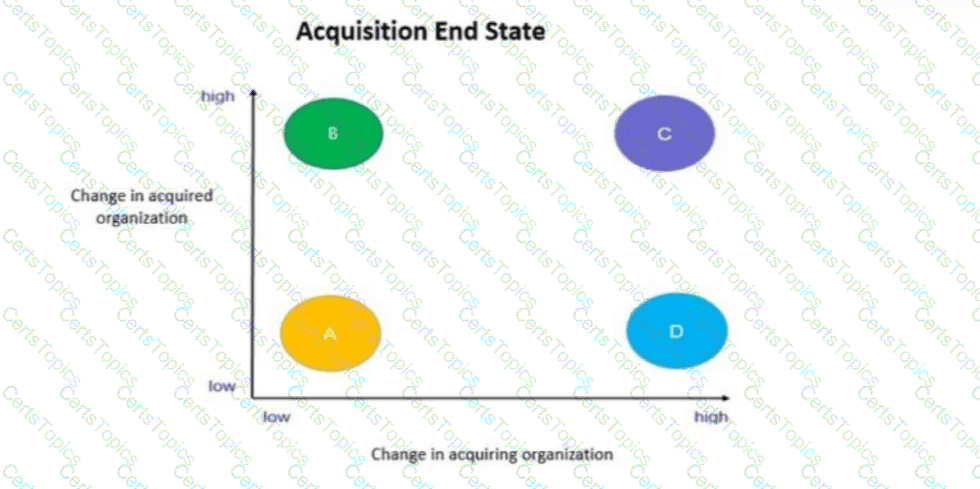
Options:

A.

A

B.

B

C.

C

D.

D

Question 56

A recruiting department strives to be more service-oriented with its business partners. Which of the following training areas best support that objective? (Select TWO options.)

Options:

A.

Blended learning

B.

Problem solving

C.

Risk management

D.

Defining vision

E.

Building alliances

Question 57

When consolidating two divisions, HR can best ease the transition by:

Options:

A.

analyzing historical data.

B.

assessing employee knowledge gaps.

C.

facilitating clear communication.

D.

conducting periodic focus groups.

Question 58

Key factors that contribute to a successful restructuring of the HR function include:

Options:

A.

Cost control and accountability

B.

Business focus and benchmarking

C.

Process design and customer focus

D.

Service improvement and communication

Question 59

For which of the following positions does the compa-ratio reflect a lagging market rate?
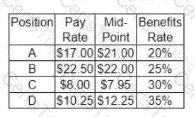
Options:

A.

Position A

B.

Position B

C.

Position C

D.

Position D

Question 60

When designing onboarding experiences for newly hired senior executives, which element is most frequently overlooked?

Options:

A.

Integrating previous and current business processes

B.

Establishing relationships with line employees

C.

Understanding talent management strategy

D.

Communicating informal processes and practices

Question 61

During mergers and acquisitions (MandA), an executive is likely to be protected financially with a:

Options:

A.

Leveraged buyout

B.

Divestiture strategy

C.

Golden parachute

D.

Stock option

Question 62

Which of the following are most effective at reducing burnout? (Select TWO options.)

Options:

A.

Promoting an Employee Assistance Program (EAP)

B.

Providing regular training on stress management

C.

Ensuring workloads are reasonable and manageable

D.

Offering hybrid and remote work opportunities

E.

Allowing staff some control over how work gets done

Question 63

An effective employer branding strategy is aligned with which of the following? (Select TWO options.)

Options:

A.

Operational efficiencies

B.

Marketing and customer promise

C.

Organizational structure

D.

Hiring and selection processes

E.

Talent management programs

Question 64

In order to measure the return on investment (ROI) of a project, an organization must:

Options:

A.

establish clear objectives.

B.

utilize qualitative data.

C.

develop performance standards.

D.

identify project ownership.

Question 65

An HR director has been hired by a high-technology business that has been growing at a rapid rate. There are 300 professional employees in manufacturing and 80 in clerical and laboratory support. There has been no formal human resource function in the past, with each department head controlling the hiring, salary adjustments, and other details of that department. There are no established working hours except for non-exempt employees and the work environment is very informal in dress and supervisory relationships. The president wants the new director to identify the key areas of importance. To plan for future staffing needs, the first step should be to:

Options:

A.

Design new compensation systems

B.

Develop an employee skills inventory

C.

Redesign the employee activities committee

D.

Evaluate the current succession planning system

Question 66

The best approach to lead a successful retention strategy is to:

Options:

A.

Focus on retaining all employees

B.

Increase the budget for recognition programs

C.

Target efforts to high performers

D.

Prioritize organizational seniority

Question 67

When developing a compensation strategy, HR must first decide whether to:

Options:

A.

provide cost-of-living increases.

B.

lead, lag, or match the market.

C.

implement pay for performance practices.

D.

use a competency-based pay approach.

Question 68

What are the most critical factors that affect an organization's ability to compete? (Select TWO options.)

Options:

A.

Ability to automate job tasks

B.

Cost of media to market services

C.

Bargaining power of buyers and suppliers

D.

Proficiency with total quality management

E.

Threat level of like products and new entrants

Question 69

What can an employer legally do when a union approaches employees about forming a bargaining unit?

Options:

A.

Promise a pay increase

B.

Ask employees how they will vote

C.

Tell employees the cost of union dues

D.

Speak with employees at their homes

Question 70

The most effective succession plans include: (Select TWO options.)

Options:

A.

standardized career paths.

B.

customized development options.

C.

emergency replacements for critical positions.

D.

cost-benefit analysis of managers’ feedback time.

E.

scorecard data for high-potential performance ratings.

Question 71

In assessing training, the three broad areas of measurement that are most important to management are cost, change, and:

Options:

A.

Participation

B.

Satisfaction

C.

Usefulness

D.

Impact

Question 72

Which of the following presents the greatest difficulty in using a profit-sharing plan as a means of rewarding employees?

Options:

A.

Payout levels can be supported effectively only at large organizations

B.

Employees may feel disconnected from factors that contribute to organizational success

C.

Compensation managers may have difficulty determining criteria for the plan

D.

Rewards for financial success are most effective for executive-level employees

Question 73

In compensation system development, internal equity conflicts directly with which other element?

Options:

A.

Recruitment efforts

B.

Employee satisfaction

C.

Market competitiveness

D.

Procedural fairness

Question 74

What type of restrictive covenant is primarily intended to protect an employer against an employee's misuse of company trade secrets and other confidential information?

Options:

A.

Non-disclosure agreement

B.

Non-compete agreement

C.

Uniform Trade Secrets Act

D.

Statutory trademark

Question 75

Which kind of analysis is used when an organization is researching the possibility of replacing three workers with a machine capable of producing more units per hour?

Options:

A.

Total quality

B.

Production output

C.

Cost-benefit

D.

Six Sigma

Question 76

Which of the following presents the greatest difficulty in using a profit-sharing plan as a means of rewarding employees?

Options:

A.

Payout levels can be supported effectively only at large organizations.

B.

Employees may feel disconnected from factors that contribute to organizational success.

C.

Compensation managers may have difficulty determining criteria for the plan.

D.

Rewards for financial success are most effective for executive-level employees.

Question 77

Which of the following is the best way to avoid an active shooter incident?

Options:

A.

Complete pre-employment background checks

B.

Increase the number of security personnel

C.

Conduct a multiple-perspective threat assessment

D.

Review the workplace violence policy with employees annually

Question 78

Pretests, post-tests, comparison groups, time series, and combination assessments are used to evaluate which of the following?

Options:

A.

Productivity analyses

B.

Training outcomes

C.

Incentive systems

D.

Employee performance

Question 79

The best long-term strategy to retain employees during periods of high turnover is to provide a(n):

Options:

A.

retention bonus.

B.

service credit award.

C.

flexible work environment.

D.

Employee Assistance Program (EAP).

Question 80

An employee accepts a counteroffer after submitting a notice of resignation. Which of the following are the possible disadvantages to the organization? (Select THREE options.)

Options:

A.

It may create internal pay inequity.

B.

Budgets are too low to allow funding.

C.

Poor performers should not be rewarded.

D.

It will impact the organization's multicultural diversity.

E.

Most employees accepting counteroffers leave shortly after.

F.

Other employees may decide to leave in order to get a raise.

G.

It limits internal development opportunities for other employees.

Question 81

Which of the following organizational design principles helps foster an adaptable organization?

Options:

A.

Specialization

B.

Innovation

C.

Hierarchy

D.

Centralization

Question 82

The most effective HR functions spend more time on:

Options:

A.

implementing analytical tools to deliver results.

B.

refining transactional activities.

C.

high-priority business activities.

D.

developing recruitment plans to attract top talent.

Question 83

Which of the following practices have a positive correlation with employee engagement? (Select TWO options.)

Options:

A.

New employee socialization

B.

Delegating management style

C.

Matrixed organizational structure

D.

Career development opportunities

E.

Strategic external marketing campaigns

Question 84

When organizations offer employees time-restricted stock options, the:

Options:

A.

vesting occurs on an employee's anniversary date.

B.

vesting occurs only after some time has elapsed.

C.

employees have the right to buy shares during open enrollment.

D.

employees are granted shares of stock when they retire.

Page: 1 / 21
Total 280 questions
