You are performing an ISMS audit at a European-based residential
nursing home called ABC that provides healthcare services. You find all
nursing home residents wear an electronic wristband for monitoring
their location, heartbeat, and blood pressure always. You learned that
the electronic wristband automatically uploads all data to the artificial
intelligence (AI) cloud server for healthcare monitoring and analysis by
healthcare staff.
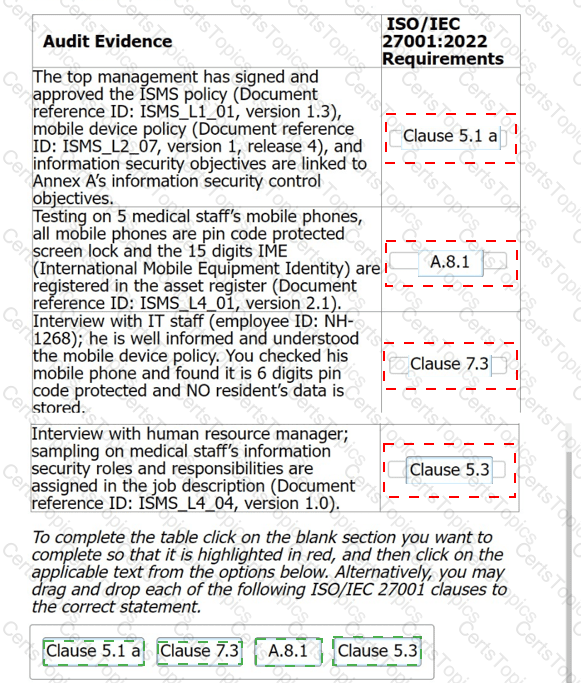
The next step in your audit plan is to verify that the information security
policy and objectives have been established by top management.
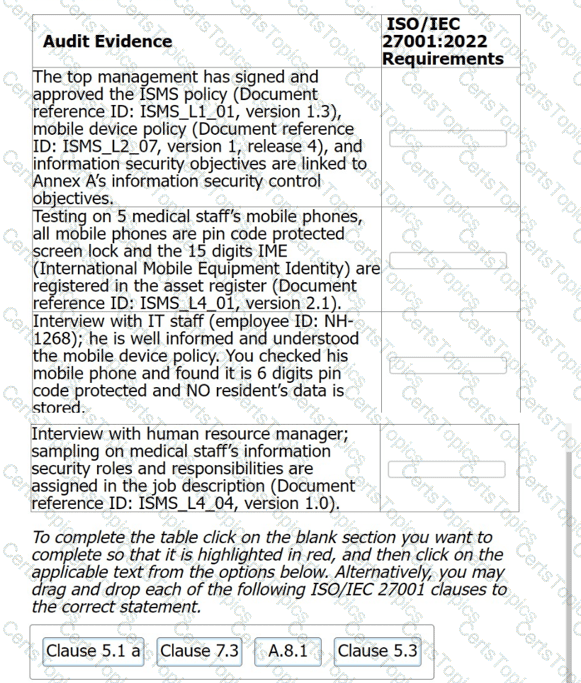
During the audit, you found the following audit evidence.
Match the audit evidence to the corresponding requirement in ISO/IEC 27001:2022.
Question:
Which situation presented below represents a threat?
You are an experienced ISMS audit team leader guiding an auditor in training. She asks you about the grading of nonconformities in audit reports. You decide to test her knowledge by asking her which four of the following statements are true.
Scenario 5: Cobt. an insurance company in London, offers various commercial, industrial, and life insurance solutions. In recent years, the number of Cobt's clients has increased enormously. Having a huge amount of data to process, the company decided that certifying against ISO/IEC 27001 would bring many benefits to securing information and show its commitment to continual improvement. While the company was well-versed in conducting regular risk assessments, implementing an ISMS brought major changes to its daily operations. During the risk assessment process, a risk was identified where significant defects occurred without being detected or prevented by the organizations internal control mechanisms.
The company followed a methodology to implement the ISMS and had an operational ISMS in place after only a few months After successfully implementing the ISMS, Cobt applied for ISO/IEC 27001 certification Sarah, an experienced auditor, was assigned to the audit Upon thoroughly analyzing the audit offer, Sarah accepted her responsibilities as an audit team leader and immediately started to obtain general information about Cobt She established the audit criteria and objective, planned the audit, and assigned the audit team members' responsibilities.
Sarah acknowledged that although Cobt has expanded significantly by offering diverse commercial and insurance solutions, it still relies on some manual processes Therefore, her initial focus was to gather information on how the company manages its information security risks Sarah contacted Cobt's representatives to request access to information related to risk management for the off-site review, as initially agreed upon for part of the audit However, Cobt later refused, claiming that such information is too sensitive to be accessed outside of the company This refusal raised concerns about the audit's feasibility, particularly regarding the availability and cooperation of the auditee and access to evidence Moreover, Cobt raised concerns about the audit schedule, stating that it does not properly reflect the recent changes the company made It pointed out that the actions to be performed during the audit apply only to the initial scope and do not encompass the latest changes made in the audit scope
Sarah also evaluated the materiality of the situation, considering the significance of the information denied for the audit objectives. In this case, the refusal by Cobt raised questions about the completeness of the audit and its ability to provide reasonable assurance. Following these situations, Sarah decided to withdraw from the audit before a certification agreement was signed and communicated her decision to Cobt and the certification body. This decision was made to ensure adherence to audit principles and maintain transparency, highlighting her commitment to consistently upholding these principles.
Based on the scenario above, answer the following question:
Question:
What type of risk did Cobt identify during the last risk assessment?
Copyright © 2021-2026 CertsTopics. All Rights Reserved