You are performing an ISMS audit at a European-based residential nursing home called ABC that provides healthcare services. The next step in your audit plan is to verify the effectiveness of the continual improvement process.
During the audit, you learned most of the residents' family members (90%) receive WeCare medical devices promotion advertisements through email and SMS once a week via ABC's healthcare mobile app. All of them do not agree on the use of the collected personal data for marketing or any other purposes than nursing and medical care on the signed service agreement with ABC. They have very strong reason to believe that ABC is leaking residents' and family members' personal information to a non-relevant third party and they have filed complaints.
The Service Manager says that, after investigation, all these complaints have been treated as nonconformities. The corrective actions have been planned and implemented according to the nonconformity and corrective management procedure (Document reference ID: ISMS_L2_10.1, version 1).
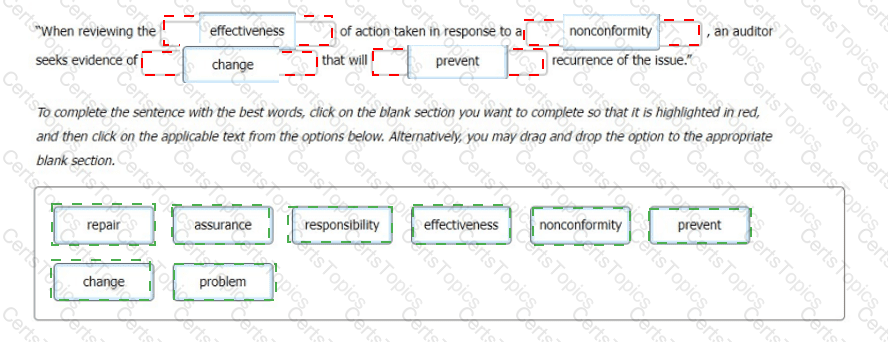
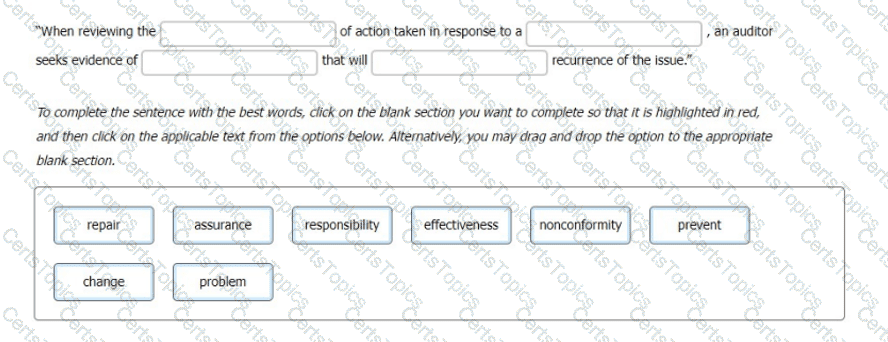
You write a nonconformity which you will follow up on later. Select the words that best complete the sentence:
You are an experienced ISMS auditor conducting a third-party surveillance audit at an organisation which offers ICT reclamation services. ICT equipment which companies no longer require is processed by the organisation. It is either recommissioned and reused or is securely destroyed.
You notice two servers on a bench in the corner of the room. Both have stickers on them with the server's name, IP address and admin password. You ask the ICT Manager about them, and he tells you they were part of a shipment received yesterday from a regular customer.
Which one action should you take?
You ask the IT Manager why the organisation still uses the mobile app while personal data
encryption and pseudonymization tests failed. Also, whether the Service Manager is authorized to approve the test.
The IT Manager explains the test results should be approved by him according to the software security management procedure. The reason why the encryption and pseudonymization functions failed is that these functions heavily slowed down the system and service performance. An extra 150% of resources are needed to cover this. The Service Manager agreed that access control is good enough and acceptable. That's why the Service Manager signed the approval.
You sample one of the medical staff's mobile and found that ABC's healthcare mobile app, version 1.01 is installed. You found that version 1.01 has no test record.
The IT Manager explains that because of frequent ransomware attacks, the outsourced mobile app development company gave a free minor update on the tested software, performed an emergency release of the updated software, and gave a verbal guarantee that there will be no impact on any security functions. Based on his 20 years of information security experience, there is no need to re-test.
You are preparing the audit findings Select two options that are correct.
There is NO nonconformity (NC). The IT Manager demonstrates he is fully competent. (Relevant to clause 7.2)
Scenario 1
Fintive is a distinguished security provider specializing in online payments and protection solutions. Founded in 1999 by Thomas Fin in San Jose, California, Fintive offers services to companies operating online that seek to improve their information security, prevent fraud, and protect user information such as personally identifiable information (PII).
Fintive bases its decision-making and operational processes on previous cases, gathering customer data, classifying them according to the case, and analyzing them.
Initially, Fintive required a large number of employees to be able to conduct such complex analyses. However, as technology advanced, the company recognized an opportunity to implement a modern tool — a chatbot — to achieve pattern analyses aimed at preventing fraud in real time. This tool would also assist in improving customer service.
The initial idea was communicated to the software development team, who supported the initiative and were assigned to work on the project. They began integrating the chatbot into the existing system and set an objective regarding the chatbot, which was to answer 85% of all chat queries.
After successfully integrating the chatbot, the company released it for customer use. However, the chatbot exhibited several issues. Due to insufficient testing and a lack of sample data provided during the training phase — when it was supposed to learn the query pattern — the chatbot failed to effectively address user queries. Additionally, it sent random files to users when it encountered invalid inputs, such as unusual patterns of dots and special characters.
Consequently, the chatbot could not effectively answer customer queries, overwhelming traditional customer support and preventing them from assisting customers with their requests.
Recognizing the potential risks, Fintive decided to implement a set of new controls. The measures included enabling comprehensive audit logging, configuring automated alert systems to flag unusual activities, performing periodic access reviews, and monitoring system behavior for anomalies. The objective was to identify unauthorized access, errors, or suspicious activities in a timely manner, ensuring that any potential issues could be quickly recognized and investigated before causing significant harm.
Question
According to Scenario 1, which of the following could be a potential impact of the chatbot issues?
Copyright © 2021-2026 CertsTopics. All Rights Reserved