You are an ISMS audit team leader tasked with conducting a follow-up audit at a client's data centre. Following two days on-site you conclude that of the original 12 minor and 1 major nonconformities that prompted the follow-up audit, only 1 minor nonconformity still remains outstanding.
Select four options for the actions you could take.
Scenario 5
Scenario 5
CyberShielding Systems Inc. provides security services spanning the entire information technology infrastructure. It provides cybersecurity software, including endpoint security, firewalls, and antivirus software. CyberShielding Systems Inc. has helped various companies secure their networks for two decades through advanced products and services. Having achieved a reputation in the information and network security sector, CyberShielding Systems Inc. decided to implement a security information management system (ISMS) based on ISO/IEC 27001 and obtain a certification to better secure its internal and customer assets and gain a competitive advantage.
The certification body initiated the process by selecting the audit team for CyberShielding Systems Inc.'s ISO/IEC 27001 certification. They provided the company with the name and background information of each audit member. However, upon review, CyberShielding Systems Inc. discovered that one of the auditors did not hold the security clearance required by them. Consequently, the company objected to the appointment of this auditor. Upon review, the certification body replaced the auditor in response to CyberShielding Systems Inc.'s objection.
As part of the audit process, CyberShielding Systems Inc.'s approach to risk and opportunity determination was assessed as a standalone activity. This involved examining the organization’s methods for identifying and managing risks and opportunities. The audit team’s core objectives encompassed providing assurance on the effectiveness of CyberShielding Systems Inc.'s risk and opportunity identification mechanisms and reviewing the organization's strategies for addressing these determined risks and opportunities. During this, the audit team also identified a risk due to a lack of oversight in the firewall configuration review process, where changes were implemented without proper approval, potentially exposing the company to vulnerabilities. This finding highlighted the need for stronger internal controls to prevent such issues.
The audit team accessed process descriptions and organizational charts to understand the main business processes and controls. They performed a limited analysis of the IT risks and controls because their access to the IT infrastructure and applications was limited by third-party service provider restrictions. However, the audit team stated that the risk of a significant defect occurring in CyberShielding’s ISMS was low since most of the company's processes were automated. They therefore evaluated that the ISMS, as a whole, conforms to the standard requirements by questioning CyberShielding representatives on IT responsibilities, control effectiveness, and anti-malware measures. CyberShielding’s representatives provided sufficient and appropriate evidence to address all these questions.
Despite the agreement signed before the audit, which outlined the audit scope, criteria, and objectives, the audit was primarily focused on assessing conformity with established criteria and ensuring compliance with statutory and regulatory requirements.
Question
Based on Scenario 5, is the approach used by the audit team to assess the conformity of the ISMS to the standard requirements in line with audit recommended practices?
You are an experienced ISMS audit team leader, assisting an auditor in training to write their first audit report.
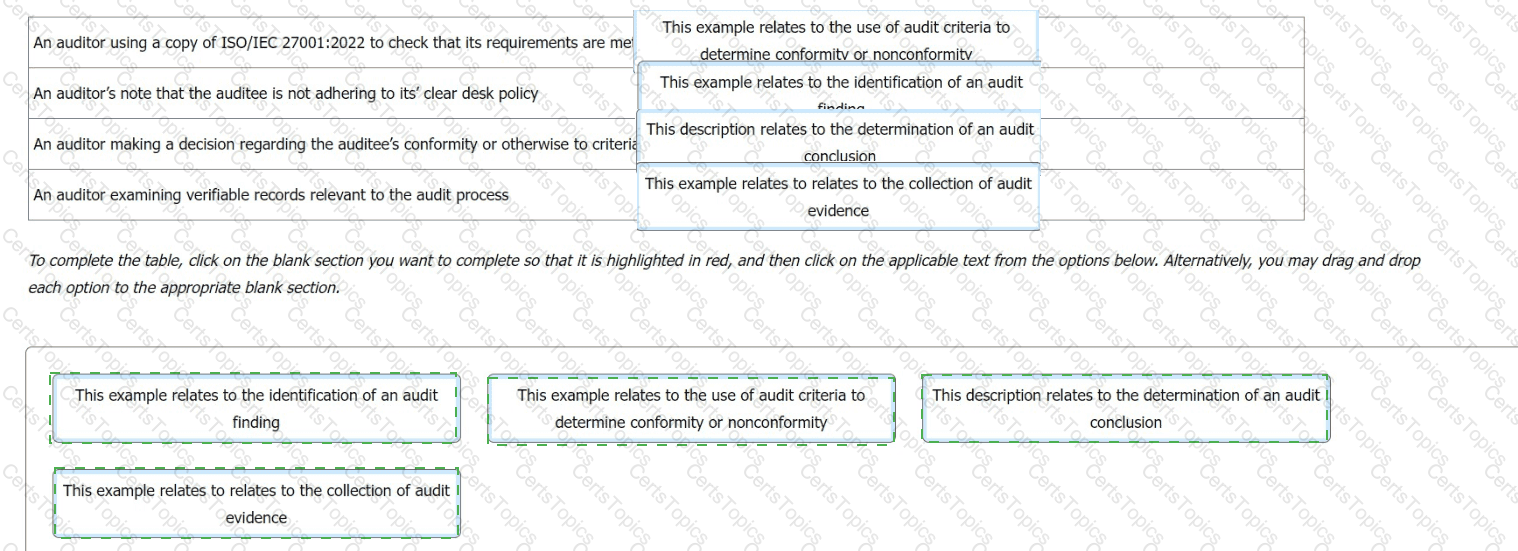
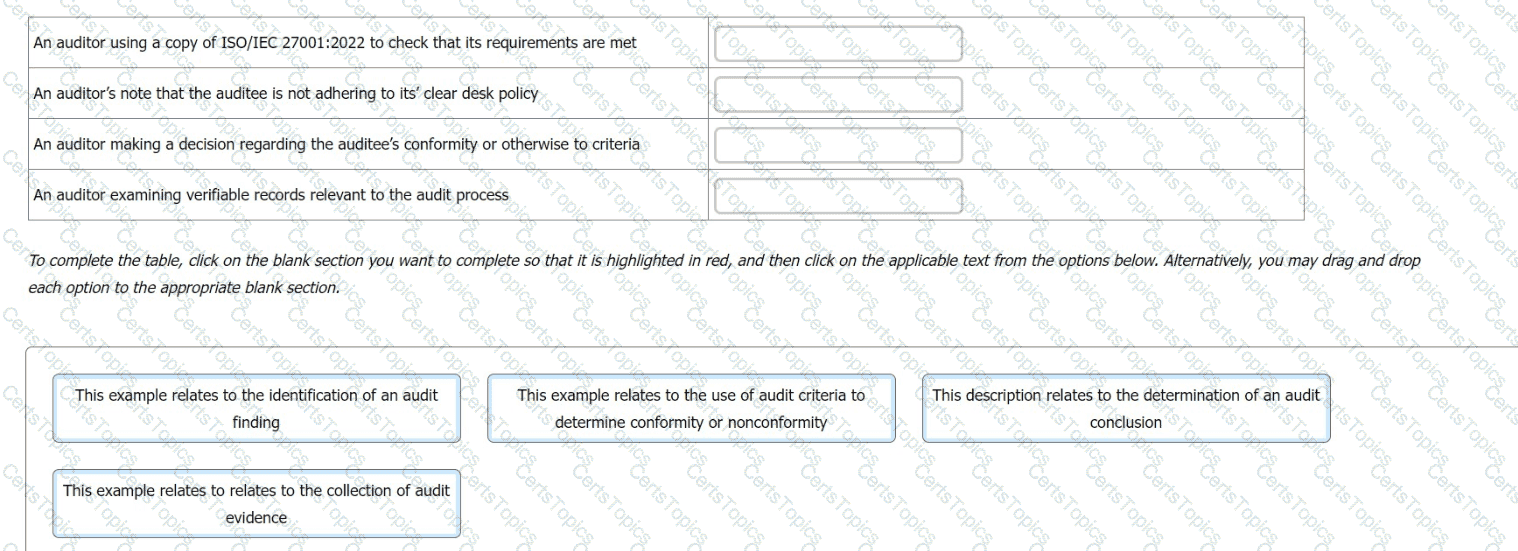
You want to check the auditor in training's understanding of terminology relating to the contents of an audit report and chose to do this by presenting the following examples.
For each example, you ask the auditor in training what the correct term is that describes the activity
Match the activity to the description.
After drafting the audit conclusions, the work documents of the audit team leader were reviewed by another auditor selected by the certification body. Is this acceptable?
Copyright © 2021-2026 CertsTopics. All Rights Reserved