
You are conducting a third-party surveillance audit when another member of the audit team approaches you seeking clarification. They have been asked to assess the organisation's application of control 5.7 - Threat Intelligence. They are aware that this is one of the new controls introduced in the 2022 edition of ISO/IEC 27001, and they want to make sure they audit the control correctly.
They have prepared a checklist to assist them with their audit and want you to confirm that their planned activities are aligned with the control's requirements.
Which three of the following options represent valid audit trails?
You are performing an ISMS audit at a residential nursing home called ABC that provides healthcare services.
The next step in your audit plan is to verify the information security on ABC's healthcare mobile app
development, support, and lifecycle process. During the audit, you learned the organization outsourced the
mobile app development to a professional software development company with CMMI Level 5, ITSM (ISO/IEC
20000-1), BCMS (ISO 22301) and ISMS (ISO/IEC 27001) certified. The IT Manager presented the software
security management procedure and summarised the process as follows:
The mobile app development shall adopt "security-by-design" and "security-by-default" principles, as a
minimum. The following security functions for personal data protection shall be available:
Access control.
Personal data encryption, i.e., Advanced Encryption Standard (AES) algorithm, key lengths: 256 bits; and
Personal data pseudonymization.
Vulnerability checked and no security backdoor
You sample the latest Mobile App Test report - details as follows:
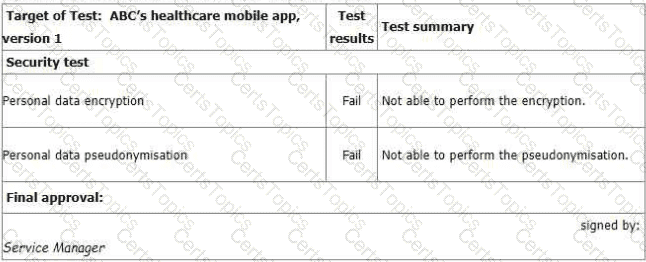
You ask the IT Manager why the organisation still uses the mobile app while personal data
encryption and pseudonymization tests failed. Also, whether the Service Manager is authorized to
approve the test.
The IT Manager explains the test results should be approved by him according to the software
security management procedure. The reason why the encryption and pseudonymization functions
failed is that these functions heavily slowed down the system and service performance. An extra
150% of resources are needed to cover this. The Service Manager agreed that access control is
good enough and acceptable. That's why the Service Manager signed the approval.
You sample one of the medical staff's mobile and found that ABC's healthcare mobile app, version
1.01 is installed. You found that version 1.01 has no test record.
The IT Manager explains that because of frequent ransomware attacks, the outsourced mobile app
development company gave a free minor update on the tested software, performed an emergency
release of the updated software, and gave a verbal guarantee that there will be no impact on any
security functions. Based on his 20 years of information security experience, there is no need to re-
test.
You are preparing the audit findings Select two options that are correct.
During a third-party certification audit you are presented with a list of issues by an auditee. Which four of the following constitute 'external' issues in the context of a management system to ISO/IEC 27001:2022?
After analyzing the audit conclusions, Company X decided to accept the risk related to one of the detected nonconformities. They claimed that no corrective action was necessary; however, their decision was not documented. Is this acceptable?
Copyright © 2021-2026 CertsTopics. All Rights Reserved
