Summer Certification Sale 70% Discount Offer - Ends in 0d 00h 00m 00s - Coupon code: save70

400-007 Cisco Exam Lab Questions

Page: 27 / 37
Total 503 questions

Cisco Certified Design Expert (CCDE v3.1) Questions and Answers

Question 105

Two routers R1 and R2 are directly connected through an Ethernet link. Both routers are running OSPF over the Ethernet link and OSPF has been registered with BFD. R1 has been set up to transmit BFD at a 50 ms interval, but R2 can receive only at a 100 ms rate due to platform limitations. What does this mean?

Options:

A.

After the initial timer exchange, R2 sets its transmission rate to the R1 Desired Min TX interval

B.

After the initial timer exchange, R1 sets its transmission rate to the R2 Required Min RX interval

C.

Timers renegotiate indefinitely, so the timer exchange phase never converges

D.

R2 sets the P-bit on all BFD control packets until R2 sends a packet with the F-bit set

Question 106

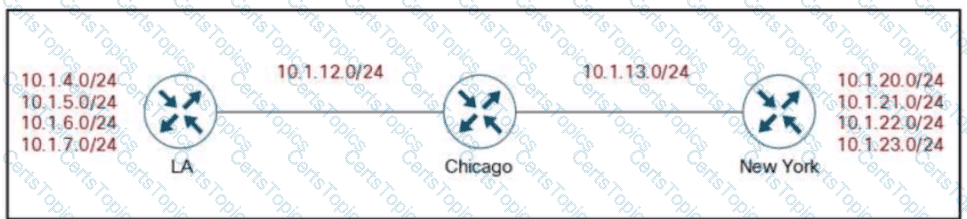
Refer to the exhibit.

Company XYZ’s BGP topology is as shown in the diagram. The interface on the LA router connected toward the 10.1.5.0/24 network is faulty and is going up and down, which affects the entire routing domain. Which routing technique can be used in the routing policy design so that the rest of the network is not affected by the flapping issue?

Options:

A.

Use route dampening on LA router for the 10.1.5.0/24 network so that it does not get propagated when it flaps up and down

B.

Use route filtering on Chicago router to block the 10.1.5.0/24 network from coming in from the LA router

C.

Use route filtering on LA router to block the 10.1.5.0/24 network from getting propagated toward Chicago and New York

D.

Use route aggregation on LA router to summarize the 10.1.4.0/24, 10.1.5.0/24, 10.1.6.0/24, and 10.1.7.0/24 networks toward Chicago

Question 107

Which two statements describe the functionality of OSPF packet-pacing timers? (Choose two.)

Options:

A.

The group-pacing timer controls the interval that is used for group and individual LSA refreshment

B.

OSPF flood-pacing timers allow dynamic control of the OSPF transmission queue size

C.

OSPF retransmission-pacing timers allow control of interpacket spacing between consecutive link-state update packets in the OSPF retransmission queue

D.

OSPF retransmission-pacing timers allow control of packet interleaving between nonconsecutive link-state update packets in the OSPF retransmission queue

E.

OSPF flood-pacing timers allow control of interpacket spacing between consecutive link-state update packets in the OSPF transmission queue

Question 108

A network security team observes phishing attacks on a user machine from a remote location. The organization has a policy of saving confidential data on two different systems using different types of authentication. What is the next step to control such events after the security team verifies all users in Zero Trust modeling?

Options:

A.

Enforce risk-based and adaptive access policies.

B.

Assess real-time security health of devices.

C.

Apply a context-based network access control policy for users.

D.

Ensure trustworthiness of devices.

Page: 27 / 37
Total 503 questions