
Month End Sale 70% Discount Offer - Ends in 0d 00h 00m 00s - Coupon code: save70

CKS Exam Dumps : Certified Kubernetes Security Specialist (CKS)

PDF
CKS pdf
 Real Exam Questions and Answer
 Last Update: Jan 30, 2026
 Question and Answers: 64 With Explanation
 Compatible with all Devices
 Printable Format
 100% Pass Guaranteed
$25.5  $84.99
CKS exam
PDF + Testing Engine
CKS PDF + engine
 Both PDF & Practice Software
 Last Update: Jan 30, 2026
 Question and Answers: 64
 Discount Offer
 Download Free Demo
 24/7 Customer Support
$40.5  $134.99
Testing Engine
CKS Engine
 Desktop Based Application
 Last Update: Jan 30, 2026
 Question and Answers: 64
 Create Multiple Test Sets
 Questions Regularly Updated
  90 Days Free Updates
  Windows and Mac Compatible
$30  $99.99

Verified By IT Certified Experts

CertsTopics.com Certified Safe Files

Up-To-Date Exam Study Material

99.5% High Success Pass Rate

100% Accurate Answers

Instant Downloads

Exam Questions And Answers PDF

Try Demo Before You Buy

Certification Exams with Helpful Questions And Answers

What our customers are saying

South Georgia certstopics South Georgia
Brady
Jan 9, 2026
Certstopics.com's Exam preparation course was detailed and effective. It gave me the edge I needed to pass my Linux Foundation CKS exam.
Western Sahara certstopics Western Sahara
Kane
Jan 4, 2026
My experience was great with certstopic as it provided detailed resource and important information which made me score 93% on the CKS test. Thanks!
Morocco certstopics Morocco
Sarah
Jan 1, 2026
CertsTopics is a very interesting platform to learn the Linux Foundation CKS exam course. Practicing with tests at the following levels will be very helpful while sitting for any exam or interview.
Bangladesh certstopics Bangladesh
Brooklyn
Dec 29, 2025
Certstopics's CKS study material is comprehensive and reliable. With their support, I cleared my certification exam effortlessly. Guaranteed success!
Cook Islands certstopics Cook Islands
Agim
Nov 17, 2025
I owe my success for sure to certstopics CKS exam material. Guaranteed success with their help!

Certified Kubernetes Security Specialist (CKS) Questions and Answers

Question 1

Context

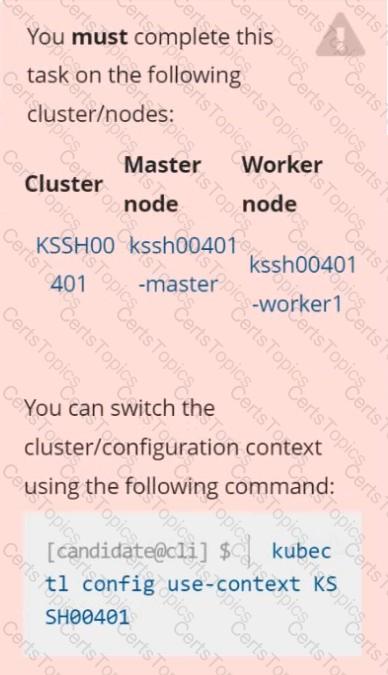
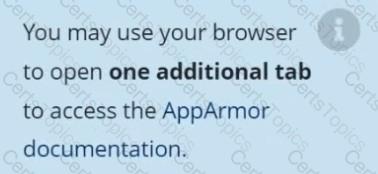
AppArmor is enabled on the cluster's worker node. An AppArmor profile is prepared, but not enforced yet.

Task

On the cluster's worker node, enforce the prepared AppArmor profile located at /etc/apparmor.d/nginx_apparmor.

Edit the prepared manifest file located at /home/candidate/KSSH00401/nginx-pod.yaml to apply the AppArmor profile.

Finally, apply the manifest file and create the Pod specified in it.

Options:

Buy Now
Question 2

Documentation

ServiceAccount, Deployment,

Projected Volumes

You must connect to the correct host . Failure to do so may

result in a zero score.

[candidate@base] $ ssh cks000033

Context

A security audit has identified a Deployment improperly handling service account tokens, which could lead to security vulnerabilities.

Task

First, modify the existing ServiceAccount stats-monitor-sa in the namespace monitoring to turn off automounting of API credentials.

Next, modify the existing Deployment stats-monitor in the namespace monitoring to inject a ServiceAccount token mounted at /var/run/secrets/kubernetes.io/serviceaccount/token.

Use a Projected Volume named token to inject the ServiceAccount token and ensure that it is mounted read-only.

The Deployment's manifest file can be found at /home/candidate/stats-monitor/deployment.yaml.

Options:

Question 3

Cluster: dev

Master node: master1

Worker node: worker1

You can switch the cluster/configuration context using the following command:

[desk@cli] $ kubectl config use-context dev 

Task:

Retrieve the content of the existing secret named adam in the safe namespace.

Store the username field in a file names /home/cert-masters/username.txt, and the password field in a file named /home/cert-masters/password.txt.

1. You must create both files; they don't exist yet.

2. Do not use/modify the created files in the following steps, create new temporary files if needed. 

Create a new secret names newsecret in the safe namespace, with the following content:

Username: dbadmin

Password: moresecurepas

Finally, create a new Pod that has access to the secret newsecret via a volume:

    Namespace:safe

    Pod name:mysecret-pod

    Container name:db-container

    Image:redis

    Volume name:secret-vol

    Mount path:/etc/mysecret

Options: