Spring Sale 70% Discount Offer - Ends in 0d 00h 00m 00s - Coupon code: save70

Note! Following DP-203 Exam is Retired now. Please select the alternative replacement for your Exam Certification. The new exam code is DP-700

Verified By IT Certified Experts

CertsTopics.com Certified Safe Files

Up-To-Date Exam Study Material

99.5% High Success Pass Rate

100% Accurate Answers

Instant Downloads

Exam Questions And Answers PDF

Try Demo Before You Buy

Certification Exams with Helpful Questions And Answers

What our customers are saying

Ghana certstopics Ghana
Kamil
Jan 17, 2026
certstopics's DP-203 exam material is the real deal. I couldn't be happier with the results I achieved using their resources.
Denmark certstopics Denmark
Shawn
Jan 3, 2026
certstopics's DP-203 study material is top-class. Verified questions in the testing engine replicate real exams. Thanks to them, I achieved success.
Hong Kong S.A.R. certstopics Hong Kong S.A.R.
Lula
Dec 17, 2025
I'm so glad I chose certstopics for my DP-203 exam preparation. The testing engine was amazing, and the braindumps were a lifesaver.
Georgia certstopics Georgia
Mark
Nov 19, 2025
This website has all the exam dumps available and detailed explanations of topics as well. I gave the DP-203 exam and scored 870/1000 on the test, all the credit goes to this website.

Data Engineering on Microsoft Azure Questions and Answers

Question 1

You need to integrate the on-premises data sources and Azure Synapse Analytics. The solution must meet the data integration requirements.

Which type of integration runtime should you use?

Options:

A.

Azure-SSIS integration runtime

B.

self-hosted integration runtime

C.

Azure integration runtime

Buy Now
Question 2

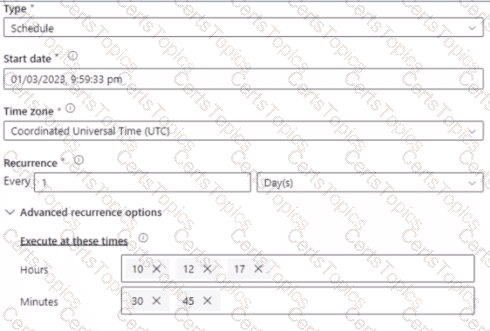
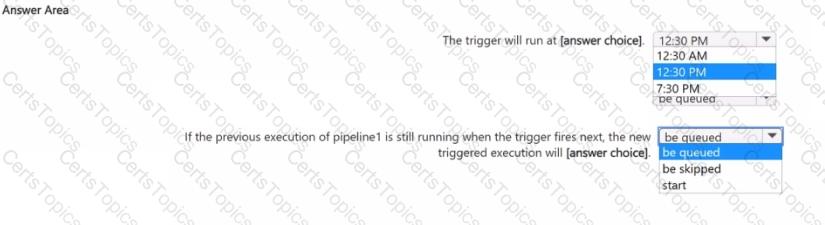
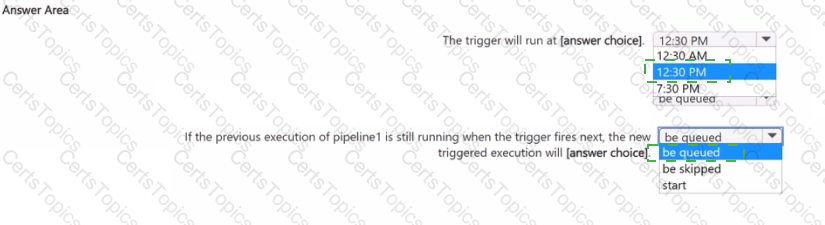
You have an Azure Synapse Analytics pipeline named pipeline1 that has concurrency set to 1.

To run pipeline 1, you create a new trigger as shown in the following exhibit.

Use the drop-down menus to select the answer choice that completes each statement based on the information presented in the [graphic.

NOTE: Each correct selection is worth one point.

Options:

Question 3

Note: This question is part of a series of questions that present the same scenario. Each question in the series contains a unique solution that might meet the stated goals. Some question sets might have more than one correct solution, while others might not have a correct solution.

After you answer a question in this section, you will NOT be able to return to it. As a result, these questions will not appear in the review screen.

You plan to create an Azure Databricks workspace that has a tiered structure. The workspace will contain the following three workloads:

A workload for data engineers who will use Python and SQL.

A workload for jobs that will run notebooks that use Python, Scala, and SOL.

A workload that data scientists will use to perform ad hoc analysis in Scala and R.

The enterprise architecture team at your company identifies the following standards for Databricks environments:

The data engineers must share a cluster.

The job cluster will be managed by using a request process whereby data scientists and data engineers provide packaged notebooks for deployment to the cluster.

All the data scientists must be assigned their own cluster that terminates automatically after 120 minutes of inactivity. Currently, there are three data scientists.

You need to create the Databricks clusters for the workloads.

Solution: You create a Standard cluster for each data scientist, a High Concurrency cluster for the data engineers, and a Standard cluster for the jobs.

Does this meet the goal?

Options:

A.

Yes

B.

No