In a Virtual Switching Framework (VSF) stack, high availability and control plane redundancy depend on the designation of specific roles among the stack members.
Conductor and Secondary Roles:
Conductor: The " brain " of the stack that manages the control plane and synchronization. By default, the first switch configured (Member 1) becomes the Conductor.
Secondary: This is the " Standby Conductor. " It maintains a synchronized state of the management and control planes. If the Conductor fails, the Secondary immediately takes over the Conductor role to keep the stack operational.
Analyzing the Exhibit:
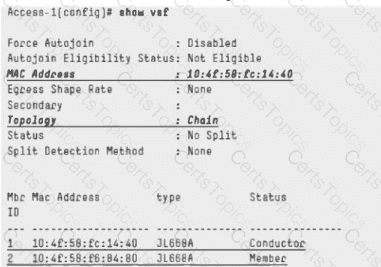
Looking at the output of show vsf, the Secondary field is currently empty (blank).
While Member 2 is seen as a " Member, " it has not been officially promoted to the Secondary role.
In the current state, if Member 1 (the Conductor) fails, there is no designated standby to take over. The stack would lose its control plane, and Member 2 would not be able to function as a standalone manager for the stack configuration.
The Solution: To ensure the stack survives a failure of either member, you must explicitly configure a secondary member. On a 2-member 6300 stack, the command vsf secondary-member 2 is used to designate Member 2 as the standby. This populates the " Secondary " field seen in the exhibit and enables redundancy.
Evaluating Other Options:
Option A: Split-detection is a separate mechanism used to prevent " split-brain " scenarios (where both members think they are the conductor after a link failure), but it requires a secondary member to be defined first to even function as a redundant pair.
Option B: Auto-stacking is a deployment method used to automatically number and link members during initial setup; it does not configure high-availability roles.
Option D: There is no command vsf conductor-member 2. The conductor role is assigned dynamically or via the secondary role promotion.