Pre-Winter Sale 70% Discount Offer - Ends in 0d 00h 00m 00s - Coupon code: save70

Professional-Cloud-Architect Questions Bank

Google Certified Professional - Cloud Architect (GCP) Questions and Answers

Question 53

For this question, refer to the TerramEarth case study

You analyzed TerramEarth ' s business requirement to reduce downtime, and found that they can achieve a majority of time saving by reducing customers ' wait time for parts You decided to focus on reduction of the 3 weeks aggregate reporting time Which modifications to the company ' s processes should you recommend?

Options:

A.

Migrate from CSV to binary format, migrate from FTP to SFTP transport, and develop machine learning analysis of metrics.

B.

Migrate from FTP to streaming transport, migrate from CSV to binary format, and develop machine learning analysis of metrics.

C.

Increase fleet cellular connectivity to 80%, migrate from FTP to streaming transport, and develop machine learning analysis of metrics.

D.

Migrate from FTP to SFTP transport, develop machine learning analysis of metrics, and increase dealer local inventory by a fixed factor.

Question 54

For this question, refer to the TerramEarth case study.

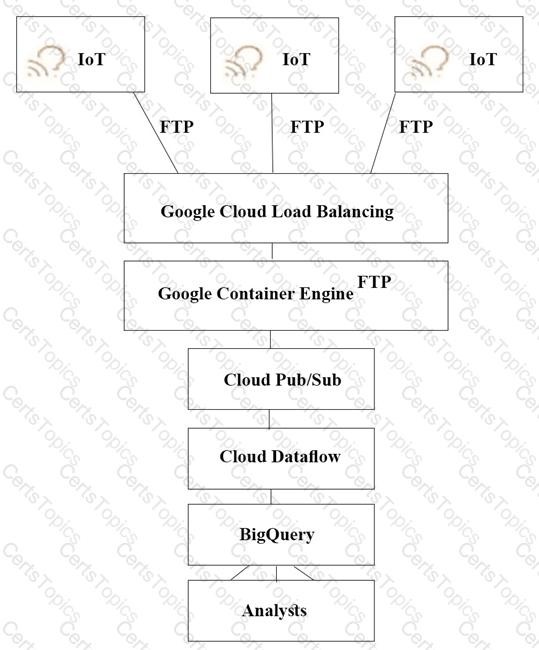
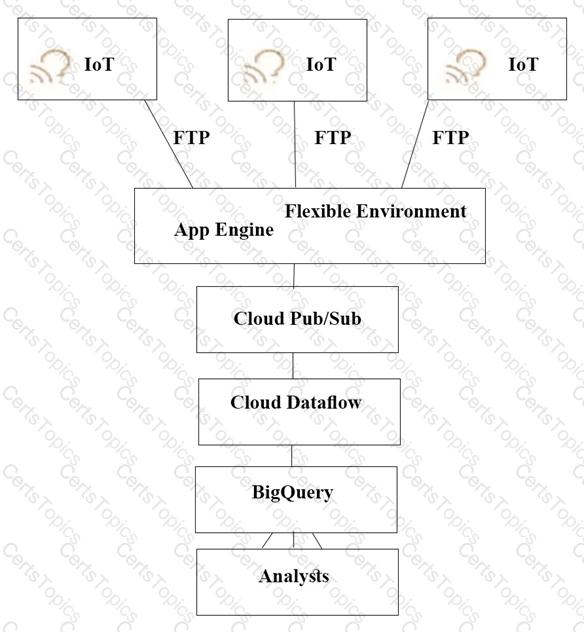
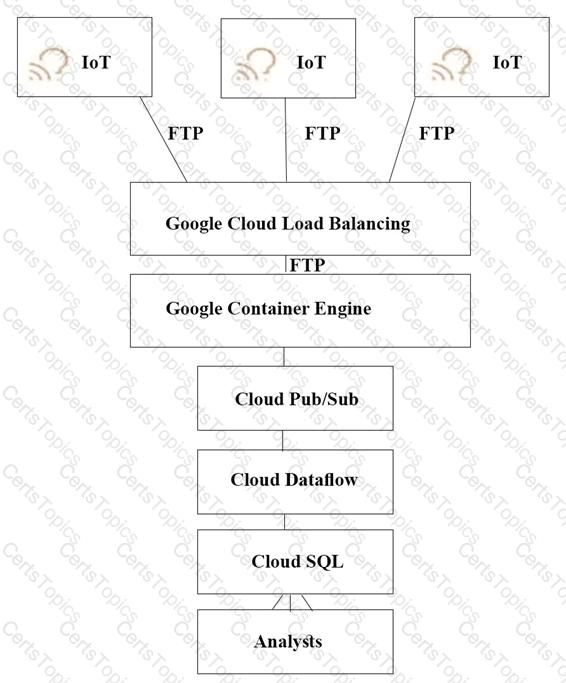
TerramEarth ' s CTO wants to use the raw data from connected vehicles to help identify approximately when a vehicle in the development team to focus their failure. You want to allow analysts to centrally query the vehicle data. Which architecture should you recommend?

A)
B)
C)
D)

Options:

A.

Option A

B.

Option B

C.

Option C

D.

Option D

Question 55

For this question, refer to the TerramEarth case study.

TerramEarth has equipped unconnected trucks with servers and sensors to collet telemetry data. Next year they want to use the data to train machine learning models. They want to store this data in the cloud while reducing costs. What should they do?

Options:

A.

Have the vehicle’ computer compress the data in hourly snapshots, and store it in a Google Cloud storage (GCS) Nearline bucket.

B.

Push the telemetry data in Real-time to a streaming dataflow job that compresses the data, and store it in Google BigQuery.

C.

Push the telemetry data in real-time to a streaming dataflow job that compresses the data, and store it in Cloud Bigtable.

D.

Have the vehicle ' s computer compress the data in hourly snapshots, a Store it in a GCS Coldline bucket.

Question 56

For this question, refer to the TerramEarth case study.

TerramEarth plans to connect all 20 million vehicles in the field to the cloud. This increases the volume to 20 million 600 byte records a second for 40 TB an hour. How should you design the data ingestion?

Options:

A.

Vehicles write data directly to GCS.

B.

Vehicles write data directly to Google Cloud Pub/Sub.

C.

Vehicles stream data directly to Google BigQuery.

D.

Vehicles continue to write data using the existing system (FTP).