

Microsoft Related Exams
SC-500 Exam
Note: This section contains one or more sets of questions with the same scenario and problem. Each question presents a unique solution to the problem. You must determine whether the solution meets the stated goals. More than one solution in the set might solve the problem. It is also possible that none of the solutions in the set solve the problem.
After you answer a question in this section, you will NOT be able to return. As a result, these questions do not appear on the Review Screen.
You have a Microsoft Sentinel workspace
You have a multi-tier Security Operations Center (SOC) team.
You need to ensure that all new security incidents are assigned immediately to the Tier 1 analysts group and flagged for triage.
Solution: You create an analytics rule.
Does this meet the goal?
You have an Azure subscription that contains the following resources:
•An Azure SQL Database logical server named Server1 that contains a database named DB1
•An Azure SQL Managed Instance named Instance1 that contains a database named DB2
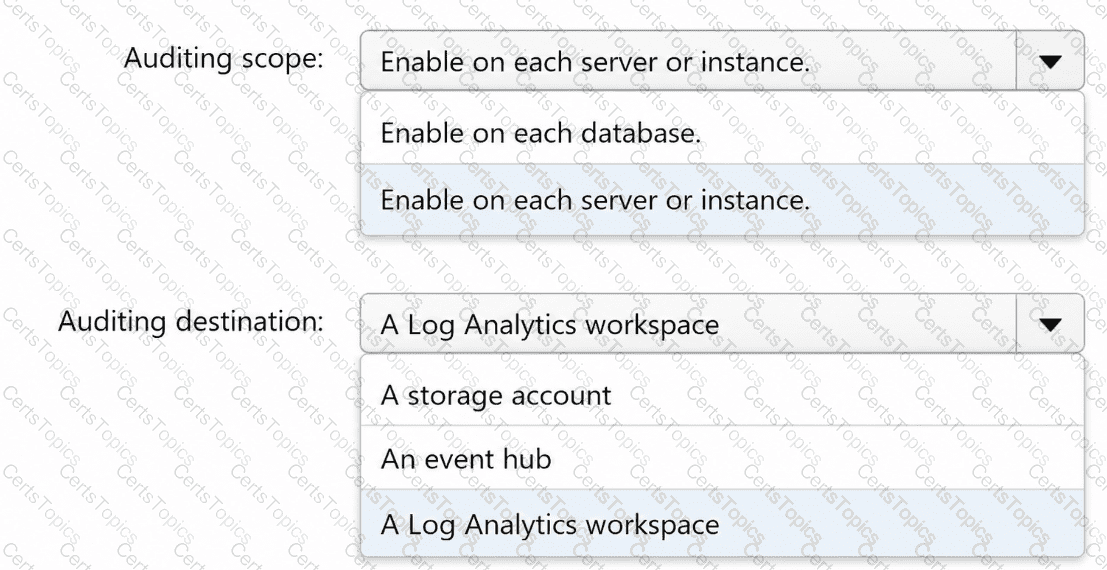
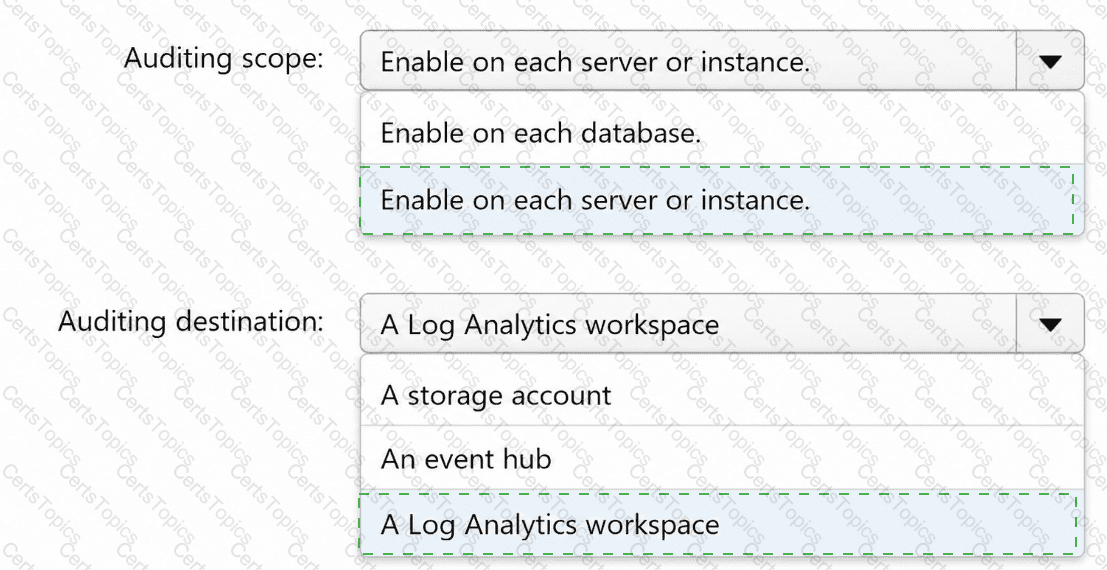
You need to configure database auditing. The solution must meet the following requirements:
•Ensure that audit data is centrally available in a location that supports for KQL queries.
•Minimize ongoing administrative effort as additional databases are added.
What should you configure? To answer, select the appropriate options in the answer area.
NOTE: Each correct selection is worth one point.

Note: This section contains one or more sets of questions with the same scenario and problem. Each question presents a unique solution to the problem. You must determine whether the solution meets the stated goals. More than one solution in the set might solve the problem. It is also possible that none of the solutions in the set solve the problem.
After you answer a question in this section, you will NOT be able to return. As a result, these questions do not appear on the Review Screen.
You have an Azure subscription that contains two virtual machines named VM1 and VM2. Each virtual machine has system-assigned managed identity enabled.
You have an Azure Storage account named storage1. Public access from all networks is enabled for storage1.
You need to ensure that VM1 and VM2 can access storage1.
Solution: You add each virtual machine to a role on storage1.
Does this meet the goal?