A decisioning architect wants to use the customer properties income and age in a Filter component. Which decision component is required to enable access to these properties?
A mortgage company defines a new suppression policy to limit promotional emails for home loan offers. The policy is complete, but it must be applied to all to home loan actions. The implementation team must associate this policy with the appropriate business structure.
Where should the team associate the contact policy to apply it to home loan promotions?
Which of the following reasons explains why a customer might receive an action that they already accepted?
U+ Bank has recently implemented Pega Customer Decision Hub™. As a first step, the bank went live with the contact center to improve customer engagement. Now, U+ Bank wants to extend its customer engagement through the web channel. As a decisioning architect, you have created the new set of actions, the corresponding treatments, and defined a new trigger in the Next-Best-Action Designer for the new web channel.
What else do you configure for the new treatments to be present in the next-best-action recommendations?
A financial services organization introduces a new policy that limits each customer to two promotional emails per month. To meet compliance requirements, the implementation team must configure this limit in the Next-Best-Action Designer.
Which configuration steps achieve the desired email frequency limit?
MyCo, a telecom company, wants to use Pega Customer Decision Hub™ to send the MyFone Pro offer through email to qualified customers. In preparation, the marketing team created an action, a treatment, and an action flow. As a decisioning architect, you verify the settings in the Channel tab of Next-Best-Action Designer to enable email communication.
To implement this requirement, the completion of which two tasks do you verify in the Channel tab of Next-Best-Action Designer? (Choose Two)
U+Bank presents various credit card offers to Its customers on Its website. The bank uses AI to prioritize the offers according to customer behavior. After the introduction of the Gold credit card offer, the offer click-through propensity decreased to 0.42.
What does the decrease in the propensity value most likely indicate?
A customer qualifies for Standard card (priority 60), Rewards card {priority 40), and Premium card {priority 30). Standard card volume is exhausted. Rewards card has remaining volume, and Premium card has remaining volume. The system uses "Return any action that does not exceed constraint" mode.
Which actions does the customer receive in this scenario?
An NBA Specialist Is configuring the engagement policy for a new loan offer and wants to validate the policy. What is the best way for the NBA Specialist to validate the engagement policy?
MyCo, a telecom company, wants to send promotional SMSs with data plan offers to their qualified customers. The business intends to use the same action flow template with their target flow pattern for all the data plan actions.
What do you configure to implement this requirement?
MyCo, a telecom company, wants to Include offer-related images in the emails that they send to their qualified customers. As a decisioning architect, what best practice do you follow to include images in emails?
As a decisioning architect, you have built a decision strategy that selects actions that are below the average printing cost. The decision strategy contains 'Black Label', 'Red Label,' and 'Blue Label" Proposition components. The printing cost of the Proposition components are calculated based on the 'BaseCost' and 'LetterCount*.
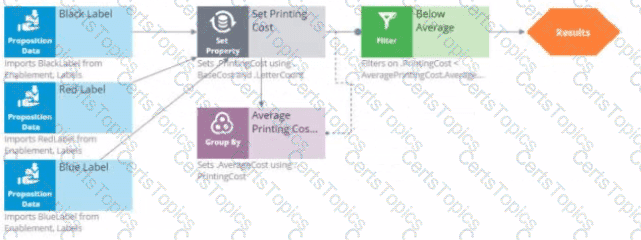
The details of the proposition components are provided in the following table:

Which propositions does the strategy output?
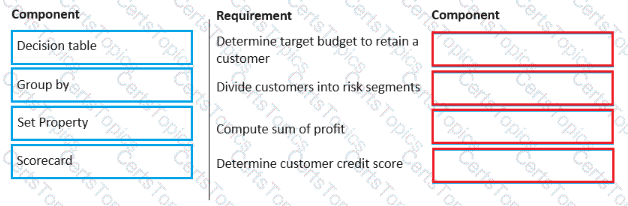
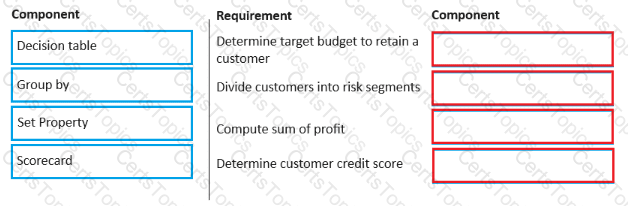
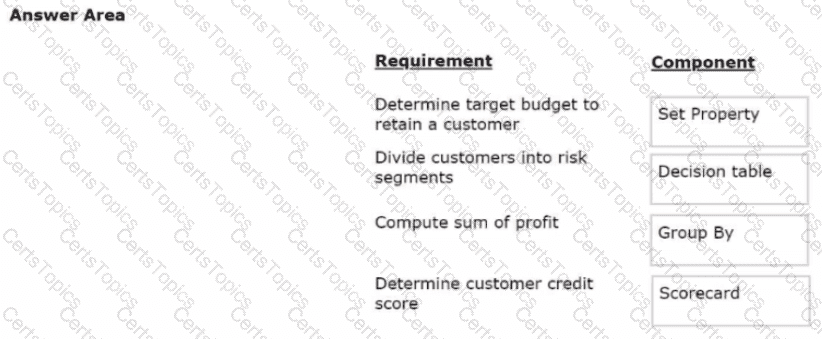
You are a deaccessioning architect on a next-best-action project and are responsible for designing and implementing decision strategies. Select each component on the left and drag it to the correct requirement on the right.
U+ Bank implemented a customer journey for its customers. The journey consists of five stages. The bank observes that as customers progress through the journey, one customer entered the third stage of the journey, and then received an offer that is not included in any journey.
Which statement explains the cause of this behavior?
MyCo, a telecom company, wants to introduce a new group of offers called Tablets for all customers. As a decisioning architect, which two valid actions do you create? (Choose Two)
An outbound run identifies 150 Standard card offers, 75 on email, and 75 on the SMS channel. If the following volume constraint Is applied, how many actions are delivered by the outbound run?
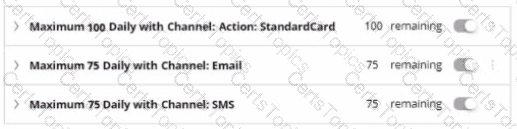
U+ Bank observes that some customers receive the same credit card offer multiple times within a short period, which results in dissatisfaction. The bank wants to suppress a specific credit card offer if it has been shown three times within seven days.
What should you configure in the Contact Policy to prevent a specific credit card offer from being shown to a customer more than three times in seven days?
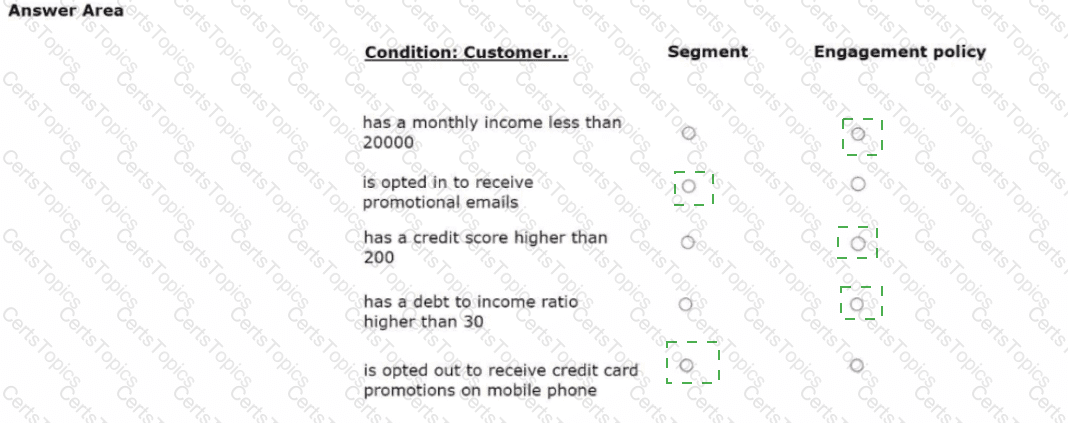
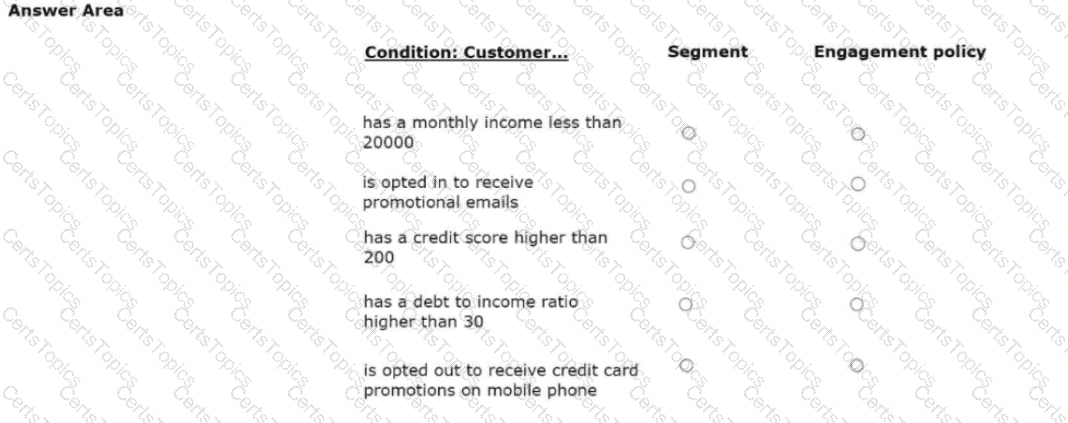
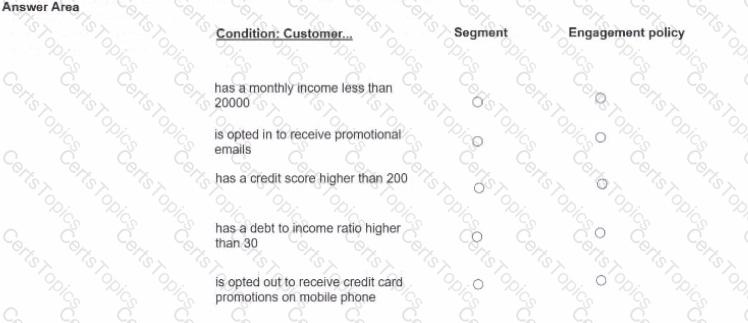
U+ Bank's marketing department wants to use the always-on outbound approach to send promotional emails about credit card offers to qualified customers. As a part of this promotion, the bank wants to identify the starting population by defining a few high-level criteria in a segment.
For each condition below, select which two conditions should be defined in Segment and which three conditions should be defined in Engagement policy as best practice.
U+ Bank wants to send promotional emails related to credit card offers to their qualified customers. The business intends to use the same action flow template with the desired flow pattern for all the credit card actions.
What do you configure to implement this requirement?
MyCo, a mobile company, uses Pega Customer Decision Hub'" to display offers to customers on its website. The company wants to present more relevant offers to customers based on customer behavior. The following diagram is the action hierarchy in the Next-Best-Action Designer.
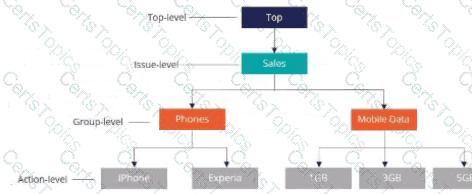
The company wants to present offers from both the groups and arbitrate across the two groups to select the best offer based on customer behavior.
As a decisioning architect, what must you do to present offers from the two groups'
U+ Bank, a retail bank, has recently implemented a project in which qualified customers see mortgage offers when they log in to the web self-service portal.
Currently, only the customers who satisfy the following engagement policy conditions receive the Fifteen-year fixed-rate mortgage offer:
The bank decides to make two changes:
1. Update the suitability condition for the Fifteen-year fixed-rate mortgage offer.
2. Introduce a new offer , Twenty-year fixed-rate mortgage.
The following table shows the new engagement policy conditions for both mortgage offers:

What is the best practice to fulfill this change management requirement in the Business Operations Environment?
What does a dotted line from a "Group By" component to a "Filter" component mean?
Acme Retail uses Pega Customer Decision Hub™ to present various offers to its customers. The company notices that some high-value customers are not receiving any offers. The marketing team wants to identify these underserved customers.
Which tool in Pega Customer Decision Hub can Acme Retail use to identify segments of customers who are not receiving relevant offers?
l)+ Bank uses Pega Customer Decision Hub™ to approve credit card limit changes requested by customers automatically. A scorecard model determines the customer credit score. The automatic approval of credit card limits are processed based on the following criteria set by the bank.
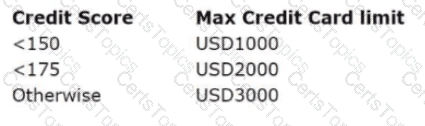
The bank wants to change the threshold value for the USD2000 credit limit from <175 to <200. How do you implement this change?
Regional Bank experiences an unexpected system outage affecting online banking services across multiple locations. The bank needs to immediately inform all customers about the temporary service disruption and provide alternative banking options. The communication must reach every customer simultaneously and should not be repeated.
Which communication approach should the bank use to address this urgent customer notification requirement?
As a decisioning architect, you advise the board on the business issues for which they must use the Next-Best-Action strategy. Which three business issues do you recommend? (Choose Three)
1yCo, a telecom company, wants to start promoting data plan offers through SMS to qualified customers. The marketing team needs to ensure that the outbound run always uses the latest customer information.
What do you configure to implement this requirement?
In a decision strategy, to use a customer property in an expression, you
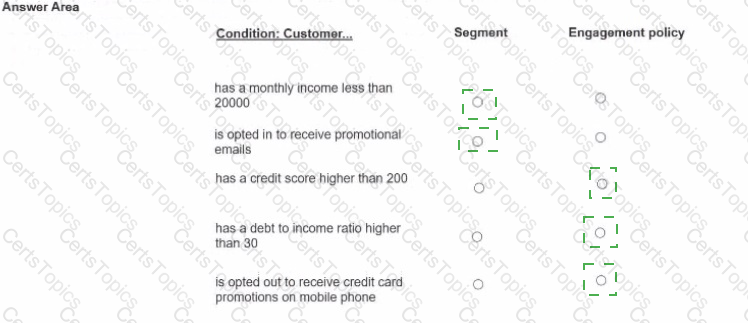
U+ Bank's marketing department wants to use the always-on outbound approach to send promotional emails about credit card offers to qualified customers. As a part of this promotion, the bank wantsto identify the starting population by defining a few high-level criteria ina segment.
For each condition below, select which two conditions should be defined in Segment and which three conditions should be defined in Engagement policy as best practice
In the Impact Analyzer tool, what does It mean when the overall health Indicator of the next best action has a red highlight?
U+ Bank, a retail bank, is currently presenting a cashback offer on its website.
Currently, only the customers who satisfy the following engagement policy conditions receive the cashback offer:
While continuing cross-selling on the web, the bank now wants to present the cashback offer through a new channel, SMS. The bank also wants to update the suitability condition by lowering the threshold of the debt-to-income ratio from 48 to 45.
As a business user, what are the two tasks that you define to update the cashback offer? (Choose Two)
Copyright © 2021-2026 CertsTopics. All Rights Reserved

 A close-up of a list of words AI-generated content may be incorrect.