New Year Sale 70% Discount Offer - Ends in 0d 00h 00m 00s - Coupon code: save70

Legit PEGACPDC25V1 Exam Download

Certified Pega Decisioning Consultant 25 Questions and Answers

Question 29

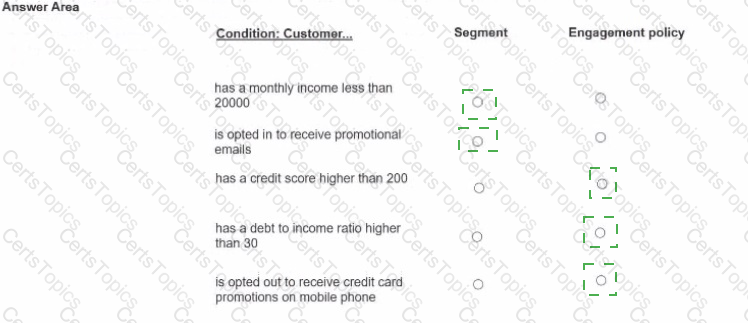
U+ Bank's marketing department wants to use the always-on outbound approach to send promotional emails about credit card offers to qualified customers. As a part of this promotion, the bank wants to identify the starting population by defining a few high-level criteria in a segment.

For each condition below, select which two conditions should be defined in Segment and which three conditions should be defined in Engagement policy as best practice.

Options:

Question 30

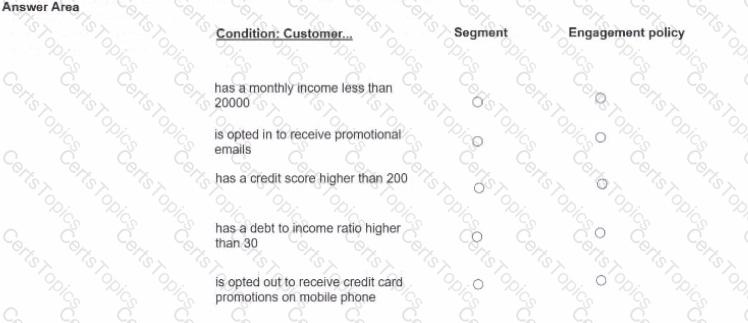
U+ Bank's marketing department wants to use the always-on outbound approach to send promotional emails about credit card offers to qualified customers. As a part of this promotion, the bank wantsto identify the starting population by defining a few high-level criteria ina segment.

For each condition below, select which two conditions should be defined in Segment and which three conditions should be defined in Engagement policy as best practice
Options:

Question 31

U+ Bank wants to offer credit cards only to customers with a low-risk profile. The customers are divided into various risk segments from AAA to CCC. The risk segmentation rules that the business provides use the Age and the customer Credit Score based on the following table. The bank uses a scorecard model to determine the customer Credit Score.

As a decisioning architect, how do you implement the business requirement?

Options:

A.

Add a decision table to a decision strategy and reference it in the scorecard component.

B.

Add the risk segmentation rules in the Results tab of the scorecard rule.

C.

Add three contact policies that correspond to the three risk segments.

D.

Add a decision table to a decision strategy and pass the credit score as the parameter.

Question 32

U+ Bank implemented a customer journey for its customers. The journey consists of five stages. The bank observes that as customers progress through the journey, one customer entered the third stage of the journey, and then received an offer that is not included in any journey.

Which statement explains the cause of this behavior?

Options:

A.

The bank implemented upweighting for the third stage.

B.

The customer was not eligible for the last stage of the journey and the system presented an offer outside the journey.

C.

The customer can be involved in only one active journey at a given moment.

D.

The customer always receives the most relevant action, even if an action is not a part of any journey.