Summer Certification Sale 70% Discount Offer - Ends in 0d 00h 00m 00s - Coupon code: save70

Free and Premium Fortinet NSE7_FSN_AR-7.6 Dumps Questions Answers

Fortinet NSE 7 - Secure Networking 7.6 Architect Questions and Answers

Question 1

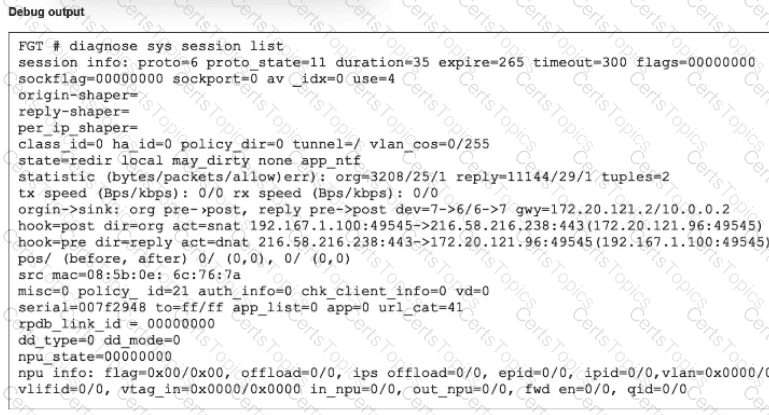
Refer to the exhibit.
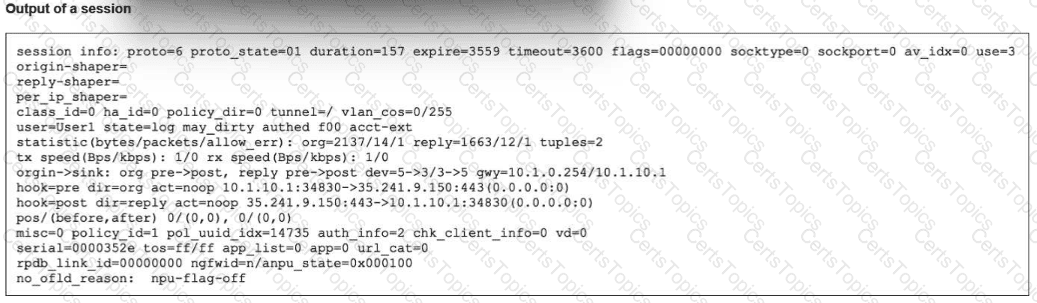
The exhibit shows the output of a session. Which two statements are correct? (Choose two.)

Options:

A.

The session did not match a firewall policy.

B.

The gateway to the destination is 10.1.10.1.

C.

The session was initiated from an authenticated user.

D.

The TCP session has been successfully established.

Buy Now
Question 2

Refer to the exhibit.

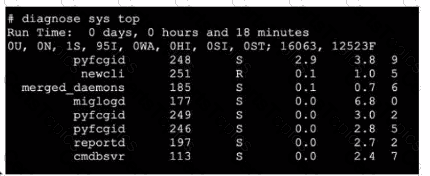
Which three pieces of information does the diagnose sys top command provide? (Choose three.)

Options:

A.

The miglogd daemon is running on CPU core ID 0.

B.

The diagnose sys top command has been running for 18 minutes.

C.

The miglogd daemon would be on top of the list, if the administrator pressed m on the keyboard.

D.

The cmdbsvr process is occupying 2.4% of the total user memory space.

E.

If the neweli daemon continues to be in the R state, it will need to be manually restarted.

Question 3

Refer to the exhibit.

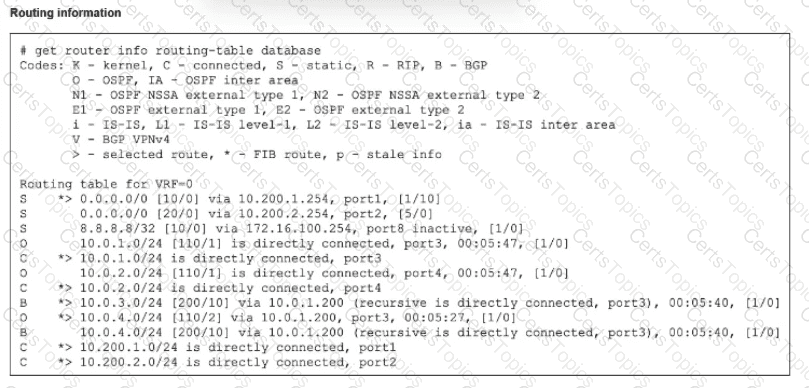
The modified output of live routing kemel is shown

Which two statements about the output are (rue? (Choose two.)

Options:

A.

The BGP route to 10.0.4.0/24 is not in the forwarding information base.

B.

The default static route through 10.200.1 254 is in the forwarding information base.

C.

FortiGate is performing ECMP using both default static routes.

D.

The local FortiGate is receiving only one LSA from one OSPF neighbor.

Question 4

Refer to the exhibit.

Which two observations can you make about the web filter traffic captured using the flow tool? (Choose two.)

Options:

A.

The session is offloaded to the NPU.

B.

The firewall policy is configured with proxy-based inspection mode.

C.

The web filter profile is configured with proxy-based inspection mode.

D.

The HTTPS port is mapped to 443 in the SSL/SSH Inspection Profile

Question 5

Refer to the exhibit.

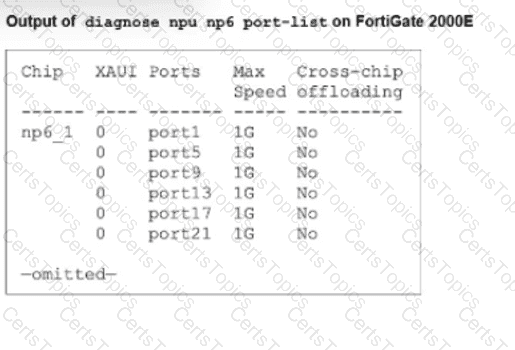
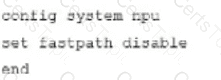
A partial output of diagnose npu up6 port-list on FortiGate 2000E is shown.

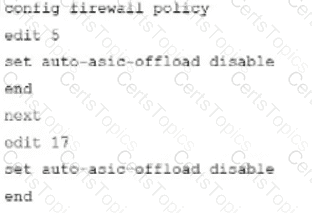
An administrator is unable to analyze traffic flowing between port1 and port17 using the diagnose sniffer command.

Which two commands allow the administrator to view the traffic? (Choose two.)

A)

B)
C)

D)
Options:

A.

Option A

B.

Option B

C.

Option C

D.

Option D

Question 6

Consider the scenario where the server name indication (SNI) does not match either the common name (CN) or any of the subject alternative names (SAN) in the server certificate. Which two actions will FortiGate take when using the default settings for SSL certificate inspection? (Choose two answers)

Options:

A.

FortiGate uses the SNI from the user ' s web browser.

B.

FortiGate does not decrypt the traffic if the traffic is blocked by the web filter profile.

C.

FortiGate uses the CN information from the Subject field in the server certificate.

D.

FortiGate does not decrypt the traffic if the traffic is allowed by the web filter profile.

Question 7

Which two statements about Security Fabric communications are true? (Choose two.)

Options:

A.

By default, the downstream FortiGate establishes a connection with the upstream FortiGate using TCP port 8013.

B.

FortiTelemetry must be manually enabled on the FortiGate interface.

C.

The default ports for FortiTelemetry and Neighbor Discovery can be modified.

D.

Security Fabric communication is enabled by default among all Fortinet devices.

Question 8

Refer to the exhibit.

An administrator has configured a firewall policy to use proxy-based inspection mode. What could explain the messages observed in the debug flow output?

Options:

A.

At least one protocol port under Protocol Options has been mapped to Any.

B.

SSL deep inspection is not configured.

C.

The FTP protocol has not yet been mapped to port 211 under Protocol Options.

D.

FortiGate does not have enough free memory to perform proxy-based inspections.

Question 9

Refer to the exhibit.

Which Iwo statements about FortiGate behavior relating to this session are correct? (Choose two.)

Options:

A.

FortiGate is performing a security profile inspection using the CPU.

B.

FortiGate redirected the client to trio captive portal to authenticate so that a correct policy match could be made

C.

FortiGate either initiated the session or the session terminates at FortiGate.

D.

FortiGate forwarded this session without any inspection.

Question 10

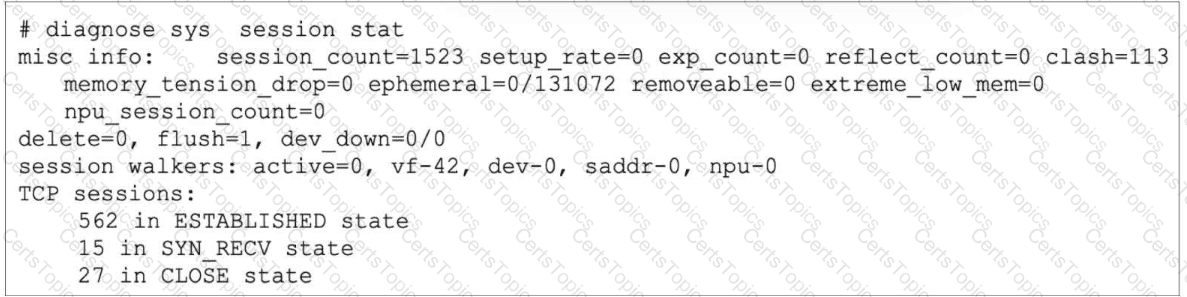
Refer to the exhibit.

The partial output of diagnose sys session stat command is shown.

Which statement about the output shown in the exhibit is correct?

Options:

A.

113 sessions have been dropped because of memory page exhaustion.

B.

There have been 131072 recorded ephemeral sessions but there are no current ones.

C.

562 TCP sessions have their proto_state set to 01 if there is no inspection.

D.

27 sessions have expired but are still in the session table in case any out-of-order packets arrive.

Question 11

Refer to the exhibit, which shows partial outputs from two routing debug commands.
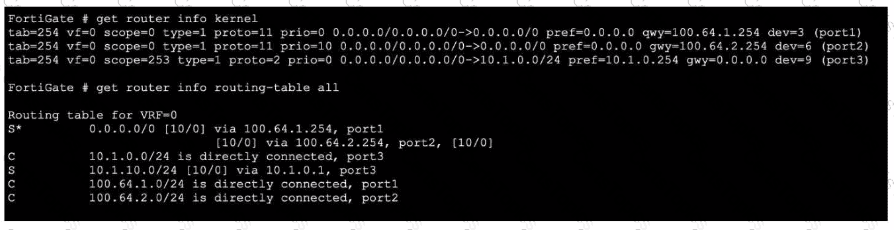
Which change must an administrator make on FortiGate to route web traffic from internal users to the internet, using ECMP?

Options:

A.

Set snat-route-change to enable.

B.

Set the priority of the static default route using port2 to 1.

C.

Set preserve-session-route to enable.

D.

Set the priority of the static default route using port1 to 10.

Question 12

Which exchange lakes care of DoS protection in IKEv2?

Options:

A.

Create_CHILD_SA

B.

IKE_Auth

C.

IKE_Req_INIT

D.

IKE_SA_NIT

Question 13

An administrator wants to capture encrypted phase 2 traffic between two FotiGate devices using the built-in sniffer.

If the administrator knows that there Is no NAT device located between both FortiGate devices, which command should the administrator run?

Options:

A.

diagnose sniffer packet any ' udp port 500 '

B.

diagnose sniffer packet any ' lp proto 50 '

C.

diagnose sniffer packet any ' udp port 4500 '

D.

diagnose sniffer packet any ' ah '

Question 14

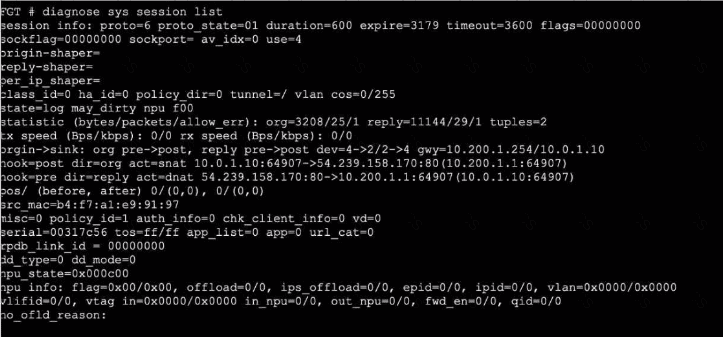
Refer to the exhibit, which shows the omitted output of a session table entry.

Which two statements are true? (Choose two.)

Options:

A.

The traffic has been tagged for VLAN 0000.

B.

NP7 is handling offloading of this session.

C.

The traffic matches Policy ID 1.

D.

The session has been offloaded.

Question 15

A VPN tunnel is up. To monitor traffic flow, the administrator enters the following CLI commands on an SSH session on FortiGate:

# diagnose debug enable

# diagnose sniffer packet any ' udp and port 500 ' 4

However, the sniffer does not show any output. Assuming default configuration values, what are two possible reasons there is no output? (Choose two answers)

Options:

A.

The filter should be modified to also capture packets for TCP port 443 or UDP port 4500 .

B.

NAT Traversal is enabled.

C.

The sniffer must be restricted to the remote peer IP address.

D.

The sniffer output will be ignored because running diagnose debug enable shows only application real-time debugs.

Question 16

Which two statements about an auxiliary session ate true? (Choose two.)

Options:

A.

With the auxiliary session selling disabled, only auxiliary sessions are offloaded.

B.

With the auxiliary session setting enabled. ECMP traffic is accelerated to the NP6 processor.

C.

With the auxiliary session setting enabled. Iwo sessions are created in case of routing change.

D.

With the auxiliary session setting disabled, for each traffic path. FortiGate uses the same auxiliary session.

Question 17

When FortiGate enters conserve mode because of memory pressure, which action can FortiGate perform to preserve memory?

Options:

A.

FortiGate automatically reboots to clear memory and restore full operation.

B.

FortiGate switches to a less memory-intensive inspection mode, such as flow-based inspection.

C.

FortiGate reduces or stops non-essential processes like logging and antivirus scanning.

D.

FortiGate begins dropping all new sessions to protect resources.

Question 18

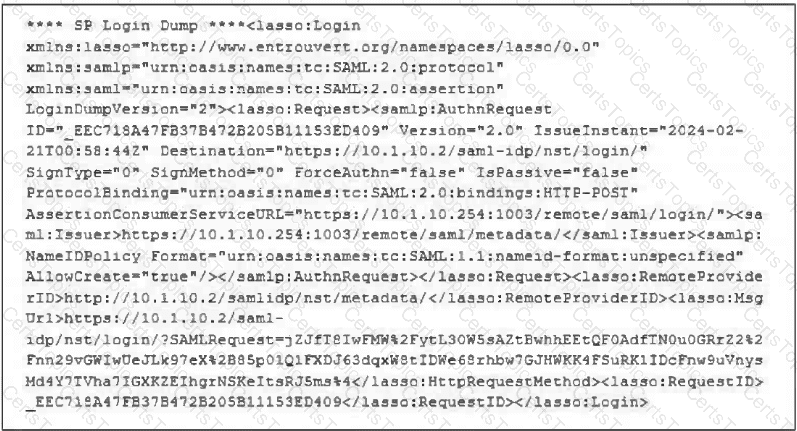
Refer to the exhibit.

The output from using the command diagnose debug application samld -1 to diagnose a SAML connection is shown. Based on this output, which two conclusions can you draw? (Choose two answers)

Options:

A.

The IdP IP address is 10.1.10.254.

B.

The SP IP address is 10.1.10.254.

C.

The SP IP address is 10.1.10.2.

D.

The IdP IP address is 10.1.10.2.

Question 19

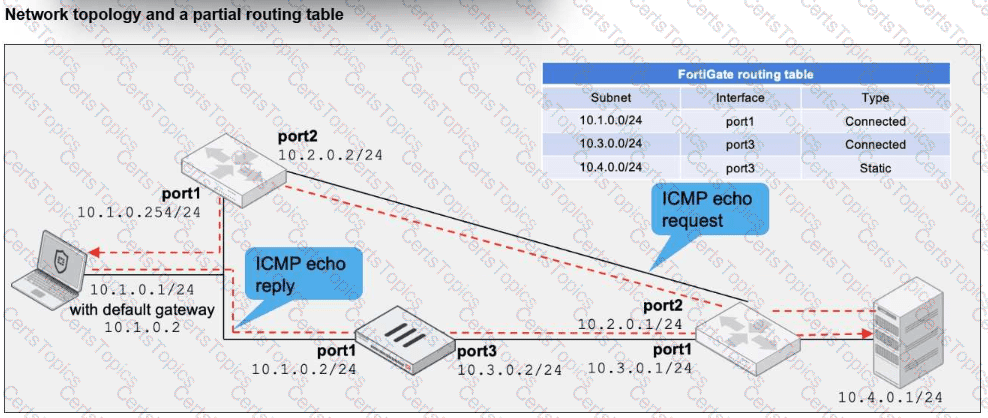
Refer to the exhibit.

A network topology and a partial routing table are shown.

FortiGate has already been configured with a firewall policy that allows all ICMP traffic to flow from port1 to port3.

Which two changes can the administrator perform to ensure the server at 10.4.0.1/24 receives the ICMP echo reply from the laptop at 10.1.0.1/24? (Choose two.)

Options:

A.

Enable asymmetric routing under config system settings.

B.

Change the FortiGate configuration from strict RPF check mode to feasible RPF check mode.

C.

Modify the default gateway on the laptop from 10.1.0.2 to 10.1.0.254.

D.

Add a default static route on FortiGate to forward all traffic to port3.

Question 20

In which two slates is a given session categorized as ephemeral? (Choose two.)

Options:

A.

A UDP session with only one packet received

B.

A UOP session with packets sent and received

C.

A TCP session waiting for the SYN ACK

D.

A TCP session waiting for FIN ACK

Question 21

Refer to the exhibit.

The partial output of a session table entry is shown.

Which two statements about the output shown in the exhibit are correct? (Choose two.)

Options:

A.

NP7 is handling offloading of this session.

B.

The traffic matches Policy ID 1.

C.

The session has been offloaded.

D.

The traffic is tagged for a VLAN interface.

Question 22

You use the FortiManager SD-WAN overlay orchestrator to prepare an SD-WAN deployment. Using information provided through the SD-WAN overlay template wizard, FortiManager creates templates that are ready to install on the spoke and hub devices.

Which three templates are created by the SD-WAN overlay orchestrator for a spoke device? (Choose three answers.)

Options:

A.

Rules template

B.

CLI template

C.

IPsec tunnel template

D.

BGP template

E.

Static route template

Question 23

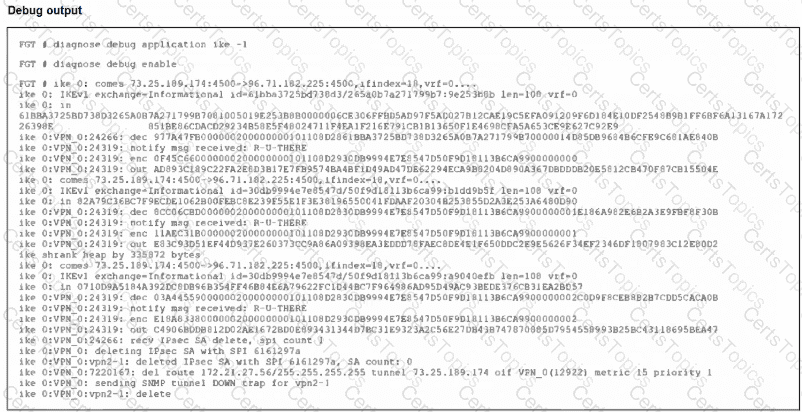
Refer to the exhibit.

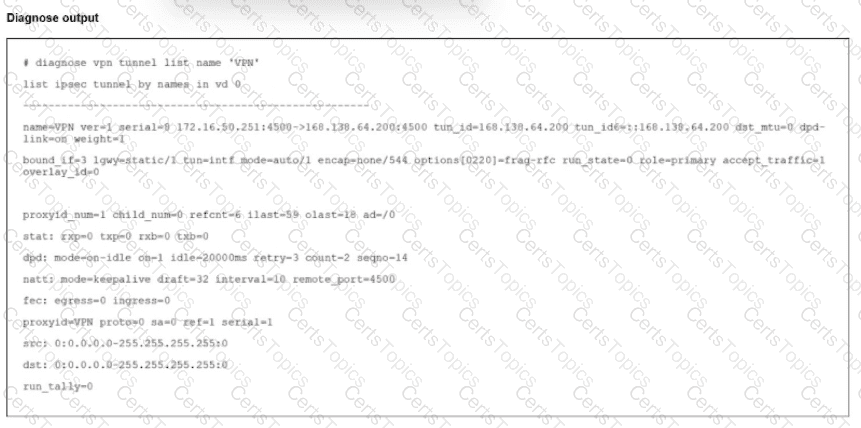
An IPsec VPN tunnel is dropping, as shown by the debug output.

Analyzing the debug output, what could be causing the tunnel to go down?

Options:

A.

Phase 2 drops but Phase 1 is up.

B.

Dead Peer Detection is not receiving its acknowledge packet.

C.

The tunnel drops during rekey negotiation.

D.

The tunnel drops after the timer expires.

Question 24

Refer to the exhibit.

The output of the command diagnose vpn tunnels liar is shown.

Which two statements accurately describe the status of the tunnel? (Choose two.)

Options:

A.

Phase 2 is down

B.

Phase 1 is down.

C.

There is currently no traffic traversing the tunnel

D.

Both Phase 1 and Phase 2 were negotiated successfully.

Question 25

Refer to the exhibit.

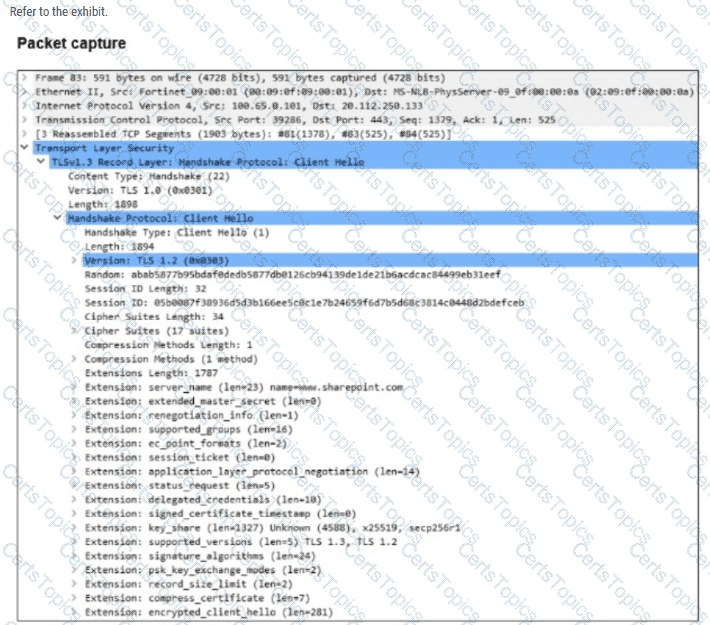
The packet capture output of a ClientHello message is shown.

You are updating a firewall policy that includes SSL certificate inspection. You are capturing packets from traffic passing through this firewall policy.

Which two statements about the packet capture are correct? (Choose two.)

Options:

A.

You can effectively apply an antivirus security profile to this traffic.

B.

You can effectively apply a web filtering profile to this traffic.

C.

The subject alternative name (SAN) is necessary to apply security profiles.

D.

The client supports only TLS versions 1.2 and 1.3.

Question 26

Refer to the exhibit, which shows the output of the command get router info bgp neighbors 100.64.2.254 advertised-routes.
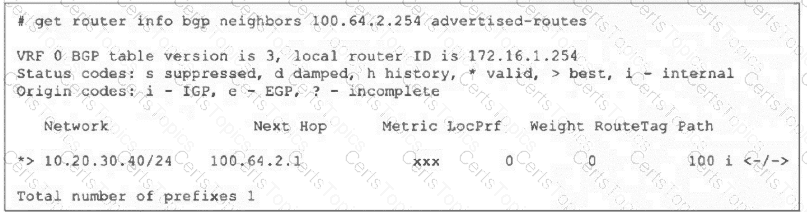
What can you conclude from the output?

Options:

A.

The BGP state of the two BGP participants is OpenConfirm.

B.

The router ID of the neighbor is 100.64.2.254.

C.

The BGP neighbor is advertising the 10.20.30.40/24 network to the local router.

D.

The local router is advertising the 10.20.30.40/24 network to its BGP neighbor.

Question 27

While troubleshooting a FortiGate web filter issue, users report that they cannot access any websites, even though those sites are not explicitly blocked by any web filter profiles that are applied to firewall policies.
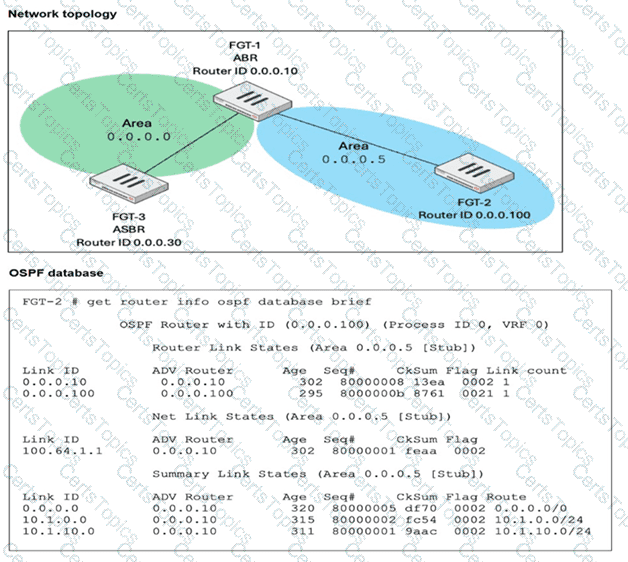
What are the three most likely reasons for this behavior? (Choose three answers)

Options:

A.

The web filter cache has been cleared causing all websites to take longer to be rated.

B.

The SSL/TLS deep inspection was configured but the browsers do not have the FortiGate certificate installed.

C.

The webfilter-force-off setting has been enabled under config system fortiguard.

D.

The DNS server is unreachable, preventing URL resolution.

E.

The FortiGuard Web Filtering license has expired, causing FortiGate to apply the default block action.

Question 28

Refer to the exhibit, which shows the output of a BGP debug command.
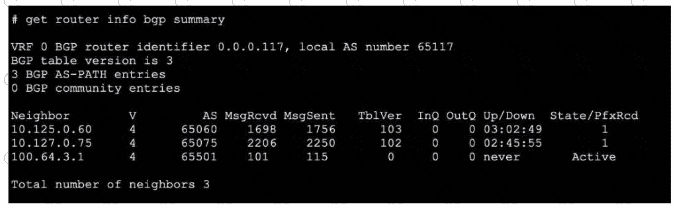
What can you conclude about the router in this scenario?

Options:

A.

The router 100.64.3.1 needs to update the local AS number in its BGP configuration in order to bring up the 8GP session with the local router.

B.

An inbound route-map on local router is blocking the prefixes from neighbor 100.64.3.1.

C.

All of the neighbors displayed are part of a single BGP configuration on the local router with the neighbor-range set to a value of 4.

D.

The BGP session with peer 10.127.0.75 is up.

Question 29

What are two reasons you might see iprope_in check () check failed, drop when using the debug How? (Choose two.)

Options:

A.

The packet was dropped because it is not allowed by any firewall policy.

B.

The packet was dropped because there is no route to the source.

C.

The packet was dropped because the trusted host list is misconfigured

D.

The packet was dropped because the requested service is not enabled on FortiGate

Question 30

Exhibit 1.

Exhibit 2.

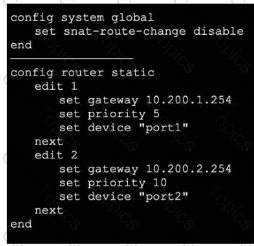
Refer to the exhibits, which show the configuration on FortiGate and partial internet session information from a user on the internal network.

An administrator would like to lest session failover between the two service provider connections.

Which two changes must the administrator make to force this existing session to immediately start using the other interface? (Choose two.)

Options:

A.

Change the priority of the port1 static route to 11.

B.

Change the priority of the port2 static route to 5.

C.

Configure unset snat-route-change to return it to the default setting.

D.

Configure set snat-route-change enable.

Question 31

Refer to the exhibit, which shows partial outputs from two routing debug commands.
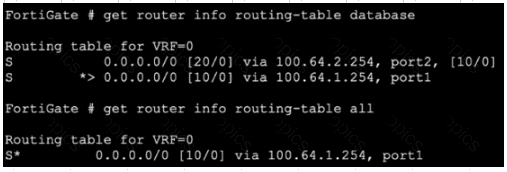
Why is the port2 default route not in the second command output?

Options:

A.

The port2 interface is disabled in the FortiGate configuration.

B.

The port1 default route has a higher priority value than the default route using port2.

C.

The port1 default route has a lower priority value than the default route using port2.

D.

The port1 default route has a lower distance than the default route using port2.

Question 32

Refer to the exhibit, which shows the output of a diagnose command.
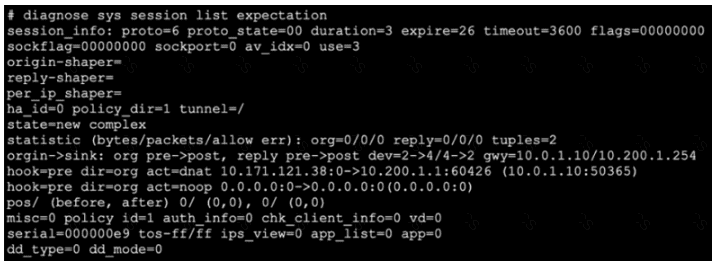
What two conclusions can you draw from the output shown in the exhibit? (Choose two answers)

Options:

A.

This is an expected session created by the IPS engine.

B.

Traffic in the original direction (coming from the IP address 10.171.121.38) will be routed to the next-hop IP address 10.0.1.10.

C.

Traffic in the original direction (coming from the IP address 10.171.121.38) will be routed to the next-hop IP address 10.200.1.1.

D.

This is a pinhole session created to allow traffic for a protocol that requires additional sessions to operate through FortiGate.

Question 33

Refer to the exhibit, which shows a truncated output of a real-time RADIUS debug.
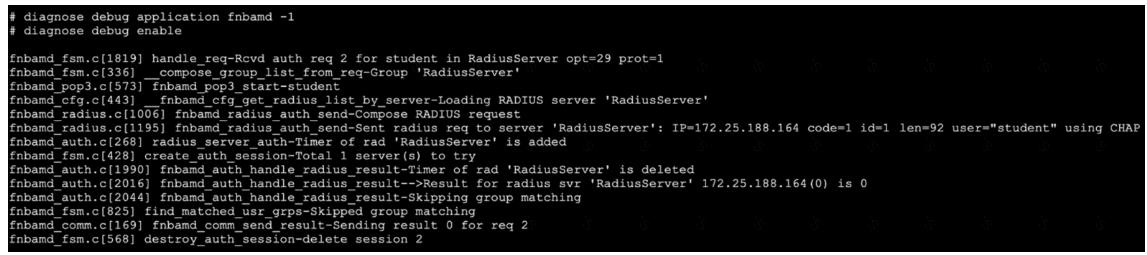
Which two statements are true? (Choose two answers)

Options:

A.

The RADIUS server queried for authentication is located at IP address 172.25.188.164.

B.

Authentication was unsuccessful.

C.

The authentication scheme used was pop3.

D.

Authentication was successful.

E.

Two-factor authentication was required.

Question 34

Refer to the exhibit, which shows the output of diagnose sys session stat.
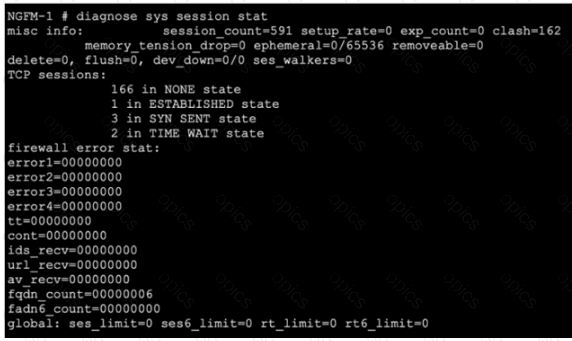
Which statement about the output shown in the exhibit is correct?

Options:

A.

All the sessions in the session table are TCP sessions.

B.

162 sessions have been deleted because of memory page exhaustion.

C.

There are 166 TCP sessions waiting to complete the three-way handshake.

D.

There are two sessions that have not been removed in case any out-of-order packets arrive.

Question 35

During the SAML negotiation process, in which section does the Identity Provider (IdP) provide the SAML attributes used in the authentication process to the Service Provider (SP)?

Options:

A.

Bindings HTTP post

B.

Assertion dump

C.

Authentication request

D.

Authentication response

Question 36

Refer to the exhibit, which shows the output of a real-time debug. Which statement about this output is true? (Choose one answer)
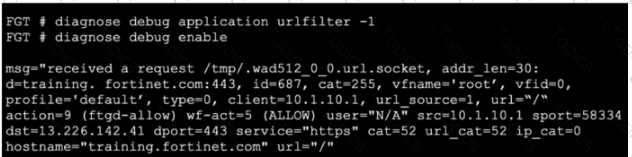
Options:

A.

The server hostname was extracted from the SNI in the client request, or from the CN in the server certificate.

B.

FortiGate found the requested URL in its local cache.

C.

This web request was inspected using the ftgd-allow web filter profile.

D.

The requested URL belongs to category ID 255.

Question 37

Which three conditions are required for two FortiGate devices to form an OSPF adjacency? (Choose three answers)

Options:

A.

OSPF link costs match.

B.

OSPF interface priority settings are unique.

C.

OSPF interface network types match.

D.

Authentication settings match.

E.

OSPF router IDs are unique.

Question 38

Refer to the exhibit.

The port1 interface configuration on FortiGate and partial session information for ICMP traffic are shown.

Which two things happen to the session information if a routing change occurs that affects this session? (Choose two answers)

Options:

A.

This session will be unaffected by routing changes. The routing changes will apply only to new sessions.

B.

The session will be flagged as dirty but no route lookups will be performed.

C.

The session information will not change unless the current route has been removed from the routing table.

D.

The session information will not change even when the active route has been removed from the routing table.

Question 39

Refer to the exhibit.

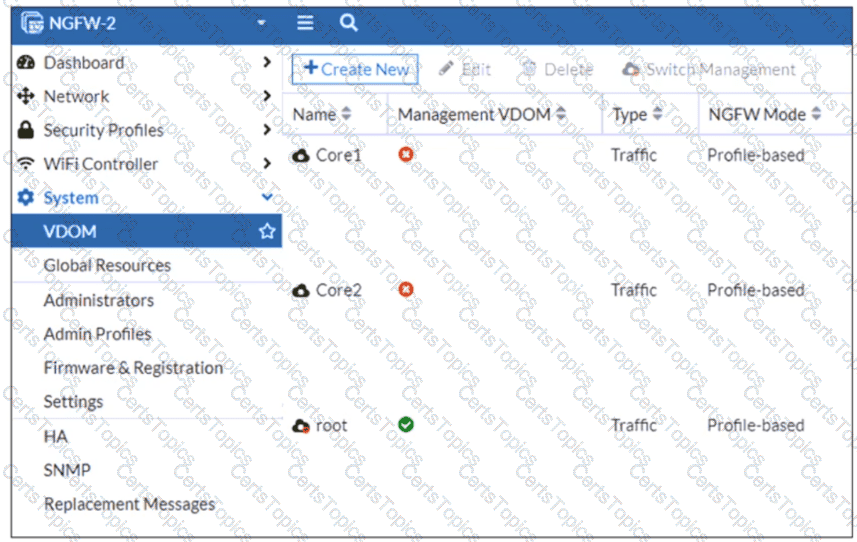
The VDOM configuration on a FortiGate device is shown. You discover that web filtering stopped working in Core1 and Core2 after a maintenance window.

What are two reasons why web filtering stopped working? (Choose two answers.)

Options:

A.

The root VDOM does not have access to FortiManager in a closed network.

B.

The root VDOM does not have access to any valid public Fortinet Distribution Network (FDN) server.

C.

The Core1 and Core2 VDOMs must also be enabled as management VDOMs to receive FortiGuard updates.

D.

The root VDOM does not use a VDOM link to connect with the Core1 and Core2 VDOMs.

Question 40

Refer to the exhibit, which shows a partial output of the fssod daemon real-time debug command.

What two conclusions can you draw from the output? (Choose two.)

Options:

A.

The workstation with IP 10.124.2.90 will be polled frequently using TCP port 445 to see if the user is still logged on.

B.

The logon event can be seen on the collector agent installed on Windows.

C.

FSSO is using DC agent mode to detect logon events.

D.

FSSO is using agentless polling mode to detect logon events.

Question 41

Refer to the exhibit.

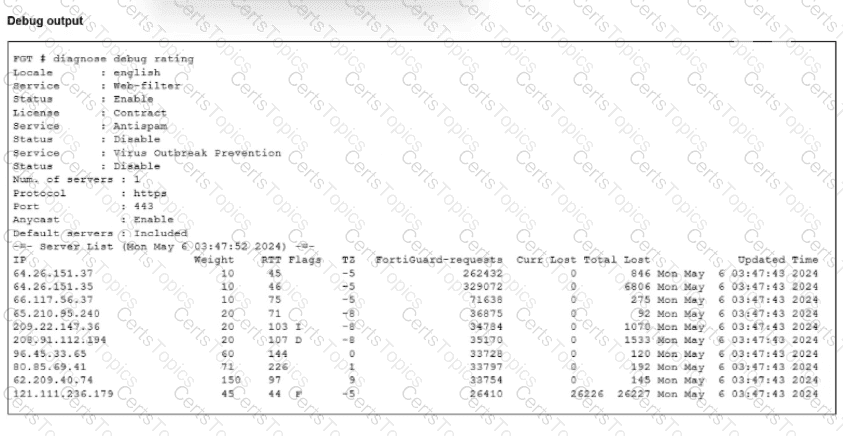
The administrator did not override the FortiGuard FODN or IP address in the FortiGate configuration

Which IP address did FortiGate get when resolving the servicem,fortiguard.net name?

Options:

A.

208.91.112.194

B.

209.22.147.36

C.

64.26.151.37

D.

96.45.33.65

Question 42

Refer to the exhibit, which shows the partial output of a diagnose command.
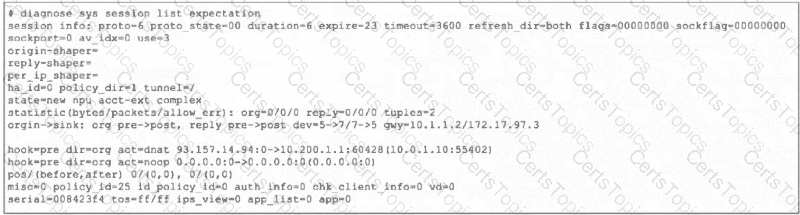
Which two conclusions can you draw from the output shown in the exhibit? (Choose two.)

Options:

A.

FortiGate will drop the expected traffic if it does not arrive within 23 seconds.

B.

Clearing the master session has no impact on the expectation session.

C.

This is a pinhole session to allow traffic for a TCP protocol that dynamically assigns TCP ports.

D.

The session is checked against firewall policy ID 25.

Question 43

Exhibit.

Refer to the exhibit, which shows two entries that were generated in the FSSO collector agent logs.eeeeeeeeeeeeeeeeeeeeeeeeeeeeeeeeeeeeeeeeeeeeeeeeeeeeeeeeeeeeeeeeeeeeeee

What three conclusions can you draw from these log entries? {Choose three.)

Options:

A.

Remote registry is not running on the workstation.

B.

The user ' s status shows as " not verified " in the collector agent.

C.

DNS resolution is unable to resolve the workstation name.

D.

The FortiGate firmware version is not compatible with that of the collector agent.

E.

A firewall is blocking traffic to port 139 and 445.