The 7.6 study guide explains the route selection order:
“Route Selection Process
Lowest distance
Lowest metric (dynamic routes)
Lowest priority (static routes)
ECMP (static, BGP, and OSPF routes)”**
It then states:
“If there are multiple routes with the same netmask, distance, metric, and priority, FortiGate shares the traffic among all of them. This is called equal-cost multi-path (ECMP).”
The FortiOS administration guide confirms the ECMP prerequisite:
“Routes must have the same destination and costs. In the case of static routes costs include distance and priority.”
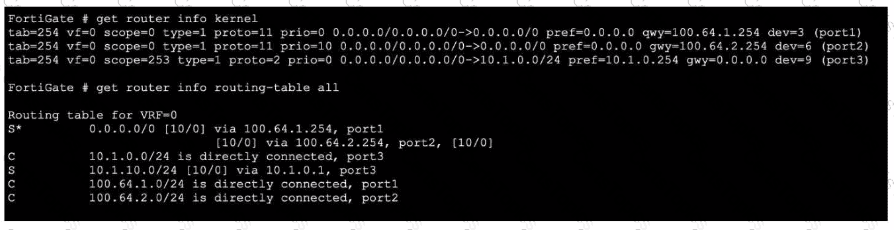
In the exhibit, the kernel/FIB output shows the two default routes as:
So although both are default routes, their priorities are different . Since FortiGate uses the FIB/kernel for forwarding traffic, ECMP will not happen until the static-route priorities are the same. The study guide also notes that the FIB is the table used to perform standard routing
Therefore, to make the two default routes eligible for ECMP, the administrator must make the priorities equal. Since port2 is already 10, the needed change is to set the port1 default route priority to 10.
Why the other options are wrong:
A is wrong because snat-route-change affects how existing SNAT sessions react to routing changes, not whether static routes qualify for ECMP
B is wrong because changing port2 to priority 1 still would not match port1 at 0, so the routes still would not have equal cost for ECMP
C is wrong because preserve-session-route affects existing-session route persistence after routing changes, not ECMP qualification