Spring Sale 70% Discount Offer - Ends in 0d 00h 00m 00s - Coupon code: save70

Cisco 300-510 Exam With Confidence Using Practice Dumps
Exam Code:
300-510
Exam Name:
Implementing Cisco Service Provider Advanced Routing Solutions
Certification:
Vendor:
Questions:
269
Last Updated:
Jun 1, 2026
Exam Status:
Stable
Cisco 300-510

300-510: CCNP Service Provider Exam 2025 Study Guide Pdf and Test Engine

Are you worried about passing the Cisco 300-510 (Implementing Cisco Service Provider Advanced Routing Solutions) exam? Download the most recent Cisco 300-510 braindumps with answers that are 100% real. After downloading the Cisco 300-510 exam dumps training , you can receive 99 days of free updates, making this website one of the best options to save additional money. In order to help you prepare for the Cisco 300-510 exam questions and verified answers by IT certified experts, CertsTopics has put together a complete collection of dumps questions and answers. To help you prepare and pass the Cisco 300-510 exam on your first attempt, we have compiled actual exam questions and their answers. 

Our (Implementing Cisco Service Provider Advanced Routing Solutions) Study Materials are designed to meet the needs of thousands of candidates globally. A free sample of the CompTIA 300-510 test is available at CertsTopics. Before purchasing it, you can also see the Cisco 300-510 practice exam demo.
Implementing Cisco Service Provider Advanced Routing Solutions Questions and Answers

Question 1

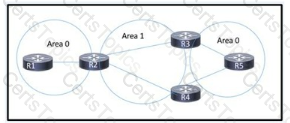
Refer to the exhibit.

After troubleshooting an OSPF adjacency issue, routers 1, 2, and 3 have formed OSPF

neighbor relationships. Which statement about the configuration is true?

Options:

A.

Router 2 receives a Type 5 LSAs from router 1 for its connected subnets

B.

Router 2 uses router 3 as the next hop for 192.168.0.0/24

C.

Router 2 uses router 1 as the next hop for 192.168.0.0/24

D.

Router 2 receives a Type 7 LSAs from router 3 for its connected subnets

Buy Now
Question 2

What is the difference between basic IS-IS and OSPF packet types?

Options:

A.

IS-IS and OSPF use area packets, but only IS-IS uses sequence number packets.

B.

IS-IS and OSPF use link-state update packets, but only OSPF uses link-state ACK packets.

C.

IS-IS and OSPF use Hello packets, but only OSPF uses DBD packets.

D.

IS-IS and OSPF use link-state update packets, but only IS-IS uses DBD packets.

Question 3

Refer to the exhibit. Users at the branch office on R1 reported issue with an application at the home office on R4. While troubleshooting the issue, a network engineer determined that

  • The branch-office users can connect to the home office.
  • The IS-IS adjacencies between R1 and R2 and R1 and the branch office are up.
  • Traffic from R1 to the R2 10.20.1.0/24 network is moving normally.
  • The application at the home office is experiencing packet drops on the connection to the Branch, and R3 cannot reach the R1 172.16.10.0/24 network.

Which action resolves the issues?

Options:

A.

Redistribute static connected routes in IS-IS on router RI.

B.

Configure the IS-IS core instance on the RI GigabitEthernet0/3 interface.

C.

Redistribute static connected routes in IS-IS on router R4.

D.

Configure the IS-IS core instance on the R2 GigabitEthernet0/1 interface.