
A VM program’s standard operating procedures should include
a requirement that each VM team member be independent from the development team.
how subjects for VM studies are identified.
a listing of standard functions to be included in a VM study.
a required number of creative ideas to be generated in a study.
The correct answer is B . A VM program’s standard operating procedures should define how candidate subjects or projects are identified, screened, selected, prioritized, and authorized for VM studies. This belongs to VM program governance because limited VM resources must be applied to subjects with appropriate scope, timing, information availability, organizational importance, and value-improvement potential. SAVE’s Value Standard states that the standard assists managers and value program managers in applying VM within organizations in a consistent manner, and also guides practitioners and managers in determining when to apply VM to a project to maximize innovation and implementation benefits. ( wsdot.wa.gov )
Option A is too rigid. SAVE recognizes multidisciplinary teams of experienced professionals and stakeholders; people outside the project may be added for perspective, but every team member is not required to be independent from the development team. ( wsdot.wa.gov ) Option C is incorrect because functions are not pre-listed generically; they are identified specifically for the study subject during Function Analysis. Option D is also incorrect because creativity should encourage broad idea generation, but the SOP should not prescribe a fixed number of ideas as a universal requirement. VM procedures should standardize the management process, not force artificial technical outputs.
References/topics: VM Programs; Program SOPs; Study Subject Identification; Value Program Management; Study Selection Criteria.
A company wants to add a new product to its manufacturing process. Who should provide input as this new product will affect the current manufacturing process?
Choose 3 answers.
Marketing
Maintenance
Production
Human resources
Engineering
The correct answers are B. Maintenance, C. Production, and E. Engineering . The question is focused on how adding a new product will affect the current manufacturing process , so input must come from the functions that directly understand equipment capability, production workflow, process design, downtime risk, maintainability, tooling, tolerances, and operational constraints. SAVE’s Value Methodology Standard specifically states that VM can be applied to manufacturing processes , and that the Value Study Team should be a multidisciplinary group of experienced professionals and project stakeholders selected based on their expertise and experience with the project.
Production is essential because it understands line capacity, sequencing, labor flow, bottlenecks, cycle time, quality impact, and daily operating constraints. Maintenance is essential because a new product may require equipment changes, additional preventive maintenance, setup changes, spare parts, downtime planning, or reliability analysis. Engineering is essential because it understands product design, process capability, manufacturing methods, fixtures, tooling, specifications, and technical feasibility.
Marketing may provide market demand or customer preference input, but that is not the best answer when the question narrows the issue to the existing manufacturing process. Human resources may support staffing or training later, but it is not one of the three primary technical process stakeholders.
References/topics: Multidisciplinary Team; Stakeholder Expertise; Manufacturing Process VM; Team Composition.
How does leveraging the ambiguity of functions foster creativity?
Choose 2 answers.
Contributes to convergent thinking
Contributes to divergent thinking
Focuses on structure
Provides subject context reframing
The correct answers are B and D . In Value Methodology, functions are intentionally expressed at an abstract level, normally in an active verb / measurable noun format, so the team can move away from the existing physical solution and examine what the subject must accomplish. SAVE guidance states that the Function Analysis Phase requires understanding the project from a functional perspective: what it must do, rather than how it is currently conceived . It also states that this phase identifies functions on which to focus the Creativity Phase. ( )
This abstraction creates productive ambiguity. Instead of locking the team into a component, design feature, or known process, the function statement reframes the subject context and opens multiple possible ways to satisfy the same need. That directly supports divergent thinking , which is specifically associated with Creativity in the CVS body of knowledge, including unrestricted idea generation, large quantities of ideas, and suspending judgment until Evaluation. ( )
Option A is incorrect because convergent thinking belongs to Evaluation, where ideas are reduced and prioritized. Option C is also incorrect because structure may support FAST or function modeling, but ambiguity fosters creativity by loosening solution bias, not by focusing on structure.
References/topics: Creativity Phase; Function Analysis Phase; Divergent Thinking; Function Abstraction; Subject Reframing.
What are typical examples of evaluation criteria used for a business process study during the Evaluation Phase?
Choose 2 answers.
Efficiency
Environmental impact
Maintenance
Scalability
The correct answers are A. Efficiency and D. Scalability . In the Evaluation Phase, the VM team uses structured criteria to screen and rank creative ideas based on their ability to improve value while still delivering the required functions. SAVE’s Value Methodology Standard defines VM as a systematic process used by a multidisciplinary team to improve value through function analysis, and it confirms that VM applies not only to products and construction projects but also to business procedures, services, manufacturing processes, and business plans . ( )
For a business process study , typical evaluation criteria focus on how well an alternative improves process performance. Efficiency is a primary criterion because business-process alternatives are commonly judged by cycle time, resource use, duplication reduction, workflow simplification, and productivity. Scalability is also typical because the improved process should remain effective as transaction volume, users, locations, or organizational complexity increase.
Environmental impact may be valid in sustainability-driven studies, construction, or product/process engineering, but it is not a typical core criterion for a general business-process VM study. Maintenance is more typical for physical assets, facilities, equipment, or technical systems. The Evaluation Phase specifically selects ideas that offer value improvement while considering performance requirements and resource limits. ( )
References/topics: Evaluation Phase; Business Process Study; Evaluation Criteria; ; Scalability; Value Improvement.
Which function of prescription eyeglasses is located in the “When” direction?
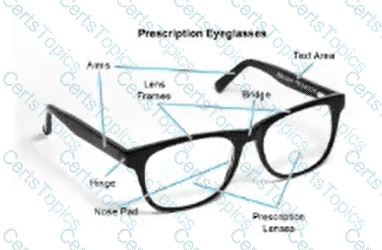
Facilitate sight
Maintain position
Modify vision
Fold eyeglasses
The correct answer is B. Maintain position . In FAST diagramming, the horizontal logic path normally answers How and Why . The vertical “When” direction is used for supporting or secondary functions that occur in relation to a function on the critical function logic path. SAVE’s VM Glossary defines a FAST diagram as a graphical representation of dependent function relationships and specifically identifies the labeled How, Why, and When arrows as FAST components. It also explains that vertical lines connect secondary functions to required secondary functions through their “When” relationships . ( )
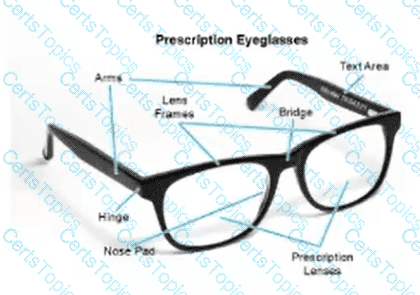
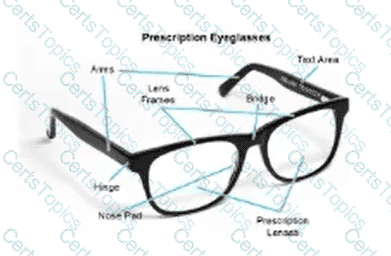
For prescription eyeglasses, Modify vision is the core/basic function because the lenses correct or adjust the user’s vision. Facilitate sight is a higher-order purpose explaining why the basic function exists. Maintain position is a supporting function because the frame, bridge, temples, and nose pads keep the lenses properly located in front of the eyes while the eyeglasses modify vision. This function happens concurrently with the basic function, making it appropriate in the When direction. Fold eyeglasses is only a convenience/storage function, not the functional support required during vision correction.
References/topics: Function Analysis Phase; FAST Diagramming; When Relationship; Secondary Function; Prescription Eyeglasses Function Model.
Match each Phase with its correct question:
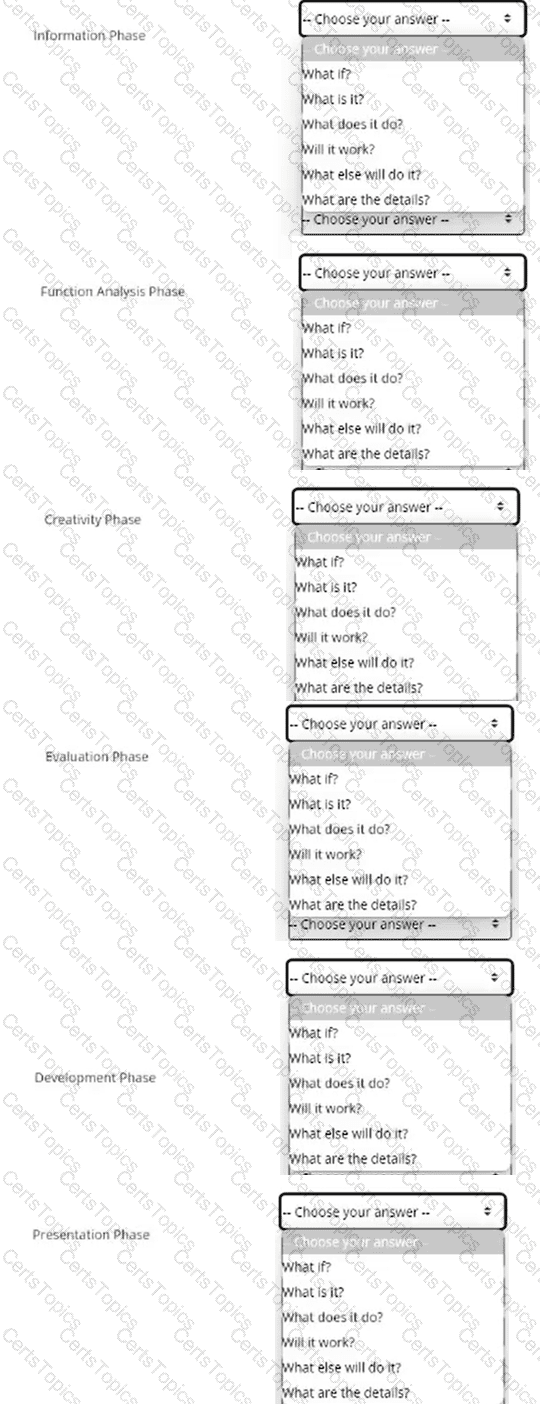
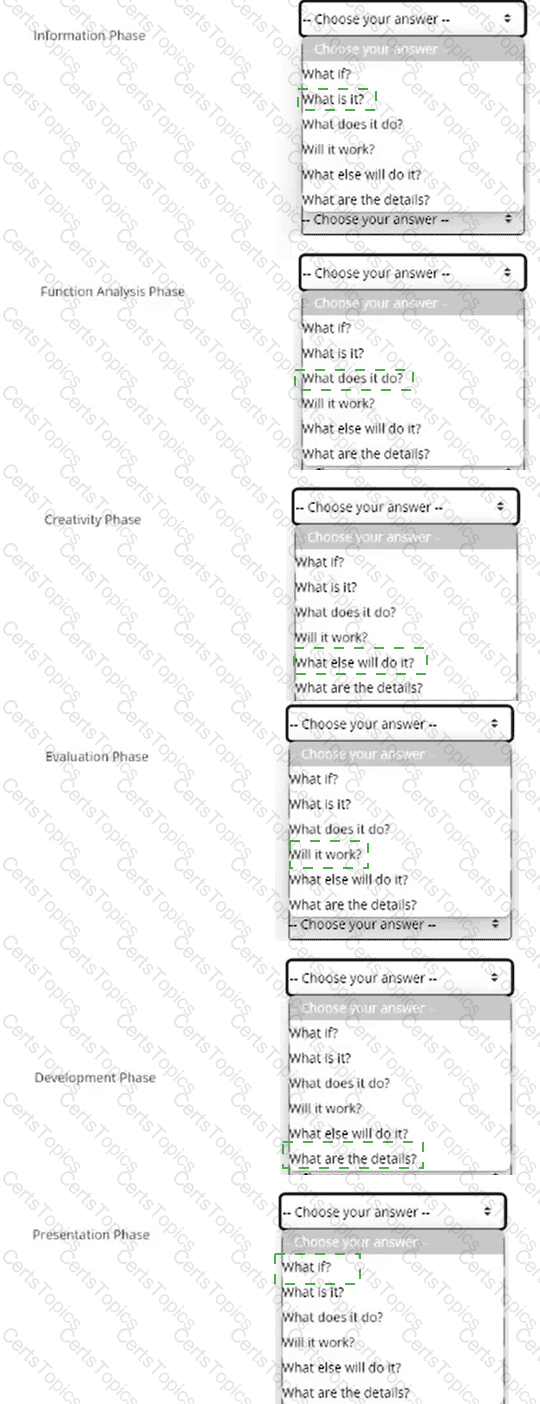
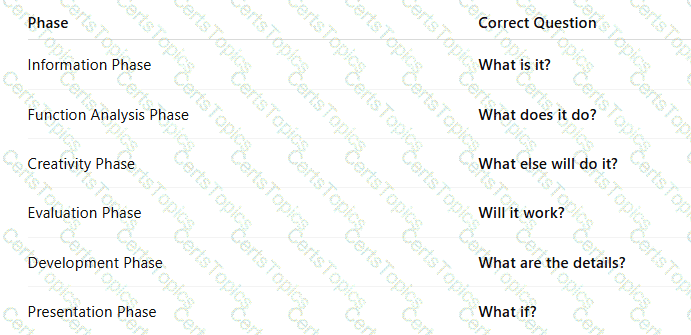
The correct matching follows the logic of the SAVE Value Methodology Job Plan. The Information Phase establishes factual understanding of the study subject, so its controlling question is “What is it?” The SAVE VM Standard describes this phase as reviewing current project conditions and identifying study goals. The Function Analysis Phase asks “What does it do?” because the team defines the project’s functions in active verb/measurable noun form and analyzes which functions require improvement, elimination, or creation. The Creativity Phase asks “What else will do it?” because the team identifies alternative ways to perform the required functions. The Evaluation Phase asks “Will it work?” because ideas are screened against value potential, performance requirements, and resource limits. The Development Phase asks “What are the details?” because selected ideas are expanded into documented alternatives or proposals. Finally, the Presentation Phase aligns with “What if?” because decision makers must understand the implications, adequacy, risks, and value improvement opportunity before approving implementation. SAVE identifies these six phases as sequential and states that each phase provides the information needed for successful execution of the next phase.
References/topics: Value Methodology and Job Plan; Information Phase; Function Analysis Phase; Creativity Phase; Evaluation Phase; Development Phase; Presentation Phase.
Select the best matches for the functions of prescription eyeglasses.
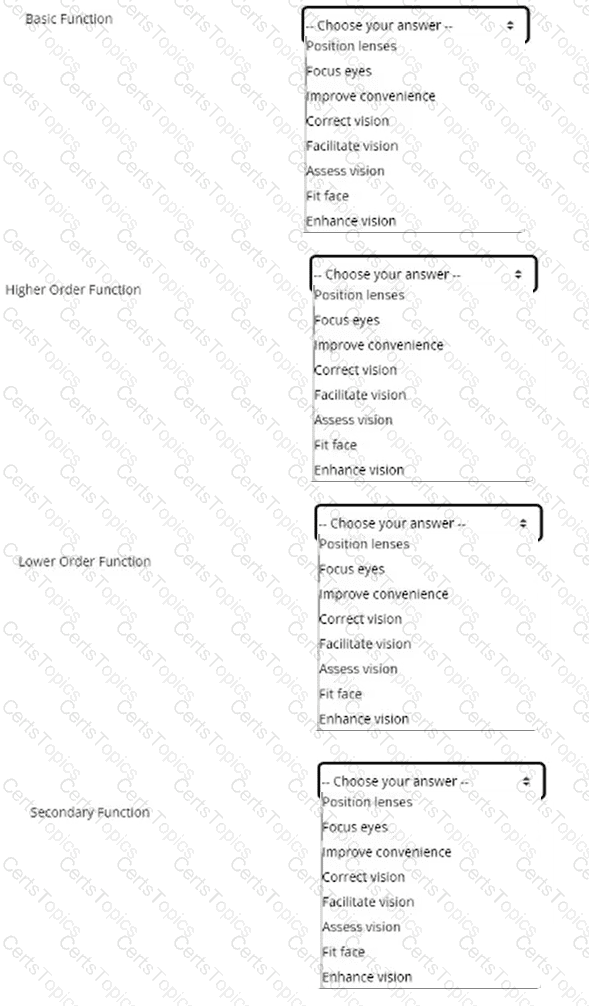
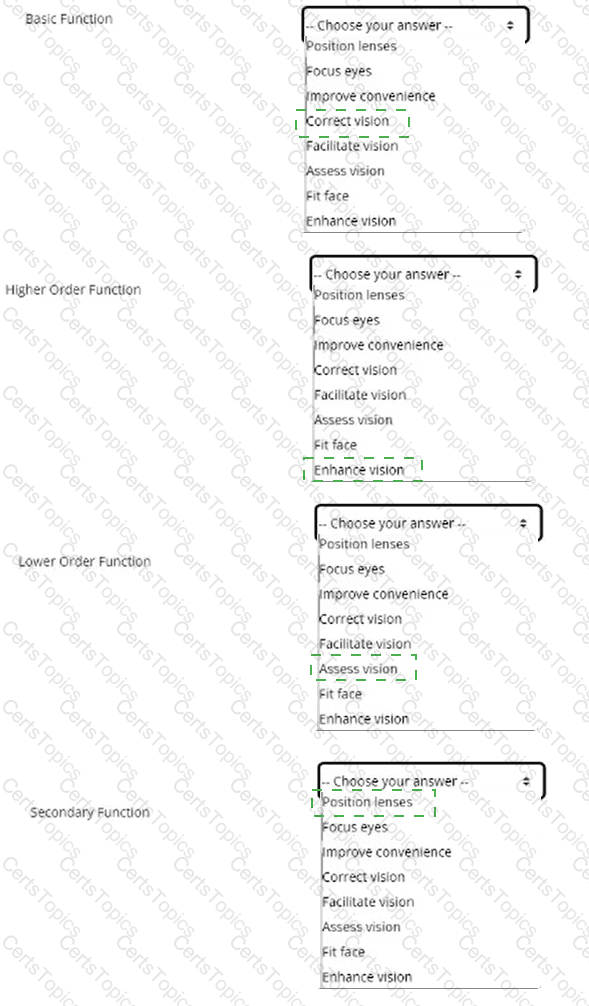
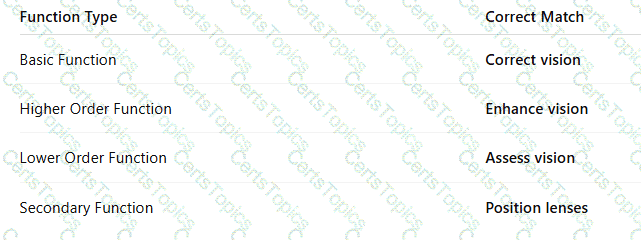
The correct matches are based on formal Function Analysis classification. SAVE defines a function as what a project, product, or process must do, independent of what it is or how it is accomplished, and it should be stated in active verb/measurable noun form. A basic function is the specific purpose for which the product exists and answers “What must it do?” For prescription eyeglasses, that purpose is Correct vision . SAVE’s function-analysis examples for spectacles also classify Correct Vision as the basic function.
A higher order function represents the broader need or outcome that causes the basic function to exist. Correcting vision exists to Enhance vision , so that is the best higher-order match. A lower order function is outside the study scope and represents a required input. For prescription eyeglasses, the prescription must be determined first; therefore Assess vision is the best lower-order function. A secondary function supports the basic function and results from the selected design approach. In eyeglasses, the frames, bridge, arms, and related hardware support the basic function by Positioning lenses correctly in front of the eyes. “Fit face” is also a supporting idea, but it is less direct than “Position lenses” for this one-slot secondary classification.
References/topics: Function Analysis Phase; Basic Function; Higher Order Function; Lower Order Function; Secondary Function; FAST Logic.
The left project scope line is located between the
Subject objectives and all-the-time functions
Secondary and lower order functions
Higher order and basic functions
Basic and secondary functions
The correct answer is C. Higher order and basic functions . In FAST diagramming, the project scope is shown by vertical scope lines that define the portion of the function logic included in the value study. The left project scope line separates the broader reason for the study from the functions that are actually inside the study boundary.
The higher order function is placed outside the left scope line because it answers the “why” question for the basic function. It represents the larger objective or purpose that the basic function supports. FAST guidance states that highest-order functions appear outside the left scope line and to the left of the basic functions. ( )
The basic function is placed immediately to the right of the left scope line. It represents the primary purpose or mission of the subject under study. The FAST reference specifically states that basic functions immediately to the right of the left scope line represent the purpose or mission of the subject. ( )
Therefore, the left project scope line is located between the higher order function and the basic function .
References/topics: Function Analysis Phase; FAST Diagramming; Project Scope Line; Higher Order Function; Basic Function; How/Why Logic.
What does VOC stand for?
Value of concepts
Voice of the customer
Voice of the client
Value of communications
VOC stands for Voice of the Customer . In Value Methodology, VOC is primarily associated with the Information Phase , where the VM team gathers, organizes, reviews, and transforms information before moving into Function Analysis. SAVE International’s Core Competencies specifically place “Voice of the customer” under Information Phase — Apply methods to transform information , tied to VM Guide Section 5.4.1 . ( )
The purpose of VOC is to capture what customers, users, owners, and stakeholders actually need, value, expect, and consider important. This is critical because VM does not define value only from the designer’s, supplier’s, or facilitator’s perspective. Instead, value must be interpreted through customer-required functions, performance expectations, quality needs, constraints, and acceptance criteria. Option C, “voice of the client,” is too narrow because the client may be only one stakeholder, while VOC reflects the broader customer/user value perspective. Options A and D are not recognized VM terms in this context.
References/topics: Information Phase; Voice of the Customer; Transforming Information; Customer Requirements; Value Determination.
During the Implementation Phase, the project manager is tasked to ensure compliance with internal tracking and auditing procedures. Which action would most effectively demonstrate the application of tracking and audit knowledge and skills?
Develop a training manual for new employees on how to use the project management system, but do not include tracking procedures.
Implement a weekly status update meeting where project milestones are discussed, but focus solely on outcomes without auditing the processes used.
Conduct regular audits of project documents to confirm all data entries are accurate and compliant with company standards.
Only review audit logs at the end of the project to assess compliance and make necessary adjustments for future projects.
The correct answer is C because it directly applies both tracking and audit controls during the Implementation Phase. The CVS/SAVE Value Methodology guidance defines Implementation Activities as ensuring that accepted value alternatives are actually implemented and that the projected benefits are realized. It also identifies implementation responsibilities such as establishing action plans, obtaining commitments, setting review timeframes, tracking value achievement, signing off deliverables, validating benefits, and managing the implementation plan. ( )
Regular audits of project documentation are the most effective action because they verify that recorded data is accurate, current, traceable, and compliant with internal procedures while implementation is still active. This supports corrective action in real time rather than after-the-fact discovery. Option A is incomplete because it excludes tracking procedures. Option B monitors milestones but deliberately avoids auditing the process, which weakens compliance assurance. Option D is reactive and delayed; reviewing logs only at project close does not adequately control implementation performance or prevent noncompliance during execution. The SAVE study guide also emphasizes the value tracking process and tracking implementation results as part of VM program discipline. ( )
References/topics: Implementation Phase; Value Tracking Process; Implementation Plan; Follow-Up Activities; VM Program Reporting.
A VM study team member arrives with new information during the development of VM proposals. What should the VM facilitator do?
Choose 2 answers.
Assess the information with the VM team.
Discuss the information with the study subject program manager.
Develop a new VM proposal.
Disregard the information.
The correct answers are A and B . During the Development Phase , the VM team is converting selected ideas into value alternatives, so any new information that affects assumptions, cost, risk, performance, stakeholder impact, or feasibility must be evaluated before the proposal is finalized. SAVE’s Study Guide explains that each Job Plan phase provides information needed for the next phase and that, as the team gains additional knowledge, a previous phase may be revisited. ( ) Therefore, the facilitator should first assess the information with the VM team to determine whether it changes the rationale, calculations, risk profile, or viability of any proposal.
The facilitator should also discuss the information with the study subject program manager because the information may affect scope, owner requirements, baseline assumptions, implementation constraints, or management expectations. In the Development Phase, value alternatives must be clearly written with supporting assumptions, calculations, vendor information, cost comparisons, and other information needed to convey the alternative. ( )
Option C is premature because new information does not automatically require a new proposal. Option D is incorrect because disregarding relevant information undermines proposal credibility and informed decision-making.
References/topics: Development Phase; Value Alternative Development; Facilitator Responsibilities; Proposal Validation; VM Team Coordination.
A company wants to add a new product to its manufacturing process. Who should provide input as this new product will affect the current manufacturing process?
Choose 3 answers.
Marketing
Maintenance
Production
Human resources
Engineering
The correct answers are Maintenance, Production, and Engineering . In the Preparation Phase, the VM Facilitator must ensure that the right stakeholders and technical participants are involved before the study begins. SAVE describes Value Methodology as a systematic process performed by a multidisciplinary team led by a qualified facilitator to improve value. ( Value Engineering ) The selected participants should represent the areas directly affected by the subject under study.
Because the new product affects the current manufacturing process , the most relevant input must come from those who understand the physical process, equipment, workflow, capacity, and technical requirements. Production provides knowledge of daily operations, labor flow, throughput, bottlenecks, quality issues, and feasibility on the shop floor. Maintenance provides input on machine reliability, downtime risk, service access, preventive maintenance needs, and equipment limitations. Engineering contributes design, tooling, process capability, specifications, manufacturability, and technical integration.
Marketing may help define customer demand or product positioning, but the question specifically focuses on manufacturing-process impact. Human resources may support staffing or training later, but it is not one of the primary technical input sources for process change.
References/topics: Preparation Phase; Team Selection; Stakeholder Involvement; Multidisciplinary Team; VM Facilitation.
During the Presentation Phase, the team leader should primarily do which of the following?
Document and communicate developed alternatives and value improvement opportunities
Begin random function identification
Generate all possible alternatives without evaluation
Replace the owner’s decision-making authority
The correct answer is A . SAVE’s VM Standard defines the Presentation Phase as the phase where the team leader develops a report and/or presentation that documents and conveys the adequacy of the developed alternatives and the associated value improvement opportunity. The purpose is to communicate recommendations clearly so decision makers can assess whether to accept, modify, defer, or reject them.
Option B belongs to Function Analysis. Option C belongs to Creativity. Option D is wrong because the VM team recommends; it does not take over governance or ownership authority. A strong CVS-level presentation must be technically credible and management-focused. It should explain what is recommended, why the alternative satisfies required functions, how it affects performance and risk, what costs change, what life-cycle benefits are expected, and what implementation actions are required. The Presentation Phase is not a sales pitch based on vague savings claims. It is a disciplined transfer of decision-ready information from the VM team to accountable decision makers.
References/topics: Presentation Phase; VM Report; Decision-Maker Communication.
Which of the following are techniques the VM facilitator might use for a VM study team that is having difficulty completing the FAST diagram?
Choose 2 answers.
Ask the VM study team if a function is missing
Reorganize the functions for the VM study team
Make sure all identified functions are used
Review level of abstraction
The correct answers are A and D . When a VM study team struggles to complete a FAST diagram, the facilitator should guide the team through questioning, not take control of the technical work. Asking whether a function is missing is an appropriate facilitation technique because a break in the How/Why logic often means the team has skipped a needed function, used an unclear verb-noun statement, or failed to connect a supporting function to a higher-order function. This keeps ownership with the team while helping them complete the logic chain.
Reviewing the level of abstraction is also correct. FAST diagramming requires functions to be placed at the right level: not too broad, not too detailed, and consistent with the project scope. If one function is stated at a strategic level and another at a component-detail level, the FAST diagram becomes difficult to organize.
Option B is incorrect because the facilitator should not reorganize the functions for the team; that weakens team participation and ownership. Option C is incorrect because not every identified function must appear in the final FAST diagram. Only functions that support the logical function model should be used.
References/topics: Function Analysis Phase; FAST Diagramming; Facilitation; Function Logic; Level of Abstraction.
Subject information:
Service Life = 12 years
Fuel = $9.00 per liter
Annual kilometers driven = 40,000 kilometers
Car A: Paid $40,000 , needs batteries every two years at $600 , needs tires every two years at $1,000 , fuel efficiency = 10 kilometers per liter .
Car B: Paid $50,000 , needs tires every two years at $2,000 , fuel efficiency = 15 kilometer per liter .
Car C: Paid $60,000 , needs tires every two years at $4,000 , fuel efficiency = 20 kilometer per liter .
What are the repair and replacement costs for Car B for the service life of the vehicle?
$6,000
$12,000
$10,000
$4,000
The correct answer is B. $12,000 . This question asks only for the repair and replacement costs of Car B , not the full life-cycle cost. Therefore, the initial purchase price of $50,000 and the fuel cost data are irrelevant for this specific calculation. The only repair/replacement item listed for Car B is tires every two years at $2,000 .
The service life is 12 years . Since tires are replaced every 2 years , the number of replacement cycles is:
12 years ÷ 2 years = 6 replacement cycles
The total repair and replacement cost is therefore:
6 × $2,000 = $12,000
Option A. $6,000 would represent only three tire replacements, which does not cover the full 12-year service life. Option C. $10,000 would represent five replacements; that approach would exclude the final two-year replacement interval, but this question’s wording asks for costs for the service life , so the full 12-year period is counted. Option D. $4,000 covers only two replacement cycles and is clearly incomplete.
In the Evaluation Phase, the CVS candidate must separate initial cost , annual operating cost , and periodic repair/replacement cost before performing life-cycle calculations. This question isolates the periodic replacement-cost component only.
References/topics: Evaluation Phase; Life-Cycle Cost; Repair and Replacement Costs; Recurrent Cost; Cost Classification.
Which of the following should the project manager use to support the implementation of proposals?
Choose 2 answers.
Previously gathered user experiences.
A detailed implementation plan including timelines and resources.
A contingency plan to address potential issues that may arise during implementation.
The implementation plan without assessing current policies and procedures.
The correct answers are B and C . In the VM Job Plan, implementation support requires more than approving an idea; it requires a controlled plan for turning accepted VM proposals into real changes. SAVE’s Value Methodology Standard identifies Create Implementation Plan and Prepare Final Proposals as Development Phase activities, followed by Presentation Phase commitment and Post-Study implementation tracking. ( UW Courses )
A detailed implementation plan is essential because the standard specifically requires an implementation plan with a proposed schedule, implementation activities, team assignments, and management requirements. ( UW Courses ) This directly supports option B . A contingency plan is also appropriate because implementation must account for risk, uncertainty, schedule impact, resource availability, policy limits, and potential barriers. The Development Phase includes implementation requirements that consider risk and uncertainty, making contingency planning a logical implementation-control tool. ( UW Courses )
Option A may be useful background information, but it is not the primary tool for implementing approved proposals. Option D is incorrect because implementation should not proceed blindly without assessing current policies, procedures, constraints, and organizational requirements.
References/topics: Implementation Phase; Development Phase; Implementation Plan; Risk and Uncertainty; Post-Study Implementation.
The VM job plan separates
creative steps from analytical steps.
designers from the VM Team.
cost estimates from functions.
project needs from functions.
The correct answer is A. creative steps from analytical steps . The VM Job Plan is structured so the team does not mix information gathering, function analysis, idea generation, judgment, and proposal development into one uncontrolled discussion. SAVE guidance describes the Job Plan as the process that guides the study team in identifying and focusing on key project functions to create ideas that result in value improvement. ( )
This separation is important because the Creative Phase requires free idea generation without premature criticism, feasibility judgment, or cost filtering. The Evaluation Phase then applies analytical judgment to screen, rank, and select ideas with value potential. The Development Phase further analyzes selected alternatives through cost, performance, risk, and implementation considerations. SAVE’s VM Standard also states that a qualifying value study follows an organized Job Plan with defined phases, including Function Analysis, Creative, Evaluation, Development, and Presentation. ( )
Option B is incorrect because designers may be part of the multidisciplinary VM team. Option C is incorrect because cost and function are intentionally related during VM analysis. Option D is incorrect because project needs and functions are also connected; functions express what must be done to satisfy needs.
References/topics: Value Methodology and Job Plan; Creative Phase; Evaluation Phase; Function Analysis; Analytical vs Creative Thinking.
Which of the following are appropriate techniques to achieve the expected output in the Function Analysis Phase?
Choose 2 answers.
Random function identification
Detailed cost analysis
Paired comparison matrix
Process flowchart
FAST diagramming
The correct techniques are Random function identification and FAST diagramming . In the Function Analysis Phase, the team must shift away from describing components, designs, or solutions and instead define what the project, product, or process must do . SAVE’s Value Methodology Standard states that this phase defines project functions using a two-word active verb / measurable noun format and analyzes those functions to determine which require improvement, elimination, or creation. This directly supports random function identification, commonly aligned with Random Function Definition, where the team identifies functions in verb-noun form before classifying and organizing them.
FAST diagramming is also a core Function Analysis technique. The standard function-analysis sequence includes building a function model as a Function Analysis System Technique (FAST) diagram , and the SAVE glossary defines a FAST diagram as a graphical representation of dependent function relationships using How/Why logic. Detailed cost analysis is not the primary technique here; cost is allocated to functions after functions are defined. A paired comparison matrix is more typical of evaluation/prioritization, and a process flowchart belongs more naturally in information/process understanding rather than function modeling.
References/topics: Function Analysis Phase; Random Function Definition; FAST Diagramming; Function Classification; Function Modeling.
Which of the following actions would be appropriate to effectively report lessons learned for a VM program?
Choose 2 answers.
Create a summarized report of lessons learned and share it with the project team.
Store the lessons learned report in a digital folder without any further distribution.
Schedule a meeting with the team to discuss the lessons learned and how they can be applied in future projects.
Ignore the lessons learned discussion since the last project was successful.
The correct answers are A and C . In a VM Program, lessons learned should be captured, communicated, and converted into practical improvement for future value studies. Creating a summarized report and sharing it with the project team is appropriate because it records what worked, what did not work, what assumptions changed, what facilitation issues occurred, and what implementation barriers or success factors were observed.
Scheduling a team meeting is also appropriate because lessons learned are most useful when discussed, validated, and connected to future application. SAVE’s VM Job Plan identifies Post-Study activity as completing changes, implementing changes, and monitoring status, with the objective of assuring implementation of approved recommendations. ( courses.washington.edu ) A lessons-learned review supports that same control mindset by improving future VM planning, team selection, facilitation, proposal development, and implementation follow-through.
Option B is weak because storing a report without distribution does not transfer knowledge. Option D is incorrect because successful projects still produce valuable positive lessons that should be repeated.
References/topics: VM Programs; Post-Study Activities; Lessons Learned; Knowledge Transfer; Continuous Improvement; VM Program Management.
What are effective approaches used by the VM facilitator during the Evaluation Phase?
Choose 2 answers.
Recognize when the group is off-topic and redirect them.
Establish a clear context for the session.
Avoid discussion of additional or modified ideas.
Select a single evaluation technique to be used for the process.
The correct answers are A and B . During the Evaluation Phase , the VM facilitator’s role is to preserve structure, discipline, and decision quality while the team screens creative ideas for value-improvement potential. SAVE’s Value Methodology Standard defines the Evaluation Phase as a structured evaluation process used to select ideas that can improve value while still delivering required functions and respecting performance requirements and resource limits. ( )
Therefore, the facilitator must recognize when discussion becomes off-topic and redirect the group toward the agreed evaluation criteria, study objectives, required functions, and constraints. This prevents the phase from becoming another brainstorming session or an unstructured debate. The facilitator must also establish a clear context for the session , meaning the team understands what is being evaluated, against which criteria, and for what decision purpose.
Option C is incorrect because evaluation may include clarification, combination, or refinement of ideas; useful modifications should not be automatically blocked. Option D is also incorrect because VM allows tailored application of methods, and the facilitator should select techniques appropriate to the study rather than force one universal technique. ( )
References/topics: Evaluation Phase; VM Facilitation; Idea Screening; Evaluation Criteria; Team Focus and Direction.
Which of the following could a VM facilitator say to stimulate creativity?
Choose 2 answers.
“What does the project manager think of these ideas?”
“What do you wish could have happened or had been done differently?”
“If you could do anything at all to change the study subject, what would that be?”
“Please wait to speak until you are called upon.”
The correct answers are B and C . In the Creativity Phase , the VM facilitator’s role is to stimulate open, unrestricted idea generation. The SAVE Value Methodology Standard states that the Creative Phase aims to develop a large quantity of ideas for performing each selected function, and that this effort should be unconstrained by habit, tradition, negative attitudes, assumed restrictions, and specific criteria. It also states that judgment and evaluation are suspended during this phase. ( courses.washington.edu )
Option B is effective because it invites reflection on missed opportunities and encourages participants to identify improvements without immediately judging feasibility. Option C is also effective because it removes normal constraints and encourages broad, imaginative thinking about the study subject. This matches the Creative Phase principle that free flow of thoughts and ideas is required, without criticism or premature evaluation. ( courses.washington.edu )
Option A is not ideal because it introduces authority influence and may cause the team to conform to the project manager’s view. Option D restricts open participation and weakens creative flow.
References/topics: Creativity Phase; VM Facilitation; Divergent Thinking; Idea Generation; Suspending Judgment.
The decision-makers agreed to implement a VM proposal requiring an organizational change. What should be done to improve success?
Choose 2 answers.
Encourage participation by those affected by the change
Strictly define the implementation plan
Hire a change management consultant
Appoint an oversight committee
The correct answers are A. Encourage participation by those affected by the change and D. Appoint an oversight committee . In the Implementation Phase, the approved VM proposal must be converted from an accepted recommendation into an actual organizational action. When the proposal requires organizational change, technical approval alone is not enough; successful implementation depends heavily on acceptance, ownership, coordination, and follow-through.
Encouraging participation by those affected by the change is essential because employees, managers, operators, and process owners who must live with the change often understand the practical barriers, workflow impacts, training needs, and resistance points. Their involvement improves buy-in and reduces implementation failure.
Appointing an oversight committee is also appropriate because organizational change normally crosses departments, responsibilities, and authority levels. Oversight provides governance, monitors progress, resolves conflicts, confirms accountability, and ensures the approved VM proposal remains aligned with the intended value improvement.
Option B is less suitable because an implementation plan should be clear and controlled, but not so rigid that it prevents adjustment during organizational transition. Option C is not required; a consultant may help in special cases, but it is not a primary VM implementation requirement.
References/topics: Implementation Phase; Change Adoption; Stakeholder Participation; Implementation Governance; VM Proposal Follow-Through.
Which of the following actions demonstrate brainwriting during the Creativity Phase?
Have participants write down their ideas in silence before sharing them verbally with the group.
Encourage participants to speak their ideas out loud as soon as they think of them to foster discussion.
Limit the session to only those ideas that are immediately feasible for implementation.
Distribute a template that prompts participants to build on each other’s ideas instead of developing their own.
The correct answer is A . Brainwriting is an idea-generation technique in which participants first develop ideas individually and silently in written form before the ideas are shared, reviewed, or expanded by the group. This fits the Creativity Phase because the purpose of that phase is to generate a quantity of ideas related to alternative ways of performing required functions. The SAVE Study Guide identifies the Creative Phase purpose as generating “a quantity of ideas” and asks the fundamental question: “How else may the functions be performed?” It also emphasizes establishing rules that protect the creative environment and using group idea-stimulation techniques. ( )
Option B describes verbal brainstorming, not brainwriting. Option C is incorrect because feasibility screening belongs later in the Evaluation Phase; limiting ideas during creativity suppresses innovation. Option D contains a partial brainwriting concept, because some brainwriting methods allow participants to build on others’ ideas, but the wording “instead of developing their own” is too restrictive and does not represent the core method. Brainwriting begins with silent individual idea capture.
References/topics: Creativity Phase; Idea Generation; Creativity Ground Rules; Group Idea-Stimulation Techniques; Brainwriting.
At a VM study implementation meeting the VM facilitator is asked to make a five-minute presentation. The presentation should
focus on the VM study job plan.
explain how the Value Methodology works.
highlight the strengths of each VM team member.
demonstrate that the VM team understood objectives of the VM study.
The correct answer is D. demonstrate that the VM team understood objectives of the VM study . At an Implementation Meeting, the decision-makers are not primarily looking for a training session on Value Methodology or a review of the VM Job Plan. They need confidence that the VM study results are grounded in the actual project objectives, constraints, required functions, and success criteria.
A five-minute presentation must be concise and decision-focused. The facilitator should quickly show that the VM team understood the study scope, owner goals, performance needs, cost drivers, risks, and implementation expectations. This builds credibility before decision-makers review the disposition of VM proposals.
Option A is incorrect because the Job Plan explains the process, but implementation decision-makers need results and alignment, not a phase-by-phase lecture. Option B is also too broad for a five-minute implementation presentation. Option C is inappropriate because the meeting is not about individual team-member recognition. The strongest presentation is one that links the VM recommendations back to the study objectives and shows that the team’s proposals support those objectives.
References/topics: Implementation Phase; Implementation Meeting; VM Proposal Disposition; Study Objectives; Decision-Maker Confidence.
Innovation styles, also known as creativity types, include
Visioning, modifying, and experimenting
Exploring, adapting, and brainstorming
Factfinding, brainstorming, and transforming
Analyzing, testing, and illustrating
The correct answer is A. Visioning, modifying, and experimenting . In the VM Creativity Phase, the facilitator must help the team generate a broad quantity of ideas and alternative ways to perform required functions. The SAVE Study Guide places creativity within the certification body of knowledge and emphasizes divergent thinking, unrestricted idea generation, brainstorming techniques, and suspending judgment until the Evaluation Phase. ( )
Innovation styles, also called creativity types, describe how different people naturally approach idea generation and change. The recognized Innovation Styles model includes Visioning, Modifying, Exploring, and Experimenting . Visioning focuses on ideal future possibilities; modifying improves or refines what already exists; experimenting combines and tests different factors; and exploring seeks new or novel possibilities. ( TrainingEdge )
Option A is the best match because all three listed terms are recognized innovation styles. Option B includes “exploring,” but “adapting” and “brainstorming” are not innovation styles; brainstorming is a creativity technique. Option C and D mix problem-solving or analysis activities with non-style terms.
References/topics: Creativity Phase; Innovation Styles; Divergent Thinking; Team Creativity; VM Facilitation.
There is resistance to a new VM program in an organization. What should a VM program coordinator focus on to increase acceptance of VM?
Explain the difference between VM and other value-improving programs (TRIZ, Lean 6-Sigma, etc.)
Highlight that there are many areas with deficiencies that will be improved by VM.
Prepare a memo for the CEO to sign that requires staff to incorporate VM in all departments.
Identify a few subjects that would benefit from change and recommend a VM study through dialogue with staff.
The correct answer is D. Identify a few subjects that would benefit from change and recommend a VM study through dialogue with staff . When an organization resists a new VM program, the coordinator should build acceptance through participation, relevance, and early demonstrated value—not by forcing compliance or emphasizing deficiencies.
SAVE’s Study Guide describes VM as a systematic process used by a multidisciplinary team to improve value through function analysis, with value improvement achieved by identifying alternate ways to accomplish required functions. ( ) This means VM acceptance is strongest when people see how the method applies to real organizational problems. The Study Guide also emphasizes that management should support resources and implementation, while affected parties should be involved early to gain maximum benefit from a Value Study. ( )
Option A may help education, but it does not directly overcome resistance. Option B can sound accusatory and may increase defensiveness. Option C creates top-down compliance, not genuine acceptance. Option D is best because it uses dialogue, selects practical pilot opportunities, and allows staff to experience VM as useful rather than imposed.
References/topics: VM Programs; Program Acceptance; Value Manager Role; Stakeholder Engagement; Organizational Change; Value Study Selection.
A RACI matrix identifies
Choose 3 answers.
what reasonable information is to be provided.
threats and opportunities.
weighted performance attributes.
level of stakeholder involvement in activities.
stakeholders required to provide feedback.
The correct answers are A, D, and E . A RACI matrix is a facilitation and stakeholder-management tool used to clarify how individuals or stakeholder groups participate in activities, tasks, deliverables, or decisions. In VM practice, this supports the facilitator’s responsibility to coordinate participation, communication, and accountability across the multidisciplinary study environment. The SAVE Study Guide emphasizes that VM is performed through a systematic process by a multidisciplinary team and that proper stakeholder participation is necessary to capture real needs versus wants and achieve maximum value. ( )
A RACI matrix identifies the level of stakeholder involvement in activities by assigning roles such as Responsible, Accountable, Consulted, and Informed. It also identifies stakeholders required to provide feedback, which aligns with the Consulted role. Cornell’s RACI definition describes Consulted parties as people whose opinions are sought and who provide knowledge or information before a decision is made. It also describes Informed parties as stakeholders kept updated on progress, process execution, and quality. ( it.cornell.edu ) Therefore, the matrix also helps identify what reasonable information should be provided to stakeholders. Threats and opportunities belong to risk or SWOT analysis, while weighted performance attributes belong to criteria weighting or evaluation methods.
References/topics: VM Facilitation; Stakeholder Engagement; Communication Planning; Team Roles and Responsibilities; RACI Matrix.
Which type of cost is calculated for study items by multiplying the unit cost by the number of units produced per year?
Total costs
Life-cycle costs
Incremental unit costs
Annualized costs
The correct answer is D. Annualized costs . In VM cost analysis, when a study item has a known unit cost and a known annual production quantity , multiplying the two gives the cost impact over one year. That makes the result an annualized cost , because the calculation converts a per-unit value into a yearly cost basis.
This distinction is important in manufacturing or repetitive-process VM studies. A component may appear inexpensive on a unit basis, but if it is used thousands or millions of times per year, its annualized cost may become a major value-improvement target. SAVE’s VM Glossary defines cost as the monetary valuation of resources consumed in the production or delivery of a project, product, or process, and it also recognizes annualized cost as a cost expression used in life-cycle cost measurement. ( )
Option A, total costs , is too broad because it may include many cost categories and periods. Option B, life-cycle costs , covers acquisition, operation, maintenance, replacement, and disposal over time. Option C, incremental unit costs , concerns the cost of an additional unit, not annual volume impact.
References/topics: Information Phase; Cost Data; Cost Modeling; Annualized Costs; Manufacturing Study Items.
Carpet and vinyl tile are acceptable alternatives for an owner to cover 1,000 square meters of floor. Carpet installation cost is $30 per square meter. What is the initial cost of the carpet?
$30,000
$32,500
$33,000
$36,000
The correct answer is A . Initial cost is the acquisition, construction, production, or installation expenditure incurred at the start of the alternative’s life. SAVE’s dictionary defines initial cost as the initial expenditure of resources to develop, acquire, produce, or construct a project, product, or process, and notes that it is interchangeable with capital cost.
Here, the calculation is direct:
1,000 square meters × $30 per square meter = $30,000.
The maintenance costs, shampooing cost, service life, and vinyl data are not needed for this specific question because it asks only for the initial cost of carpet , not the life-cycle cost. Options B, C, and D incorrectly include additional amounts or appear to mix operating/maintenance costs with initial cost. In CVS-style questions, the trap is often to include irrelevant life-cycle data. A disciplined evaluator first identifies the cost category being requested: initial cost, recurrent annual cost, single expenditure, salvage value, present worth, annualized cost, or total life-cycle cost.
References/topics: Evaluation Phase; Initial Cost; Life-Cycle Cost Analysis.
Which of the following actions would be appropriate for creating an effective evaluation framework?
Choose 2 answers.
Conduct evaluations during the Creativity Phase.
Define clear objectives and success criteria that align with the subject goals.
Use the VM team's gut feel index.
Involve stakeholders in the evaluation process.
The correct answers are B and D . An effective evaluation framework in Value Methodology must be structured, objective, and aligned with the subject’s purpose. The SAVE Value Methodology Standard describes the Evaluation Phase as the point where the team follows a structured process to select ideas with value-improvement potential while delivering required functions and considering performance requirements and resource limits. ( )
Therefore, the facilitator and team must first define clear objectives and success criteria that align with the study subject’s goals. Evaluation cannot be based on preference alone; criteria should connect to function, performance, cost, schedule, risk, quality, user needs, and implementation feasibility. Involving stakeholders is also appropriate because stakeholders help confirm whether the evaluation criteria reflect actual project, customer, owner, or user priorities. Their participation improves acceptance of selected ideas and reduces resistance during later development and implementation.
Option A is incorrect because the Creativity Phase is intended for generating ideas, not judging them. Introducing evaluation too early suppresses divergent thinking. Option C is incorrect because a “gut feel index” is informal and subjective, while VM requires disciplined, traceable evaluation methods.
References/topics: Evaluation Phase; Evaluation Criteria; Stakeholder Engagement; VM Job Plan; Structured Idea Screening.
When a higher discount rate is used to calculate life cycle costs, which change occurs to the value of money over time?
The discount rate is not needed.
There is no change.
The life cycle cost is increased.
The life cycle cost is reduced.
The correct answer is D. The life cycle cost is reduced . In Value Methodology, life cycle cost analysis is used to compare alternatives over the full ownership period, not just by initial cost. Future costs such as operation, maintenance, replacement, repair, and disposal are converted to present value using a discount rate. When the discount rate is higher, future costs are discounted more heavily, meaning their present value becomes smaller.
This does not mean the actual future cash payment disappears; it means that, in present-value terms, money spent in the future is worth less today. Therefore, increasing the discount rate reduces the present value of future cost streams and normally lowers the calculated present-value life cycle cost, especially for alternatives with large costs occurring later in the study period.
Option A is incorrect because discounting is essential when costs occur at different times. Option B is incorrect because changing the discount rate directly changes present-value calculations. Option C is incorrect because a higher discount rate does not increase the present value of future costs; it reduces them.
References/topics: Development Phase; Life Cycle Costing; Economic Analysis; Present Value; Discount Rate; VM Proposal Development.
Which of the following assists the VM Facilitator in creating a collaborative client relationship?
Choose 3 answers.
Diagnosing client needs and creating appropriate VM Job Plan elements to achieve intended outcomes
Focusing on structure
Analyzing organizational involvement
Dictating tasks, deliverables, roles, and responsibilities
Clarifying mutual involvement
The correct answers are A, C, and E . A VM Facilitator creates a collaborative client relationship by first diagnosing client needs and then tailoring the VM Job Plan to produce the intended outcomes. Value Methodology is not a rigid checklist; it is a systematic, function-oriented team process led by a qualified facilitator to improve value. ( Value Engineering ) Therefore, the facilitator must understand the client’s objectives, constraints, decision environment, and expected deliverables before structuring the study.
Analyzing organizational involvement is also essential because successful VM depends on the correct sponsor, decision-makers, technical experts, users, and stakeholders being involved at the right level. The SAVE certification study material identifies Pre-Workshop responsibilities such as identifying team members, obtaining commitment, and preparing the study structure. ( )
Clarifying mutual involvement completes the collaborative relationship by defining how the facilitator, client, sponsor, team, and management will participate. This builds shared ownership and prevents misunderstanding. Option B is too narrow because structure alone does not create collaboration. Option D is incorrect because “dictating” tasks and responsibilities is directive, not collaborative.
References/topics: VM Facilitation; Client Relationship; Preparation Phase; Team Dynamics; VM Job Plan Planning.
On the Function Logic Path, how do prescription eyeglasses correct vision?
Minimize weight
Secure position
Improve durability
Align focus
The correct answer is D. Align focus . In Function Analysis, the team defines what the subject must do, not what its parts are. SAVE’s study guidance states that functions are described using two-word active verb/measurable noun pairings, and FAST is used to show how project functions relate to each other. ( )
For prescription eyeglasses, the basic function is correct vision . On the Function Logic Path, the “how” question asks: How do eyeglasses correct vision? The best functional answer is align focus because prescription lenses bend and direct light so the image focuses correctly for the user. This directly supports the basic function.
The other choices are supporting or secondary functions. Secure position helps hold the glasses properly on the face, but it does not itself correct vision. Minimize weight improves comfort, and improve durability supports dependability, but neither explains the direct functional mechanism of vision correction. FAST logic is specifically used to map these function relationships through How/Why reasoning, making align focus the correct lower-order function linked to “correct vision.” ( )
References/topics: Function Analysis Phase; FAST Diagramming; Function Logic Path; Basic Function; Lower-Order Function.
What should the VM facilitator consider for the presentation format?
Choose 2 answers
Presentation environment and location
Who should present VM proposals
The technical experience of the audience
The type of PowerPoint presentation
The correct answers are A. Presentation environment and location and C. The technical experience of the audience . In the Presentation Phase, the facilitator must shape the format so the VM results can be clearly understood by decision-makers and stakeholders. SAVE’s Value Methodology Standard states that the team leader develops a report and/or presentation that documents and conveys the adequacy of the developed alternatives and their associated value improvement opportunity. ( )
The presentation environment and location matter because format choices depend on whether the presentation is in-person, virtual, formal, informal, executive-level, workshop-style, or held in a room with limited display or discussion capability. The facilitator must ensure the setting supports clear communication, graphics, interaction, and decision-making.
The technical experience of the audience is also essential. Highly technical reviewers may need detailed assumptions, calculations, drawings, and risk explanations. Senior executives may need a concise value case, cost impact, implementation effect, and decision options.
Option B concerns presenter assignment, not presentation format. Option D is too narrow; PowerPoint is only one possible delivery tool and does not define the proper VM presentation format.
References/topics: Presentation Phase; VM Report and Presentation; Audience Analysis; Presentation Environment; Decision-Maker Communication.
The decision makers cling to familiar ways and reject all the VM proposals. What strategy could the VM facilitator use to persuade them to reconsider their decisions?
Identify areas of instability.
Repeat the VM study with new team members.
Provide information only as required to reduce the potential for discomfort.
Identify how to modify behaviors in the context of the new situation.
The correct answer is D. Identify how to modify behaviors in the context of the new situation . This question is testing the facilitator’s understanding of resistance to change during VM implementation or decision acceptance. When decision makers cling to familiar methods and reject all VM proposals, the problem is not necessarily the technical quality of the proposals. It is usually behavioral resistance caused by uncertainty, loss of comfort, perceived risk, or attachment to existing practices.
A VM facilitator should not simply repeat the study or replace the team. The facilitator should help decision makers understand how the recommended change can be adopted in practical terms. This includes showing what behaviors, processes, responsibilities, and decision patterns need to change under the new situation.
Option A is incorrect because identifying instability may increase concern rather than reduce resistance. Option B is inefficient and does not address the root cause. Option C is also weak because withholding information can reduce trust. The better VM facilitation strategy is to guide decision makers through the behavioral transition required for successful acceptance.
References/topics: VM Facilitation and Team Dynamics; Change Management; Resistance to Change; Decision-Maker Acceptance; Implementation Phase.
Which is the least appropriate information to include in the Presentation?
Recommended proposals
VM study scope and goals
Expected implementation decisions
Recognition of VM study contributors
The correct answer is D. Recognition of VM study contributors . The Presentation Phase is intended to communicate the developed VM recommendations to decision makers in a way that supports approval, concurrence, and movement toward implementation. SAVE’s Value Methodology Standard states that the team leader develops a report and/or presentation that documents the adequacy of the developed alternatives and the associated value improvement opportunity.
Therefore, recommended proposals are central to the presentation. The VM study scope and goals are also appropriate because decision makers need to understand the boundaries, objectives, assumptions, and basis of the study. Expected implementation decisions are also relevant because the presentation should help management determine whether alternatives should proceed, require more information, or be rejected. The Presentation Phase is specifically tied to obtaining concurrence and commitment to proceed with implementation recommendations.
Recognition of contributors may be professionally courteous and can appear in a report appendix, closing remarks, or acknowledgments section, but it is not essential technical content for decision making. Compared with scope, goals, recommendations, and implementation decisions, it is the least appropriate core information for the VM presentation.
References/topics: Presentation Phase; VM Report; Recommended Proposals; Implementation Commitment; Decision-Maker Communication.
Which statement best describes a FAST diagram?
A schedule network used to calculate project float
A graphical model showing dependent relationships among functions
A cost spreadsheet used to calculate inflation
A procurement chart showing supplier lead times
The correct answer is B . FAST stands for Function Analysis System Technique. SAVE defines a FAST diagram as a graphical representation of dependent relationships of functions within a project, product, or process. The diagram uses logical relationships such as “How,” “Why,” and “When” to organize functions. It is a core Function Analysis tool because it forces the team to examine why functions exist, how they are accomplished, and which functions lie on the critical function logic path.
Option A is incorrect because schedule networks belong to project scheduling, not function modeling. Option C is wrong because cost spreadsheets may support resource analysis, but they do not show functional dependency logic. Option D is a procurement management artifact. FAST is valuable because it shifts the team from objects and components to function relationships. This enables better creativity because the team can ask, “How else can we perform this function?” rather than merely asking, “How can we make this component cheaper?”
References/topics: FAST Diagram; Function Analysis System Technique; How-Why Logic.
A baseline design has a function cost of $120,000 and the team estimates the function worth at $80,000. Using VI = FC ÷ FW, what is the Value Index?
0.67
1.00
1.50
2.00
The correct answer is C . Using the stated formula, Value Index = Function Cost ÷ Function Worth = $120,000 ÷ $80,000 = 1.50 . SAVE’s dictionary defines Function Cost as the directly related resources allocated to a function and Function Worth as the lowest overall cost to perform a function without regard to criteria or code. It also defines Value Index as the monetary relationship of function cost to function worth, expressed as FC ÷ FW, where good value is VI ≤ 1.0.
Option A reverses the formula and calculates FW ÷ FC. Option B would mean cost equals worth, which is not true here. Option D has no mathematical basis from the numbers given. A VI of 1.50 indicates a value mismatch: the current function cost exceeds the function worth. This does not automatically mean the function should be eliminated, but it does identify a strong candidate for creativity and evaluation. CVS candidates must be careful because some older materials express the ratio in reverse; the exam stem controls the formula.
References/topics: Evaluation Phase; Function Cost; Function Worth; Value Index.
Which approaches should the VM facilitator use to encourage innovation?
Choose 2 answers.
Maintaining current systems that work well
Imagining the ideal future by focusing on long-term goals for maximizing future potential
Exploring by discovering new possibilities using ideas from other areas and disciplines
Avoiding the combining and testing of new combinations
The correct answers are B and C . A VM facilitator encourages innovation by moving the team beyond existing assumptions, current habits, and normal organizational boundaries. In the Creativity Phase, SAVE-oriented VM guidance emphasizes generating ideas for all possible ways to accomplish the required functions, rather than defending the existing solution. ( Value Engineering ) The facilitator therefore supports future-focused thinking, where the team imagines an ideal condition and considers long-term potential before judging feasibility. This is consistent with VM practice because creativity must be allowed to expand before evaluation, cost review, or technical screening begins.
Option C is also correct because innovation often comes from cross-disciplinary transfer. Borrowing ideas from other industries, technologies, processes, or disciplines helps the team discover alternative ways to perform the required function. The Creative Phase is specifically described as being unconstrained by habit, tradition, negative attitudes, assumed restrictions, and specific criteria. ( UW Courses )
Option A is incorrect because simply maintaining current systems preserves the baseline and limits breakthrough thinking. Option D is incorrect because avoiding combinations and testing prevents idea development and blocks innovation.
References/topics: VM Facilitation; Team Dynamics; Creativity Phase; Innovation; Divergent Thinking; Long-Term Value Potential.
Which of the following strategies should be used to enhance understanding of VM proposals presented during the Presentation Phase?
Choose 2 answers.
Rely solely on the graphics without verbal explanations.
Include as many graphics as possible to showcase creativity.
Use baseline and proposed graphics at a similar level of complexity.
Provide clear explanations and context for each graphic presented.
The correct answers are C and D . In the Presentation Phase, the purpose is not simply to display information, but to communicate the developed VM proposals clearly enough for decision makers to understand the recommendation, its basis, and its value improvement opportunity. SAVE’s Value Methodology Standard states that the Presentation Phase should develop a report and/or presentation that documents and conveys the adequacy of the developed alternatives and their associated value improvement opportunity. ( )
Using baseline and proposed graphics at a similar level of complexity helps the audience compare the current condition against the recommended alternative without distortion. If one graphic is overly detailed and the other is simplified, the comparison may become misleading or difficult to evaluate. Providing clear explanations and context is equally important because graphics alone rarely communicate assumptions, functional trade-offs, cost implications, risks, or implementation constraints.
Option A is incorrect because relying only on graphics removes the technical reasoning needed for acceptance. Option B is also incorrect because excessive graphics can dilute the message and distract from the proposal’s functional and value basis.
References/topics: Presentation Phase; VM Proposal Communication; Baseline vs Proposed Comparison; Decision-Maker Understanding; VM Report and Presentation.
How should the VM facilitator handle “conditionally accepted” VM proposals?
Choose 2 answers.
Identify modifications required for acceptance.
List the VM proposal as accepted.
Ask decision makers for timing of the final decision.
List deficiencies of the VM proposal.
A conditionally accepted VM proposal is not fully approved yet. It means the decision makers see value in the proposal, but acceptance depends on certain changes, clarifications, added data, or further review. Therefore, the facilitator should first identify the modifications required for acceptance . This creates a clear action path and prevents the proposal from being wrongly recorded as fully approved.
The facilitator should also ask decision makers for the timing of the final decision . In VM reporting and implementation follow-up, unresolved proposals must have ownership, required actions, and a decision schedule. Without a timing commitment, conditionally accepted proposals can remain open and lose implementation momentum.
Option B is incorrect because a conditionally accepted proposal is not the same as an accepted proposal. Listing it as accepted would misrepresent the decision status. Option D is weaker because the facilitator should not merely list deficiencies; the correct VM approach is to convert concerns into specific required modifications and next steps.
References/topics: Presentation Phase; Decision Documentation; Proposal Disposition; Implementation Planning; VM Facilitator Responsibilities.
Which of the following are common change drivers?
Choose 3 answers
Organizational culture
Maintaining habits
Technological evolution
Process reviews
Crises
The correct answers are C. Technological evolution, D. Process reviews, and E. Crises . In VM facilitation and change management, a change driver is a force or condition that creates the need for an organization to alter processes, systems, products, services, or behaviors. SAVE’s Value Methodology glossary specifically identifies common change drivers as including technological evolution, process reviews, and crises , along with other external and internal pressures. ( )
Technological evolution drives change because new tools, automation, systems, and digital capabilities can make existing methods outdated or inefficient. Process reviews are also common drivers because structured review often reveals waste, duplication, poor function performance, or value gaps that require improvement. Crises are strong change drivers because urgent disruption, failure, cost pressure, safety issues, or market shock can force rapid organizational response.
Option A, organizational culture, may influence how change is accepted or resisted, but it is not listed here as a primary change driver. Option B, maintaining habits, is usually a resistance behavior, not a driver of change.
References/topics: VM Facilitation and Team Dynamics; Change Management; Change Drivers; Organizational Change; VM Programs.
Which of the following are the effects of increasing the duration of a VM study?
Choose 2 answers.
Site visit duration is unchanged
Additional creative techniques can be used
Numerous FAST diagrams are constructed
Evaluation techniques are more thoughtful
More VM proposals are implemented
The correct answers are B and D . Increasing the duration of a VM study gives the team more working time inside the structured Job Plan. SAVE describes Value Methodology as a structured process following defined phases such as Information, Function Analysis, Creativity, Evaluation, Development, and Presentation. ( Value Engineering ) When more time is available, the team can apply additional creative techniques during the Creativity Phase rather than relying only on basic brainstorming. This may include checklists, attribute listing, analogy, morphological methods, or other structured idea-generation approaches.
A longer study also allows evaluation techniques to be more thoughtful . In the Evaluation Phase, ideas from the Creativity Phase are screened, grouped, compared, ranked, and selected for further development. With more time, the team can apply better criteria, discuss advantages and disadvantages more carefully, consider cost, performance, risk, constructability, operations, and maintenance impacts, and reach stronger consensus.
Option A is incorrect because site-visit time may change depending on study scope and complexity. Option C is incorrect because more duration does not mean numerous FAST diagrams must be produced. Option E is not guaranteed because implementation depends on management approval, feasibility, funding, and follow-through after the study.
References/topics: VM Programs; Study Duration; Creativity Phase; Evaluation Phase; VM Job Plan Planning.
Function analysis is used to
Choose 2 answers.
provide a new understanding of the project.
identify improvements.
create a collaborative environment.
assist individuals with a technical background.
The correct answers are A and B . Function Analysis is used to give the VM team a clearer and often new understanding of the project by describing the project in terms of what it must do , rather than what it currently is . The SAVE International Study Guide identifies Function Analysis as the foundation of Value Methodology and states that functions are identified to describe the work being performed within the study scope. It also explains that functions are expressed through active verb and measurable noun pairings, which supports clear thinking and a shared understanding of functional requirements. ( )
Function Analysis is also used to identify improvements . After defining and naming project functions, the team reviews them to determine which functions may be inefficient, over-costly, or suitable for improvement. The Study Guide further explains that this process allows the team to identify where value improvement opportunities exist in the project. ( ) Creating a collaborative environment is more broadly related to facilitation and team dynamics, not the primary purpose of function analysis. Assisting only individuals with a technical background is incorrect because VM is multidisciplinary.
References/topics: Function Analysis Phase; Function Definition; Functional Requirements; Value Improvement Opportunities; FAST/Function Modeling.
Which of the following is information that is typically documented for “conditionally accepted” VM proposals during the Implementation Meeting?
Choose 3 answers.
Timing of the final decision
Grammar changes to the VM proposals
VM team disagreements
Action required
Responsibilities
The correct answers are A, D, and E . A “conditionally accepted” VM proposal is not rejected, but it is also not fully approved for immediate implementation. It requires follow-up before final acceptance. Therefore, the Implementation Meeting documentation must clearly record what action is required , who is responsible , and when the final decision will be made .
This aligns directly with SAVE’s VM Job Plan logic. The Development Phase requires the team to prepare implementation requirements, including initial cost, life-cycle cost, implementation cost, risk, uncertainty, and schedule impact. It also requires an implementation plan containing the proposed schedule, team assignments, and management requirements. ( UW Courses ) The Presentation Phase then seeks concurrence and commitment from management, and the written report confirms the implementation plan accepted by management. ( UW Courses ) During Post-Study, assignments are made to complete tasks associated with the approved implementation plan. ( UW Courses )
Grammar changes are editorial, not implementation-control information. VM team disagreements may be noted internally if relevant, but they are not the typical required record for conditional acceptance.
References/topics: Implementation Phase; Presentation Phase; Post-Study Activities; Implementation Plan; VM Proposal Follow-Up.
Copyright © 2021-2026 CertsTopics. All Rights Reserved
