A system API is deployed to a primary environment as well as to a disaster recovery (DR) environment, with different DNS names in each environment. A process API is a client to the system API and is being rate limited by the system API, with different limits in each of the environments. The system API's DR environment provides only 20% of the rate limiting offered by the primary environment. What is the best API fault-tolerant invocation strategy to reduce overall errors in the process API, given these conditions and constraints?
What is a key performance indicator (KPI) that measures the success of a typical C4E that is immediately apparent in responses from the Anypoint Platform APIs?
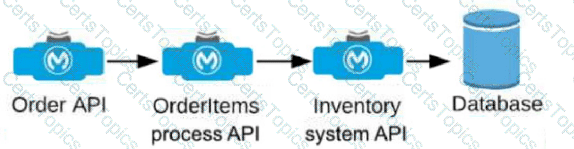
An Order API triggers a sequence of other API calls to look up details of an order's items in a back-end inventory database. The Order API calls the OrderItems process API, which calls the Inventory system API. The Inventory system API performs database operations in the back-end inventory database.
The network connection between the Inventory system API and the database is known to be unreliable and hang at unpredictable times.
Where should a two-second timeout be configured in the API processing sequence so that the Order API never waits more than two seconds for a response from the Orderltems process API?
Say, there is a legacy CRM system called CRM-Z which is offering below functions:
1. Customer creation
2. Amend details of an existing customer
3. Retrieve details of a customer
4. Suspend a customer
The application network is recomposable: it is built for change because it "bends but does not break"
What is true about automating interactions with Anypoint Platform using tools such as Anypoint Platform REST APIs, Anypoint CU, or the Mule Maven plugin?
A company wants to move its Mule API implementations into production as quickly as possible. To protect access to all Mule application data and metadata, the company requires that all Mule applications be deployed to the company's customer-hosted infrastructure within the corporate firewall. What combination of runtime plane and control plane options meets these project lifecycle goals?
A company deployed an API to a single worker/replica in the shared cloud in the U.S. West Region.
What happens when the Availability Zone experiences an outage?
A circuit breaker strategy is planned in order to meet the goal of improved response time and demand on a downstream API.
* Circuit Open: More than 10 errors per minute for three minutes
* Circuit Half-Open: One error per minute
* Circuit Closed: Less than one error per minute for five minutes
Out of several proposals from the engineering team, which option will meet this goal?
What is most likely NOT a characteristic of an integration test for a REST API implementation?
Refer to the exhibit. An organization is running a Mule standalone runtime and has configured Active Directory as the Anypoint Platform external Identity Provider. The organization does not have budget for other system components.
What policy should be applied to all instances of APIs in the organization to most effecuvelyKestrict access to a specific group of internal users?
An API implementation is updated. When must the RAML definition of the API also be updated?
An API client calls one method from an existing API implementation. The API implementation is later updated. What change to the API implementation would require the API client's invocation logic to also be updated?
Mule applications that implement a number of REST APIs are deployed to their own subnet that is inaccessible from outside the organization.
External business-partners need to access these APIs, which are only allowed to be invoked from a separate subnet dedicated to partners - called Partner-subnet. This subnet is accessible from the public internet, which allows these external partners to reach it.
Anypoint Platform and Mule runtimes are already deployed in Partner-subnet. These Mule runtimes can already access the APIs.
What is the most resource-efficient solution to comply with these requirements, while having the least impact on other applications that are currently using the APIs?
A business process is being implemented within an organization's application network. The architecture group proposes using a more coarse-grained application
network design with relatively fewer APIs deployed to the application network compared to a more fine-grained design.
Overall, which factor typically increases with a more coarse-grained design for this business process implementation and deployment compared with using a more fine-grained
design?
A Mule application implements an API. The Mule application has an HTTP Listener whose connector configuration sets the HTTPS protocol and hard-codes the port
value. The Mule application is deployed to an Anypoint VPC and uses the CloudHub 1.0 Shared Load Balancer (SLB) for all incoming traffic.
Which port number must be assigned to the HTTP Listener's connector configuration so that the Mule application properly receives HTTPS API invocations routed through the
SLB?
The implementation of a Process API must change.
What is a valid approach that minimizes the impact of this change on API clients?
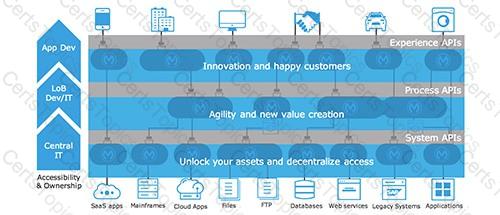
Select the correct Owner-Layer combinations from below options
A developer from the Central IT team has created an initial version of the RAML definition in Design Center for an OAuth 2.0-protected System API and published it
to Exchange. Another developer from LoB IT discovered the System API in Exchange and would like to leverage it in the Process API.
What is the MuleSoft-recommended approach for Process API to invoke the System API?
A new upstream API Is being designed to offer an SLA of 500 ms median and 800 ms maximum (99th percentile) response time. The corresponding API implementation needs to sequentially invoke 3 downstream APIs of very similar complexity.
The first of these downstream APIs offers the following SLA for its response time: median: 100 ms, 80th percentile: 500 ms, 95th percentile: 1000 ms.
If possible, how can a timeout be set in the upstream API for the invocation of the first downstream API to meet the new upstream API's desired SLA?
Refer to the exhibit.
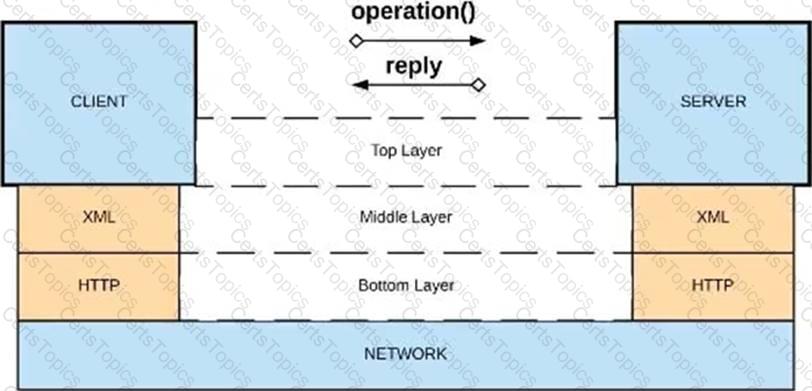
What is a valid API in the sense of API-led connectivity and application networks?
A) Java RMI over TCP
B) Java RMI over TCP
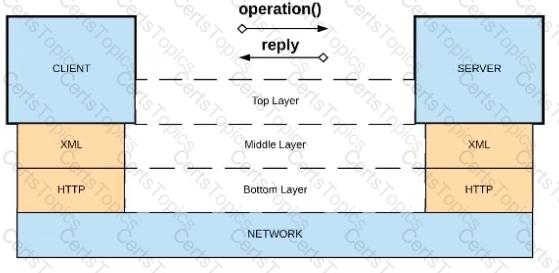
C) CORBA over HOP
D) XML over UDP
A customer has an ELA contract with MuleSoft. An API deployed to CloudHub is consistently experiencing performance issues. Based on the root cause analysis, it is
determined that autoscaling needs to be applied.
How can this be achieved?
In an organization, the InfoSec team is investigating Anypoint Platform related data traffic.
From where does most of the data available to Anypoint Platform for monitoring and alerting originate?
When using CloudHub with the Shared Load Balancer, what is managed EXCLUSIVELY by the API implementation (the Mule application) and NOT by Anypoint Platform?
An online store's marketing team has noticed an increase in customers leaving online baskets without checking out. They suspect a technology issue is at the root cause of the baskets being left behind. They approach the Center for Enablement to ask for help identifying the issue. Multiple APIs from across all the layers of their application network are involved in the shopping application.
Which feature of the Anypoint Platform can be used to view metrics from all involved APIs at the same time?
Question 10: Skipped
An API implementation returns three X-RateLimit-* HTTP response headers to a requesting API client. What type of information do these response headers indicate to the API client?
What API policy would be LEAST LIKELY used when designing an Experience API that is intended to work with a consumer mobile phone or tablet application?
An Anypoint Platform organization has been configured with an external identity provider (IdP) for identity management and client management. What credentials or token must be provided to Anypoint CLI to execute commands against the Anypoint Platform APIs?
An organization wants MuleSoft-hosted runtime plane features (such as HTTP load balancing, zero downtime, and horizontal and vertical scaling) in its Azure environment. What runtime plane minimizes the organization's effort to achieve these features?
A REST API is being designed to implement a Mule application.
What standard interface definition language can be used to define REST APIs?
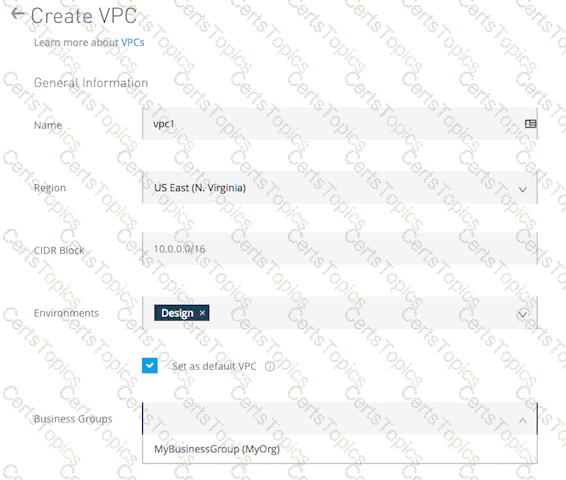
What is true about the technology architecture of Anypoint VPCs?
An organization is deploying their new implementation of the OrderStatus System API to multiple workers in CloudHub. This API fronts the organization's on-premises Order Management System, which is accessed by the API implementation over an IPsec tunnel.
What type of error typically does NOT result in a service outage of the OrderStatus System API?
Refer to the exhibit.
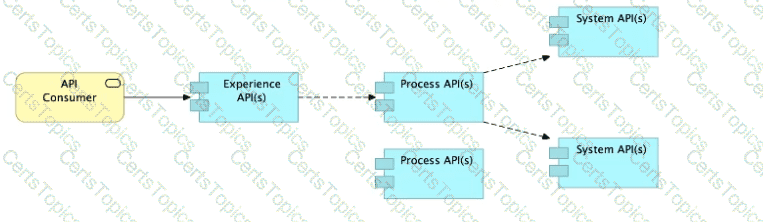
What is the best way to decompose one end-to-end business process into a collaboration of Experience, Process, and System APIs?
A) Handle customizations for the end-user application at the Process API level rather than the Experience API level
B) Allow System APIs to return data that is NOT currently required by the identified Process or Experience APIs
C) Always use a tiered approach by creating exactly one API for each of the 3 layers (Experience, Process and System APIs)
D) Use a Process API to orchestrate calls to multiple System APIs, but NOT to other Process APIs
What condition requires using a CloudHub Dedicated Load Balancer?
What is true about where an API policy is defined in Anypoint Platform and how it is then applied to API instances?
A Rate Limiting policy is applied to an API implementation to protect the back-end system. Recently, there have been surges in demand that cause some API client
POST requests to the API implementation to be rejected with policy-related errors, causing delays and complications to the API clients.
How should the API policies that are applied to the API implementation be changed to reduce the frequency of errors returned to API clients, while still protecting the back-end
system?
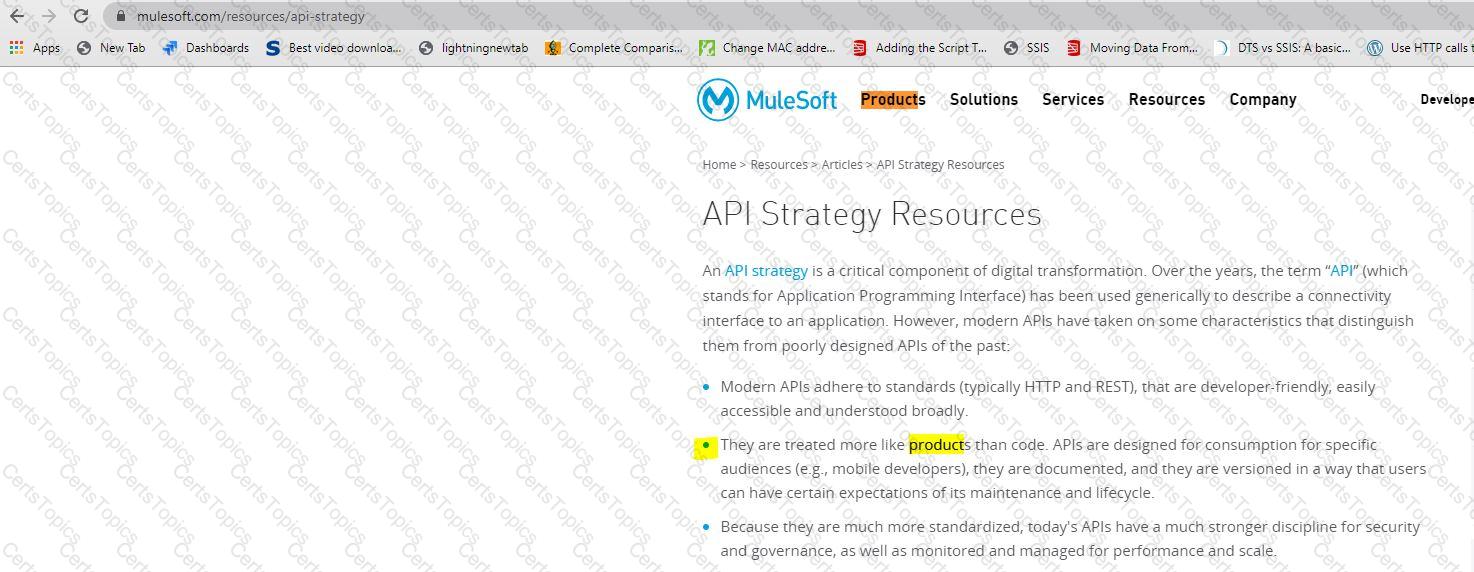
An organization makes a strategic decision to move towards an IT operating model that emphasizes consumption of reusable IT assets using modern APIs (as defined by MuleSoft).
What best describes each modern API in relation to this new IT operating model?
What do the API invocation metrics provided by Anypoint Platform provide?
A Mule 4 API has been deployed to CloudHub and a Basic Authentication - Simple policy has been applied to all API methods and resources. However, the API is still accessible
by clients without using authentication.
How is this possible?
A code-centric API documentation environment should allow API consumers to investigate and execute API client source code that demonstrates invoking one or more APIs as part of representative scenarios.
What is the most effective way to provide this type of code-centric API documentation environment using Anypoint Platform?
An organization has created an API-led architecture that uses various API layers to integrate mobile clients with a backend system. The backend system consists of a number of specialized components and can be accessed via a REST API. The process and experience APIs share the same bounded-context model that is different from the backend data model. What additional canonical models, bounded-context models, or anti-corruption layers are best added to this architecture to help process data consumed from the backend system?
Refer to the exhibit.
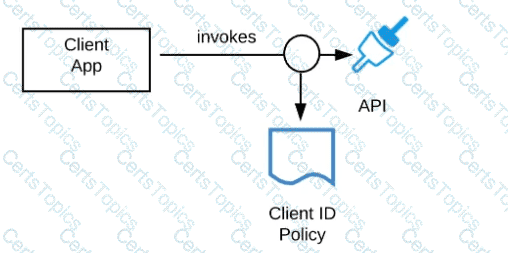
A developer is building a client application to invoke an API deployed to the STAGING environment that is governed by a client ID enforcement policy.
What is required to successfully invoke the API?
When must an API implementation be deployed to an Anypoint VPC?
An organization has implemented a Customer Address API to retrieve customer address information. This API has been deployed to multiple environments and has been configured to enforce client IDs everywhere.
A developer is writing a client application to allow a user to update their address. The developer has found the Customer Address API in Anypoint Exchange and wants to use it in their client application.
What step of gaining access to the API can be performed automatically by Anypoint Platform?
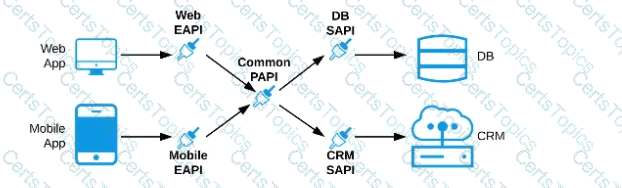
Refer to the exhibit. An organization needs to enable access to their customer data from both a mobile app and a web application, which each need access to common fields as well as certain unique fields.
The data is available partially in a database and partially in a 3rd-party CRM system.
What APIs should be created to best fit these design requirements?

A) A Process API that contains the data required by both the web and mobile apps, allowing these applications to invoke it directly and access the data they need thereby providing the flexibility to add more fields in the future without needing API changes
B) One set of APIs (Experience API, Process API, and System API) for the web app, and another set for the mobile app
C) Separate Experience APIs for the mobile and web app, but a common Process API that invokes separate System APIs created for the database and CRM system
D) A common Experience API used by both the web and mobile apps, but separate Process APIs for the web and mobile apps that interact with the database and the CRM System
Copyright © 2021-2026 CertsTopics. All Rights Reserved