New Year Sale 70% Discount Offer - Ends in 0d 00h 00m 00s - Coupon code: save70

Salesforce MuleSoft-Platform-Architect-I Based on Real Exam Environment

Salesforce Certified MuleSoft Platform Architect (Mule-Arch-201) Questions and Answers

Question 41

An organization has created an API-led architecture that uses various API layers to integrate mobile clients with a backend system. The backend system consists of a number of specialized components and can be accessed via a REST API. The process and experience APIs share the same bounded-context model that is different from the backend data model. What additional canonical models, bounded-context models, or anti-corruption layers are best added to this architecture to help process data consumed from the backend system?

Options:

A.

Create a bounded-context model for every layer and overlap them when the boundary contexts overlap, letting API developers know about the differences between upstream and downstream data models

B.

Create a canonical model that combines the backend and API-led models to simplify and unify data models, and minimize data transformations.

C.

Create a bounded-context model for the system layer to closely match the backend data model, and add an anti-corruption layer to let the different bounded contexts cooperate across the system and process layers

D.

Create an anti-corruption layer for every API to perform transformation for every data model to match each other, and let data simply travel between APIs to avoid the complexity and overhead of building canonical models

Question 42

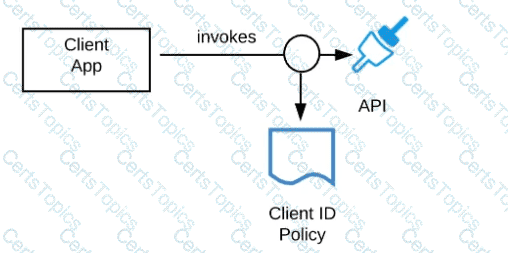
Refer to the exhibit.

A developer is building a client application to invoke an API deployed to the STAGING environment that is governed by a client ID enforcement policy.

What is required to successfully invoke the API?

Options:

A.

The client ID and secret for the Anypoint Platform account owning the API in the STAGING environment

B.

The client ID and secret for the Anypoint Platform account's STAGING environment

C.

The client ID and secret obtained from Anypoint Exchange for the API instance in the STAGING environment

D.

A valid OAuth token obtained from Anypoint Platform and its associated client ID and secret

Question 43

When must an API implementation be deployed to an Anypoint VPC?

Options:

A.

When the API Implementation must invoke publicly exposed services that are deployed outside of CloudHub in a customer- managed AWS instance

B.

When the API implementation must be accessible within a subnet of a restricted customer-hosted network that does not allow public access

C.

When the API implementation must be deployed to a production AWS VPC using the Mule Maven plugin

D.

When the API Implementation must write to a persistent Object Store

Question 44

An organization has implemented a Customer Address API to retrieve customer address information. This API has been deployed to multiple environments and has been configured to enforce client IDs everywhere.

A developer is writing a client application to allow a user to update their address. The developer has found the Customer Address API in Anypoint Exchange and wants to use it in their client application.

What step of gaining access to the API can be performed automatically by Anypoint Platform?

Options:

A.

Approve the client application request for the chosen SLA tier

B.

Request access to the appropriate API Instances deployed to multiple environments using the client application's credentials

C.

Modify the client application to call the API using the client application's credentials

D.

Create a new application in Anypoint Exchange for requesting access to the API