New Year Sale 70% Discount Offer - Ends in 0d 00h 00m 00s - Coupon code: save70

MuleSoft-Platform-Architect-I VCE Exam Download

Salesforce Certified MuleSoft Platform Architect (Mule-Arch-201) Questions and Answers

Question 17

The implementation of a Process API must change.

What is a valid approach that minimizes the impact of this change on API clients?

Options:

A.

Update the RAML definition of the current Process API and notify API client developers by sending them links to the updated RAML definition

B.

Postpone changes until API consumers acknowledge they are ready to migrate to a new Process API or API version

C.

Implement required changes to the Process API implementation so that whenever possible, the Process API's RAML definition remains unchanged

D.

Implement the Process API changes in a new API implementation, and have the old API implementation return an HTTP status code 301 - Moved Permanently to inform API clients they should be calling the new API implementation

Question 18

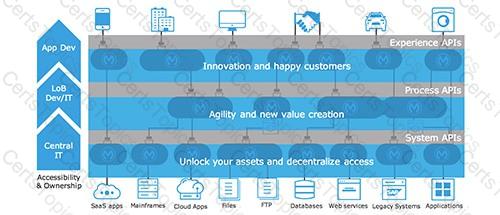
Select the correct Owner-Layer combinations from below options

Options:

A.

1. App Developers owns and focuses on Experience Layer APIs2. Central IT owns and focuses on Process Layer APIs3. LOB IT owns and focuses on System Layer APIs

B.

1. Central IT owns and focuses on Experience Layer APIs2. LOB IT owns and focuses on Process Layer APIs3. App Developers owns and focuses on System Layer APIs

C.

1. App Developers owns and focuses on Experience Layer APIs2. LOB IT owns and focuses on Process Layer APIs3. Central IT owns and focuses on System Layer APIs

Question 19

A developer from the Central IT team has created an initial version of the RAML definition in Design Center for an OAuth 2.0-protected System API and published it

to Exchange. Another developer from LoB IT discovered the System API in Exchange and would like to leverage it in the Process API.

What is the MuleSoft-recommended approach for Process API to invoke the System API?

Options:

A.

The Process API needs to import an CAuth 2.0 module from Exchange first and update it with OAuth 2.0 credentials before the System API can be invoked

B.

The Process API uses property YAML files to store the System API URLs and uses the HTTP Request Connector to invoke the Systerm API

C.

The Process APL uses the REST Connect Connector autogenerated in Exchange for the System API

D.

The Process API manually updates the Process API POM file to include the System API as a dependency

Question 20

A new upstream API Is being designed to offer an SLA of 500 ms median and 800 ms maximum (99th percentile) response time. The corresponding API implementation needs to sequentially invoke 3 downstream APIs of very similar complexity.

The first of these downstream APIs offers the following SLA for its response time: median: 100 ms, 80th percentile: 500 ms, 95th percentile: 1000 ms.

If possible, how can a timeout be set in the upstream API for the invocation of the first downstream API to meet the new upstream API's desired SLA?

Options:

A.

Set a timeout of 50 ms; this times out more invocations of that API but gives additional room for retries

B.

Set a timeout of 100 ms; that leaves 400 ms for the other two downstream APIs to complete

C.

No timeout is possible to meet the upstream API's desired SLA; a different SLA must be negotiated with the first downstream API or invoke an alternative API

D.

Do not set a timeout; the Invocation of this API Is mandatory and so we must wait until it responds