
The main objective of security policies is to reduce the intrusion success rate and detect attackers. To ensure that detection and prevention are performed throughout the attack lifecycle, a series of plans need to be made. Which of the following statements is false about security policy planning?
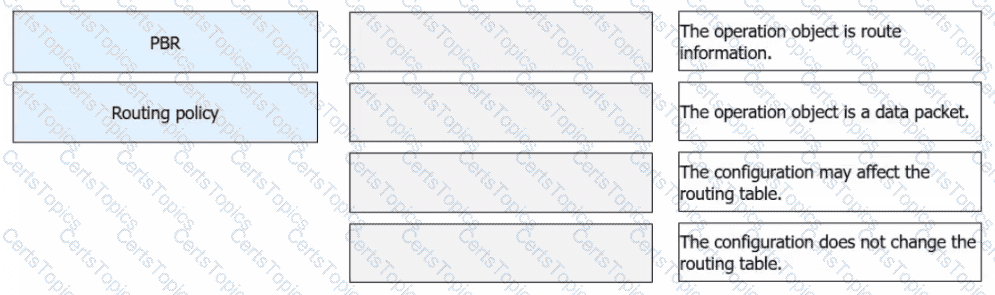
On an IP network, both PBR and routing policies are commonly used for routing and traffic control, but they are different from each other. Match PBR and routing policy with their functions.(Token is reusable)
GRE is a VPN technology that can implement packet transmission over heterogeneous networks. Which of the following statements are true about GRE?
As shown in the figure, R1 imports the direct route 10.1.1.0/24 to OSPF. An engineer enables bidirectional route re-advertisement on R2 and R3.
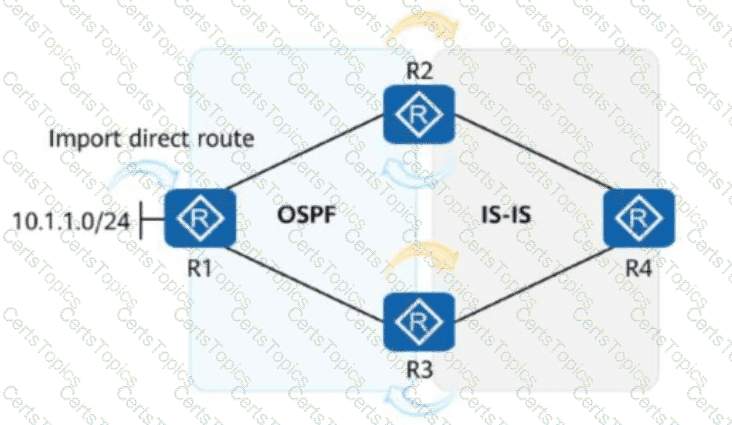
After the network becomes stable, which of the following is the Pre (preference) value of the route 10.1.1.0/24 in the routing table of R3?
Copyright © 2021-2026 CertsTopics. All Rights Reserved

