
Summer Certification Sale 70% Discount Offer - Ends in 0d 00h 00m 00s - Coupon code: save70

All H12-821_V1.0 Test Inside Huawei Questions

Page: 17 / 29
Total 376 questions

HCIP-Datacom-Core Technology V1.0 Questions and Answers

Question 65

See the network shown in the following figure.

R1 and R2 run IS-IS and establish an adjacency. IS-IS is enabled on Loopback0 of R2 but disabled on Loopback3 of R2. The configurations shown in the figure are performed in the IS-IS process of R2. Which of the following statements are true?
Options:

A.

The routing table of R1 contains the route 10.0.2.3/32.

B.

The routing table of R1 does not contain the route 10.0.2.3/32.

C.

The routing table of R1 does not contain the routes 10.0.2.2/32 and 10.0.2.3/32.

D.

The routing table of R1 contains the route 10.0.2.2/32.

Question 66

Which of the following statements about WLAN roaming are false?

Options:

A.

APs with which a STA is associated before and after roaming can work on different channels.

B.

During roaming, the STA sends a Reassociation Request frame containing home AP information to the foreign AP.

C.

During roaming, the STA sends an Association Request frame containing home AP information to the foreign AP.

D.

APs with which a STA is associated before and after roaming must work on the same channel.

Question 67

On an enterprise WLAN where Portal authentication is deployed, an AC functions as an access device and communicates with a Portal server using the Portal protocol. Which of the following statements are true about the Portal protocol?

Options:

A.

The HTTP or HTTPS protocol can be used as the Portal access or authentication protocol.

B.

By default, the access device processes Portal protocol packets through port 2000.

C.

By default, the device uses the destination port number 50100 to proactively send packets to the Portal server.

D.

Portal protocol packets are transmitted over TCP.

Question 68

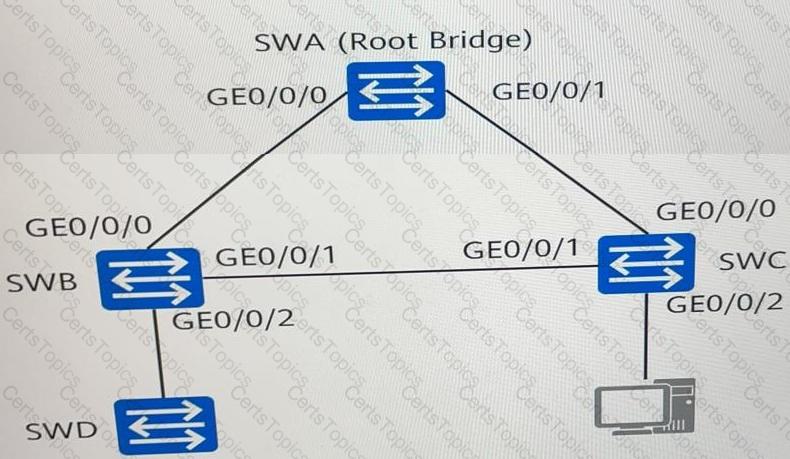
To prevent loops on an STP network , after a designated port is elected, it must wait for a long time and can forward packets only after the status of all ports on the entire network is determined . To solve this problem, RSTP uses the P/A mechanism to speed up the downstream port ' s transition to the Forwarding state .

Options:

A.

TRUE

B.

FALSE

Page: 17 / 29
Total 376 questions
