An ML engineer is setting up a continuous integration and continuous delivery (CI/CD) pipeline for an ML workflow in Amazon SageMaker AI. The pipeline needs to automate model re-training, testing, and deployment whenever new data is uploaded to an Amazon S3 bucket. New data files are approximately 10 GB in size. The ML engineer wants to track model versions for auditing.
Which solution will meet these requirements?
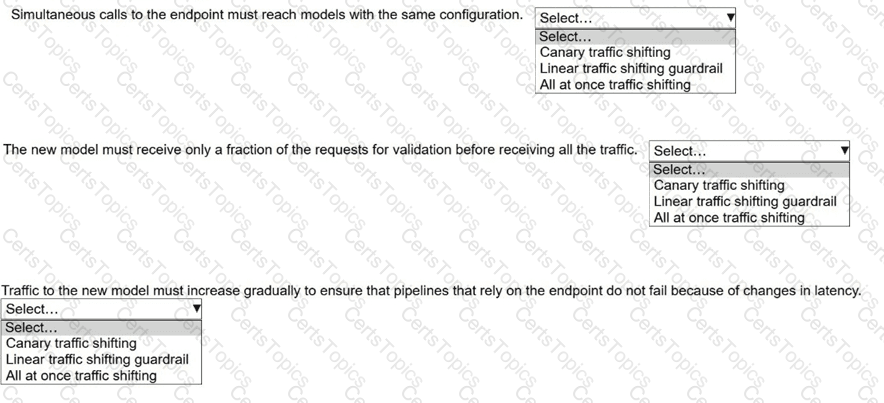
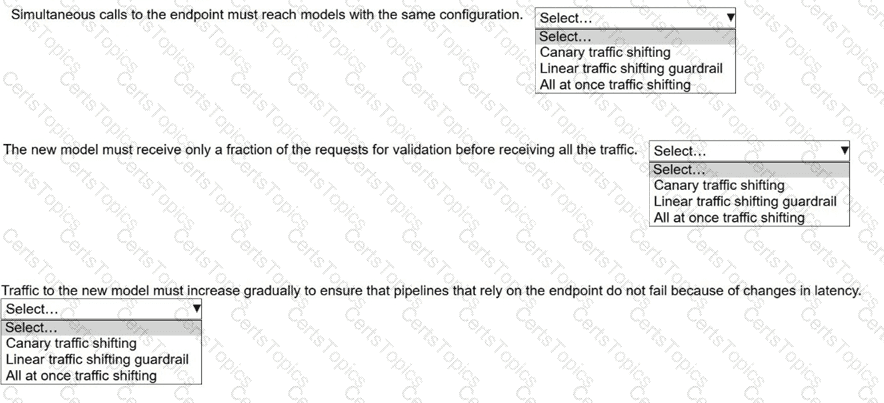
A company has multiple models that are hosted on Amazon SageMaker Al. The models need to be re-trained. The requirements for each model are different, so the company needs to choose different deployment strategies to transfer all requests to a new model.
Select the correct strategy from the following list for each requirement. Select each strategy one time. (Select THREE.)
. Canary traffic shifting
. Linear traffic shifting guardrail
. All at once traffic shifting
A travel company wants to create an ML model to recommend the next airport destination for its users. The company has collected millions of data records about user location, recent search history on the company ' s website, and 2,000 available airports. The data has several categorical features with a target column that is expected to have a high-dimensional sparse matrix.
The company needs to use Amazon SageMaker AI built-in algorithms for the model. An ML engineer converts the categorical features by using one-hot encoding.
Which algorithm should the ML engineer implement to meet these requirements?
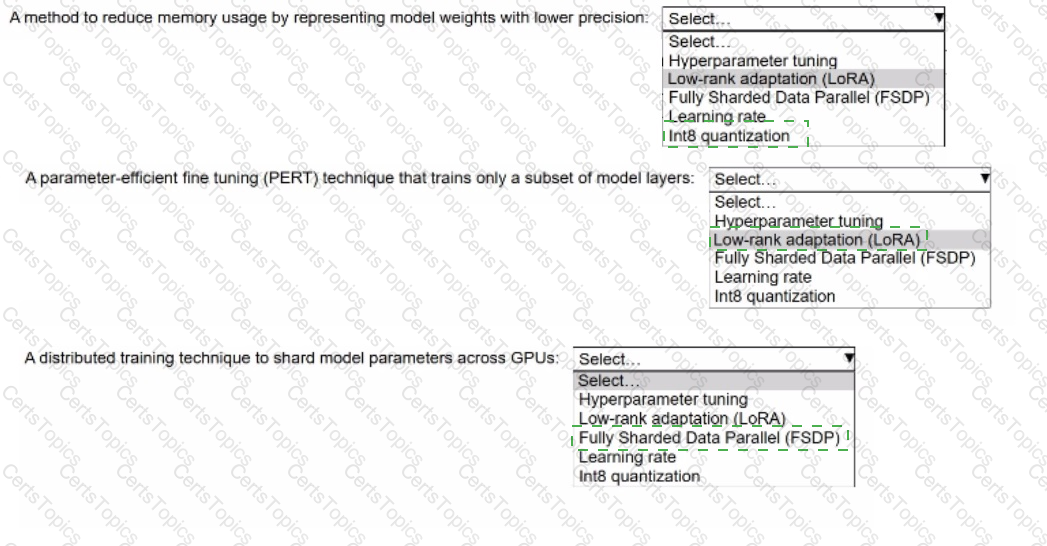
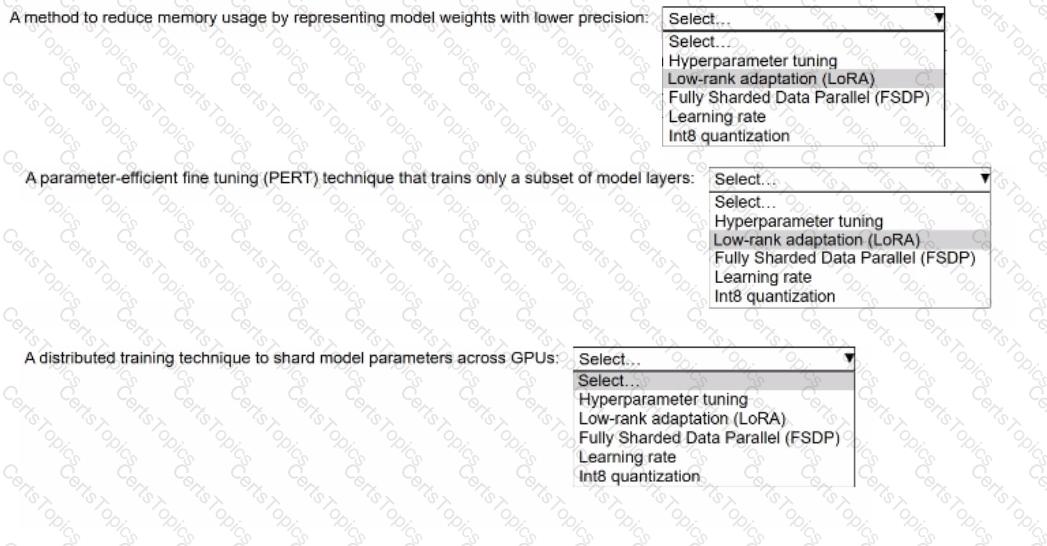
An ML engineer is using Amazon SageMaker JumpStart to fine-tune a Llama 3.2 model for text generation. The ML engineer is using an instruction-based fine-tuning method. The model uses 70 billion parameters.
Select the correct fine-tuning term from the following list to match each description. Select each term one time or not at all. (Select THREE.)
• Hyperparameter tuning
• Low-rank adaptation (LoRA)
• Fully Sharded Data Parallel (FSDP)
• Learning rate
• Int8 quantization
Copyright © 2021-2026 CertsTopics. All Rights Reserved