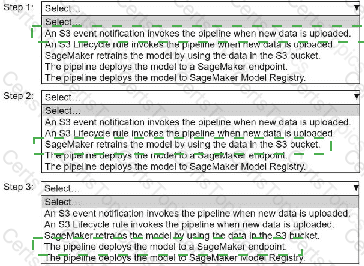
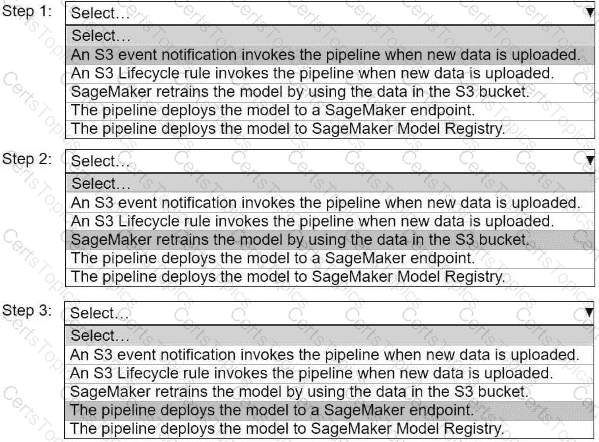
A company wants to host an ML model on Amazon SageMaker. An ML engineer is configuring a continuous integration and continuous delivery (Cl/CD) pipeline in AWS CodePipeline to deploy the model. The pipeline must run automatically when new training data for the model is uploaded to an Amazon S3 bucket.
Select and order the pipeline ' s correct steps from the following list. Each step should be selected one time or not at all. (Select and order three.)
• An S3 event notification invokes the pipeline when new data is uploaded.
• S3 Lifecycle rule invokes the pipeline when new data is uploaded.
• SageMaker retrains the model by using the data in the S3 bucket.
• The pipeline deploys the model to a SageMaker endpoint.
• The pipeline deploys the model to SageMaker Model Registry.
A company wants to deploy an Amazon SageMaker AI model that can queue requests. The model needs to handle payloads of up to 1 GB that take up to 1 hour to process. The model must return an inference for each request. The model also must scale down when no requests are available to process.
Which inference option will meet these requirements?
A company needs an AWS solution that will automatically create versions of ML models as the models are created. Which solution will meet this requirement?
A company is building a near real-time data analytics application to detect anomalies and failures for industrial equipment. The company has thousands of IoT sensors that send data every 60 seconds. When new versions of the application are released, the company wants to ensure that application code bugs do not prevent the application from running.
Which solution will meet these requirements?
Copyright © 2021-2026 CertsTopics. All Rights Reserved