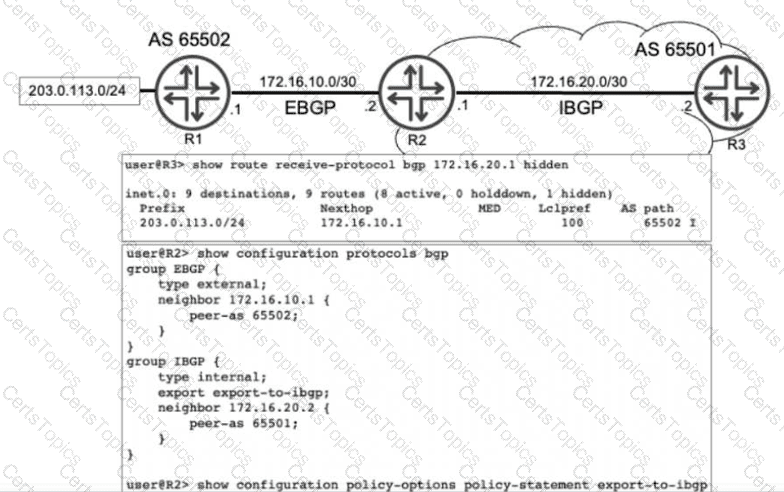
In Juniper Networks Junos OS, a "hidden" route in the BGP table typically signifies that the router has received the prefix but cannot install it into the active routing table because theBGP next hop is unreachable. This is a common occurrence in service provider environments when transitioning betweenExternal BGP (EBGP)andInternal BGP (IBGP).
According to Juniper technical documentation, when an EBGP speaker (R1) advertises a prefix to its peer (R2), it sets the next hop to its own interface IP address ($172.16.10.1$). By default, when R2 re-advertises that prefix to its IBGP peer (R3), itpreserves the original EBGP next-hop address. Unless R3 has a specific route in its Interior Gateway Protocol (IGP) or a static route to reach the $172.16.10.1$ subnet, it will mark the route as unusable (hidden).
In the exhibit, the show route output onR3explicitly shows the nexthop for $203.0.113.0/24$ as $172.16.10.1$. Since this route is marked "hidden," we can conclude R3 does not know how to reach R2's external peering link. To resolve this, the network administrator must modify the next-hop attribute before the route is sent to R3.
By adding the statementset policy-options policy-statement export-to-ibgp then next-hop self(Option B) on routerR2, R2 will replace the external next-hop ($172.16.10.1$) with its own internal peering address ($172.16.20.1$) before advertising the route to R3. Because R3 already has a direct or IGP connection to R2's internal address, it will successfully resolve the next hop, and the route will transition from "hidden" to "active."
Option A is unnecessary because the route is already being exported; Option C is redundant as the policy is already applied to the IBGP group; and Option D changes path preference but does not solve the underlying reachability problem.







 Kazakhstan