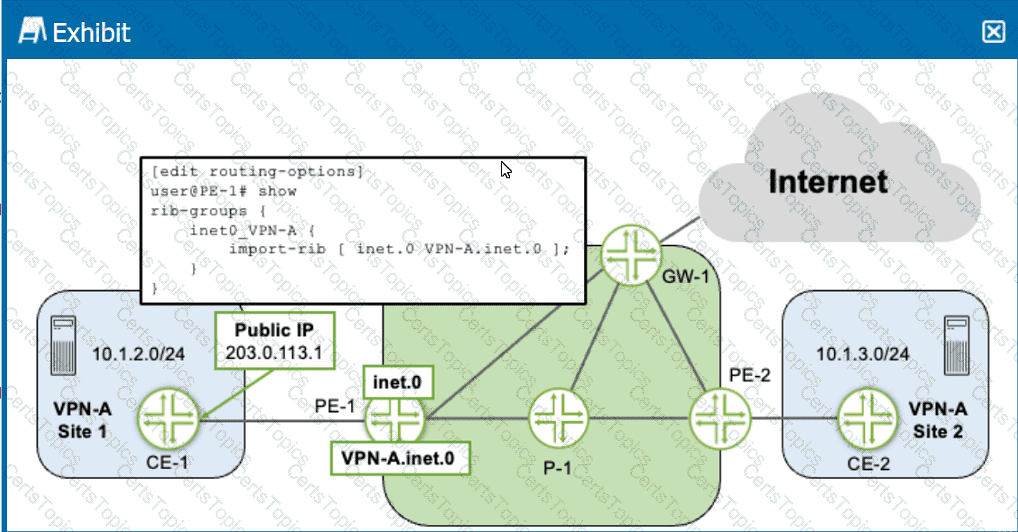
In the provided exhibit, the configuration involves using a RIB (Routing Information Base) group to facilitate internet access for VPN-A Site 1 through PE-1. The goal is to provide VRF Internet access over a single connection.
1. **Understanding RIB Groups**:
- RIB groups allow for the import and export of routes between different routing tables.
- In this scenario, we have two RIBs: `inet.0` (the main routing table) and `VPN-A.inet.0` (the VRF-specific routing table).
2. **Statement Analysis**:
- **A. You must use the RIB group to move a default route, which is learned through BGP, from the inet.0 table to the VPN-A.inet.0 table.**
- Correct. To provide Internet access to VPN-A, the default route (0.0.0.0/0) learned via BGP in the `inet.0` table must be made available in the `VPN-A.inet.0` table. This is done using the RIB group to import the default route.
- **B. You do not need to use the RIB group to move interface routes from the inet.0 table to the VPN-A.inet.0 table.**
- Correct. Interface routes (connected routes) are typically directly added to both the global and the VRF routing tables without needing a RIB group. These routes are known to the VRF because the interfaces are part of the VRF configuration.
- **C. You do not need to use the RIB group default route, which is learned through BGP, from the inet.0 table to the VPN-A.inet.0 table.**
- Incorrect. As discussed, the default route needs to be imported into the VRF's routing table using a RIB group to enable Internet access for the VRF.
- **D. You must use the RIB group to move interface routes from the inet.0 table to the VPN-A.inet.0 table.**
- Incorrect. Interface routes are directly associated with the VRF interfaces and are automatically known to the VRF routing table. There is no need to use a RIB group for these routes.
**Conclusion**:
The correct answers are:
**A. You must use the RIB group to move a default route, which is learned through BGP, from the inet.0 table to the VPN-A.inet.0 table.**
**B. You do not need to use the RIB group to move interface routes from the inet.0 table to the VPN-A.inet.0 table.**
**References**:
- Juniper Networks Documentation on RIB Groups: [RIB Groups
- Junos OS VPNs Configuration Guide: [Junos VPNs