
You are designing an MPLS network and want to ensure that traffic traverses an LSP between PE routers that follow an explicit path through the core. Which protocol would accomplish this task?
Exhibit:
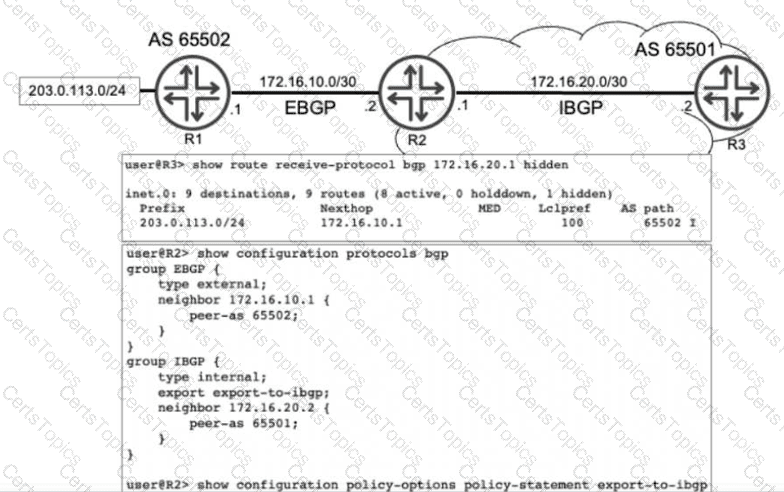
Referring to the exhibit, R1 is advertising prefix 203.0.113.0/24 to R2 over EBGP. R2 is configured to advertise this prefix into IBGP. R3 receives the 203.0.113.0/24 route, however the route is hidden. Which configuration statement do you need to add to R2 to solve this problem?
Exhibit:
user@R1> show route 10.16.2.0/23 exact detail
inet.0: 12 destinations, 12 routes (11 active, 0 holddown, 1 hidden)
10.16.2.0/23 (1 entry, 1 announced)
*Aggregate Preference: 130
Next hop type: Reject
Address: 0x8f3fd44
Next-hop reference count: 2
State:
Age: 1:39:21
Task: Aggregate
Announcement bits (1): 0-KRT
AS path: I (LocalAgg)
Flags: Depth: 0 Active
AS path list:
AS path: I Refcount: 2
Contributing Routes (2):
10.16.2.0/24 proto Direct
10.16.3.0/24 proto Direct
Which destination IP address will be matched by the aggregate route shown in the exhibit?
For two or more switches to participate in the same MSTP region, which parameter must match?
By default, which routing table contains a list of all ingress LSPs?
What prevents routing loops in a single-area OSPF network?
Exhibit:
user@Router-1> show route 172.24/16
inet.0: 9 destinations, 9 routes (9 active, 0 holddown, 0 hidden)
+ = Active Route, - = Last Active, * = Both
...
172.24.0.0/24 *[OSPF/150] 01:31:31, metric 0, tag 0
> to 172.20.0.2 via ge-0/0/2.0
to 172.20.1.2 via ge-0/0/3.0
user@Router-1> show route forwarding-table
Routing table: default.inet
Internet:
Destination Type RtRef Next hop Type Index NhRef Netif
...
172.24.0.0/24 user 0
172.20.0.2 ucst 551 2 ge-0/0/2.0
172.20.1.2 ucst 552 2 ge-0/0/3.0
Referring to the exhibit, which two statements are true? (Choose two.)
Which IS-IS adjacency state indicates that hello packets have been exchanged but the adjacency is not yet fully established?
Which OSPF packet type is used to initiate and maintain neighbor relationships?
During OSPF neighbor establishment, which packet type is used to describe the contents of the link-state database?
You are evaluating BGP between two Juniper routers and the BGP session is stuck in the Idle state. What would cause this behavior?
A service provider is onboarding a new enterprise customer that operates multiple branch offices, each with its own set of VLANs. The customer requires transparent Layer 2 connectivity between sites while maintaining separation of internal VLANs. The provider must also ensure that customer VLAN identifiers do not conflict with other customers on the shared infrastructure. Which solution would provide the desired results?
Which two events cause a static route to be removed from a routing table? (Choose two.)
You are asked to configure a new network environment that will be based on IPv6 and use OSPF. In this scenario, which two statements correctly identify configuration task considerations? (Choose two.)
Exhibit:
user@R2> show route 198.51.100.1
inet.0: 19 destinations, 19 routes (19 active, 0 holddown, 0 hidden)
Restart Complete
+ = Active Route, - = Last Active, * = Both
198.51.100.1/32 *[Static/5] 5d 21:02:26
> to 203.0.113.65 via ge-0/0/3.0
user@R2> show route 172.20.110.0/24
inet.0: 19 destinations, 19 routes (19 active, 0 holddown, 0 hidden)
Restart Complete
+ = Active Route, - = Last Active,
* = Both
172.20.110.0/24 *[Static/5] 10:43:01
> via gr-0/0/0.0
Referring to the exhibit, traffic destined to which network will be sent through the tunnel?
The MPLS Label Information Base (LIB) is stored in which table?
You are configuring BGP for IPv6 operations. In this scenario, which two statements are correct? (Choose two.)
Which IPv6 extension header is used to specify intermediate nodes for a packet's path?
Exhibit:

Referring to the exhibit, why is the ge-0/0/0.0 interface shown as belonging to Level 3?
Copyright © 2021-2026 CertsTopics. All Rights Reserved
