
Which of the following commands can be used to check OSPF routes in the global routing table?
R1 has the following configurations:
[R1] nat server for_telnet protocol tcp global 100.0.23.2 telnet inside 192.168.1.1 telnet
When a public network user and 100.0.23.2 are reachable, the public network user can run the telnet 192.168.1.1 command to log in to 192.168.1.1.
Which of the following DHCPv4 messages are sent by a DHCPv4 server?
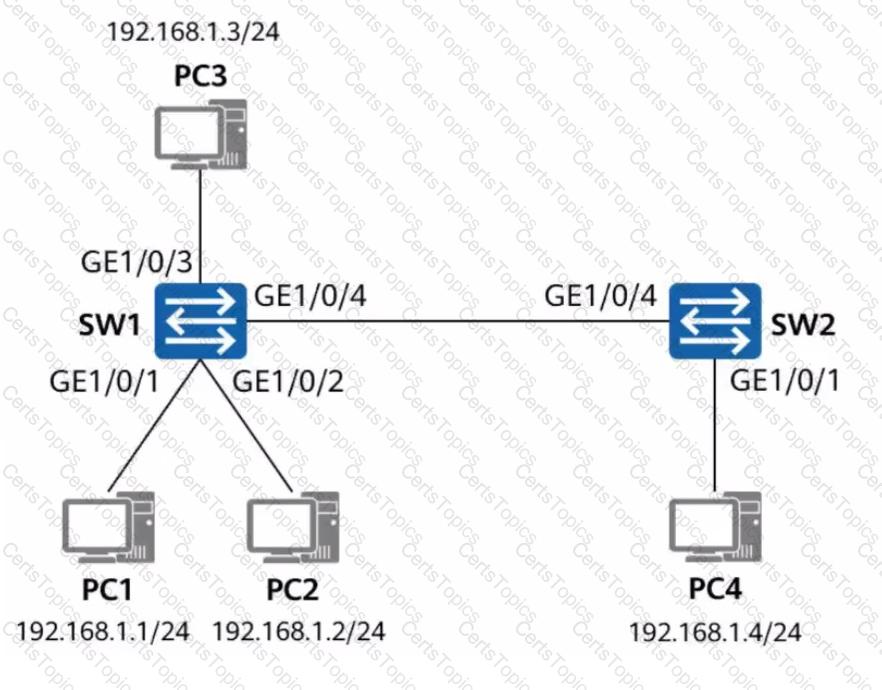
On the network shown in the figure, the interfaces connecting switches to terminals are access interfaces, and the interfaces connecting switches to each other are trunk interfaces. The administrator configures interface-based VLAN assignment. PC1 and PC3 belong to VLAN 2, and PC2 and PC4 belong to VLAN 3. Trunk interfaces allow packets from VLAN 2 and VLAN 3 to pass through and use the default PVID. The MAC address tables of switches are empty. When SW1 receives a unicast data frame sent from PC1 to PC3, through which of the following interfaces does SW1 not send the data frame?
R1 has two equal-cost routes to 10.0.12.0/24 after the following commands are configured.
[R1] ip route-static 10.0.12.0 24 10.0.12.2 preference 60
[R1] ip route-static 10.0.12.0 24 10.0.21.2 preference 60

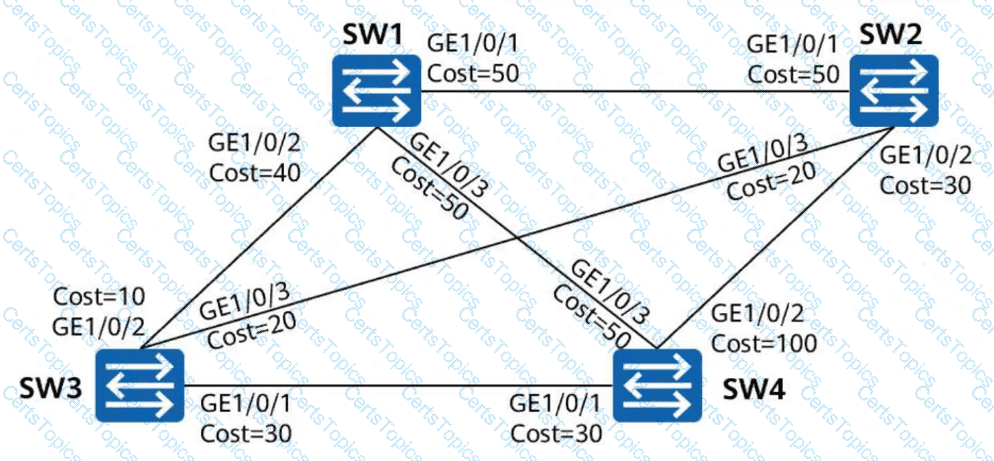
In the STP topology shown in the figure, all links have the same path cost, and SW1 is the root bridge. Which of the following ports will become designated ports? (Select all that apply)
When a Huawei network device functions as an FTP server, which of the following are possible causes of an FTP client failing to log in to the FTP server? (Select all that apply)
Assume you are an administrator of a campus network. You want to enable STelnet on network devices so that you can remotely log in to them for service commissioning and configuration changes. Which of the following statements is false about STelnet?
During VLAN planning for a campus network, VLAN IDs for different service types must be allocated consecutively, without redundancy, to prevent omissions in future allocations.
In Layer 3 in-path WLAN networking, the WAC and Fit APs are connected at Layer 3. APs can obtain the WAC’s address through broadcast or DHCP.
With the continuous development of AI, data center application scenarios are gradually divided into general-purpose computing and intelligent computing scenarios. Data centers need to ensure service continuity of general-purpose computing clusters while unleashing the full potential of intelligent computing clusters, so as to guarantee stable and efficient operation in the AI era. Which of the following statements are true about the service requirements of data center networks in the two scenarios? (Select all that apply)
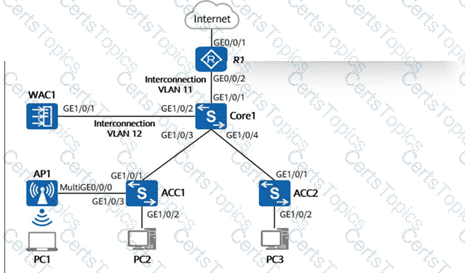
On the campus network shown in the figure below, the core switch Core1 functions as a Layer 3 gateway and as a DHCP server to dynamically assign IP addresses to AP1, PC1, PC2, and PC3. The network below Core1 is a Layer 2 network. WAC1 and R1 are connected to Core1 at Layer 3. AP1 goes online through VLAN 100. The wireless service VLAN is VLAN 101, and the wired service VLANs for PC2 and PC3 are VLAN 102 and VLAN 103, respectively. Additionally, the direct forwarding mode is used for wireless traffic forwarding. If no additional VLANs are allowed on device interfaces, which of the following VLANs must be allowed on GE1/0/1 of ACC1? (Select all that apply)
R1 has the following configurations:
[R1] nat address-group test 1
[R1-address-group-test] section 1 100.1.23.1 100.1.23.254
[R1-address-group-test] mode pat
[R1-address-group-test] quit
[R1] nat-policy
[R1-policy-nat] rule name test
[R1-policy-nat-rule-test] source-address range 192.168.0.0 192.168.255.255
[R1-policy-nat-rule-test] action source-nat address-group test
[R1-policy-nat-rule-test] quit
[R1-policy-nat] quit
[R1] interface GE 0/0/2
[R1-GE0/0/2] nat enable
[R1-GE0/0/2] quit
Which of the following statements is false ?
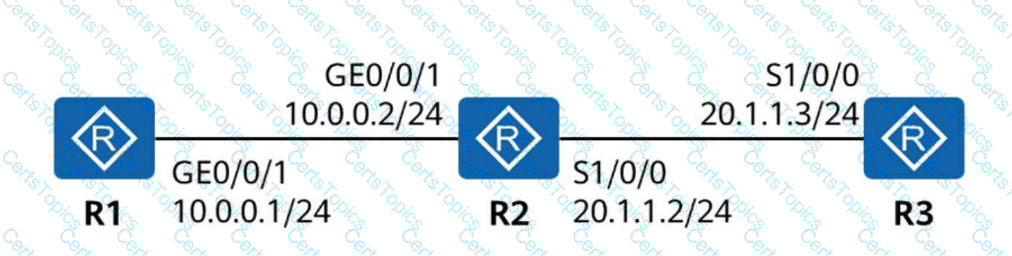
Which of the following configurations can enable connectivity between interfaces on R1 and R3? (Select all that apply)
With the development of data centers, a large number of services are deployed on virtual machines (VMs). The original VLAN isolation solution cannot achieve isolation between so many VMs. VXLAN uses VXLAN Network Identifiers (VNIs) to provide a larger range than VLAN IDs, so that a larger number of VMs can be isolated.
Assume that you cannot configure an IP address for GE1/0/1 on a Huawei switch. Which of the following commands can you run in the interface view to resolve this problem?
Assume that the IPv6 address of GE0/0/0 on R1 is 2001:db8:12::1/64. Which of the following is the solicited-node multicast address of this IPv6 address?
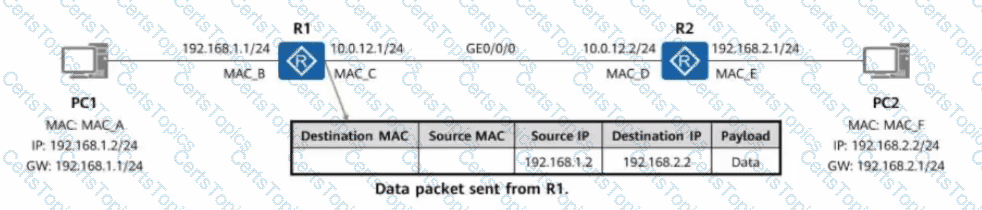
Assume that PC1 and PC2 can communicate with each other. When R1 forwards a data packet sent from PC1 to PC2, which of the following statements are true?
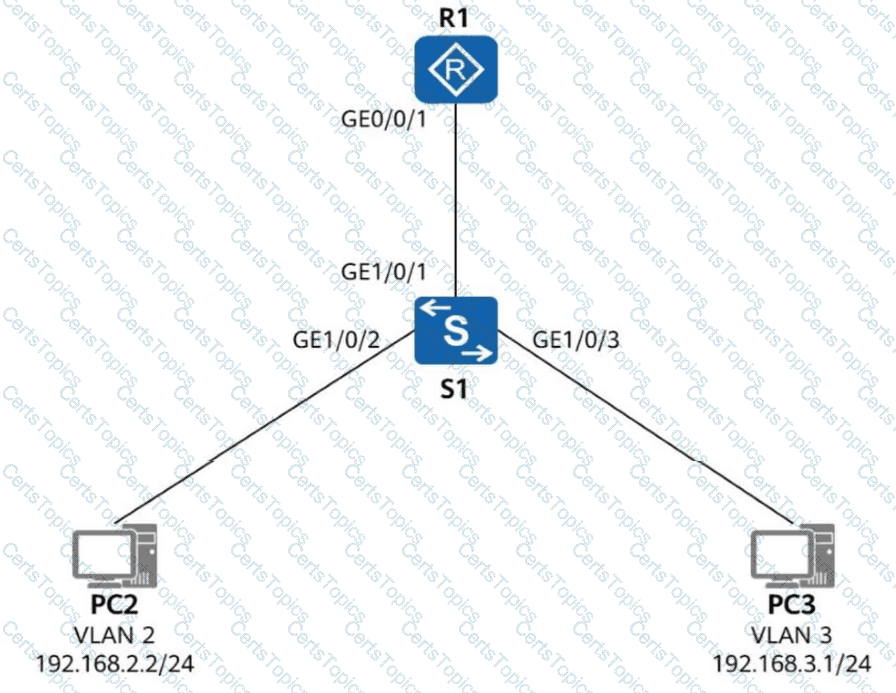
On the network shown in the figure, R1 serves as the gateway for PC2 and PC3, and directly connects to S1 through a physical link. GE1/0/1 on S1 is configured as a trunk interface and permits traffic of VLANs 2 and 3. Its PVID retains the default value. Which of the following statements are true if PC2 and PC3 can communicate with each other? (Select all that apply)
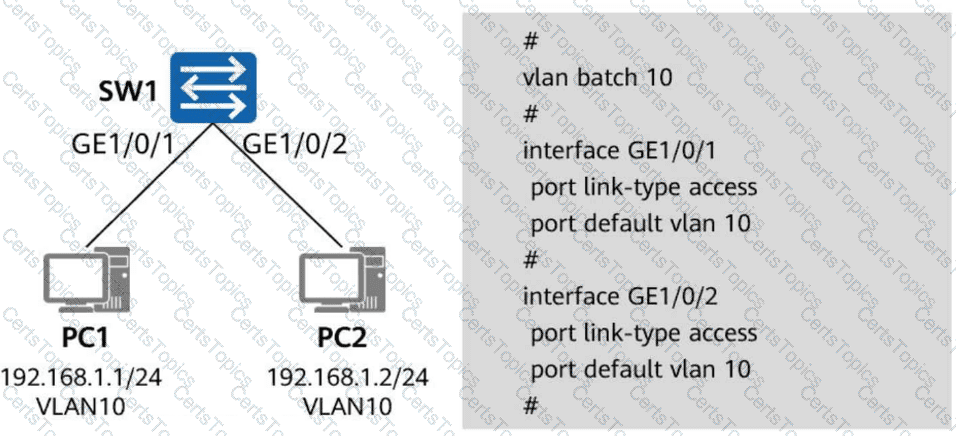
In the figure, both PC1 and PC2 belong to VLAN 10. Interface GE1/0/1 on SW1 is a trunk interface with the default PVID, and interface GE1/0/2 on SW1 is an access interface in VLAN 10. Which of the following statements are true about the forwarding of data frames between PC1 and PC2? (Select all that apply)
In TCP/IP-based end-to-end communication, only the source and destination hosts process the header information added at the transport layer. Routers along the path will definitely not process this information.
After the root bridge is elected on an STP network, which of the following parameters may be compared by ports on non-root bridge nodes to elect the root port? (Select all that apply)
PC1 and PC2 are connected to the same switch, but they cannot learn each other’s ARP information. This may be caused by incorrect VLAN configuration on the switch.
In the leader AP networking architecture, the leader AP functions as a WAC and uses the CAPWAP protocol to uniformly manage and configure Fit APs.
If a network device has both a static route and a direct route to network 10.1.1.0/24, it uses the direct route preferentially.
The essence of communication is the transmission and exchange of information between two or more points. The three elements of communication are the sender, content, and transmission channel of the information. The receiver of the information is not included among these elements.
An enterprise ' s network switch has security vulnerabilities because its software version is outdated. The administrator wants to upload a patch file through FTP to fix the vulnerabilities. Which of the following files is a patch file that can be uploaded by the administrator?
Enterprise data center (DC) services are no longer carried by physical machines or provided only for internal users. Instead, cloud platforms integrate resources in a unified manner and provide services for external users. Continuous service innovation requires the DC construction mode to evolve from single-DC to multi-site multi-DC.
The administrator configures an Eth-Trunk in LACP mode between two switches, and sets the maximum number of active links in the Eth-Trunk to 3 and the number of remaining standby links to 1. If one of the active links fails, the two switches automatically adjust the number of active links to 2 through negotiation, and the standby link remains in the standby state.
If the neighbor relationship between R1 and R2 has reached the Full state in OSPF, which of the following statements are true? (Select all that apply)
Copyright © 2021-2026 CertsTopics. All Rights Reserved
