
During VLAN planning for a campus network, VLAN IDs for different service types must be allocated consecutively, without redundancy, to prevent omissions in future allocations.
In Layer 3 in-path WLAN networking, the WAC and Fit APs are connected at Layer 3. APs can obtain the WAC’s address through broadcast or DHCP.
With the continuous development of AI, data center application scenarios are gradually divided into general-purpose computing and intelligent computing scenarios. Data centers need to ensure service continuity of general-purpose computing clusters while unleashing the full potential of intelligent computing clusters, so as to guarantee stable and efficient operation in the AI era. Which of the following statements are true about the service requirements of data center networks in the two scenarios? (Select all that apply)
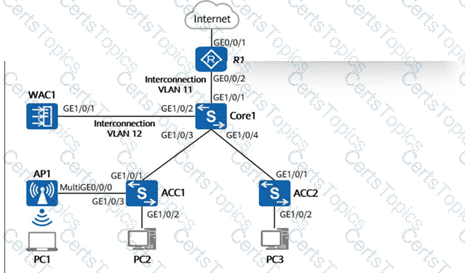
On the campus network shown in the figure below, the core switch Core1 functions as a Layer 3 gateway and as a DHCP server to dynamically assign IP addresses to AP1, PC1, PC2, and PC3. The network below Core1 is a Layer 2 network. WAC1 and R1 are connected to Core1 at Layer 3. AP1 goes online through VLAN 100. The wireless service VLAN is VLAN 101, and the wired service VLANs for PC2 and PC3 are VLAN 102 and VLAN 103, respectively. Additionally, the direct forwarding mode is used for wireless traffic forwarding. If no additional VLANs are allowed on device interfaces, which of the following VLANs must be allowed on GE1/0/1 of ACC1? (Select all that apply)
Copyright © 2021-2026 CertsTopics. All Rights Reserved
