A financial organization successfully deployed a new Workload Domain in VMware Cloud Foundation (VCF) using NFS storage. All ESX hosts are commissioned and connected to the same storage network. The system administrator is tasked to configure a new NFS datastore in the existing cluster.
Which two steps are correct? (Choose two.)
An administrator is tasked designing a vSAN storage solution while respecting the following requirements:
• Must use vSAN ESA
• Must be stretched between two data centers
• Must configure Failures to tolerate = 1
• Must configure Erasure Coding
How many components per Virtual Machine (VM) will be created?
An administrator is monitoring a vSAN ESA backed workload domain that is dedicated for running AI inferencing. When the administrator navigates to the Storage Performance dashboard in VMware Cloud Foundation Operations, the performance dashboard shows:
• High backend write latency ( > 8 ms)
• Low read latency ( < 1 ms)
• Normal network throughput
• Disk Group Health = Green
Based on the readings above, what would be the explanation?
An administrator is using an external Key Management Server (KMS) with a vSAN Data-at-Rest Encryption cluster.
The KMS becomes temporarily unavailable.
What happens if a host without a Trusted Platform Module in the cluster is rebooted during this outage?
An administrator is presented with the following scenario:
• 20 TB of additional storage is being requested by a VM application owner.
• The application has high CPU/Memory requirements that can only be satisfied by the current cluster the application runs in.
• The application has high IOPS and bandwidth requirements to run properly.
• The existing vSAN cluster only has 10 TB of unused capacity.
• The hosts in the cluster have no additional NVMe slots left.
• The administrator does not have permission to purchase additional hosts or re-assign hosts from other vSAN clusters.
• Other vSAN clusters exist in the environment that can satisfy the requirement.
Which vSAN feature should be used to fulfill this scenario?
An architect is designing a vSAN Original Storage Architecture (OSA) cluster for a VMware Cloud Foundation (VCF) Management Domain. The following details were made available:
• 12 hosts, each host with: 3 x 800 GB NVMe (cache) and 12 x 3.84 TB SAS SSD (capacity).
• Planned configuration: 3 disk groups per host (1 NVMe + 4 SSD each).
• Storage policy: FTT = 2 (RAID-1), Checksum. Deduplication and Compression are Enabled.
• Network: 25 GbE dedicated vSAN network fabric, properly configured for jumbo frames.
After deployment and loading test data to 70% capacity, the operations team reported extended resync times when two hosts are placed into maintenance mode with “Ensure Accessibility” selected and no hardware or network bottlenecks were detected.
How can the administrator explain the observed behavior?
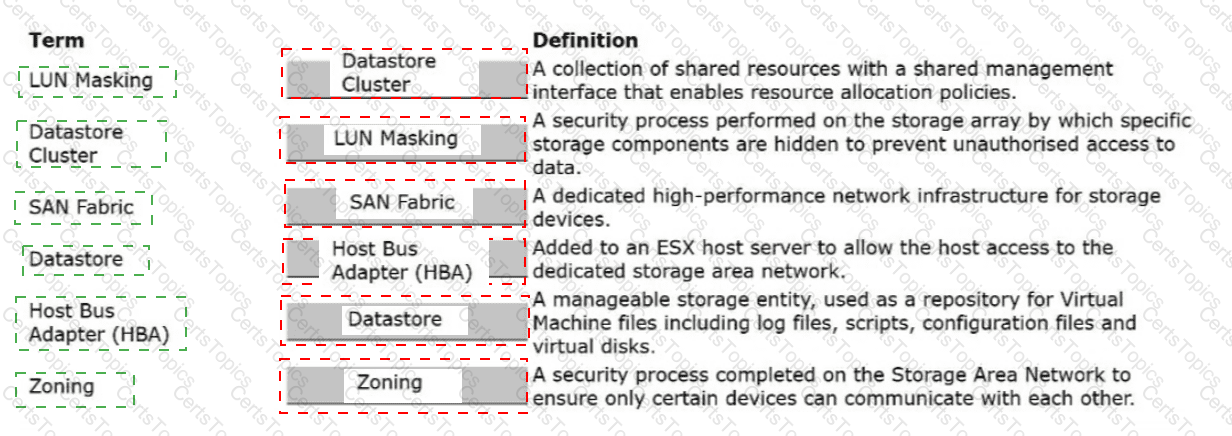
An administrator is responsible for a VMware Cloud Foundation (VCF) Private Cloud and has been tasked with identifying and explaining the different Fibre Channel (FC) Storage Area Network (SAN) components within a VCF Workload Domain cluster.
Drag and drop the correct Term onto its matching Definition.

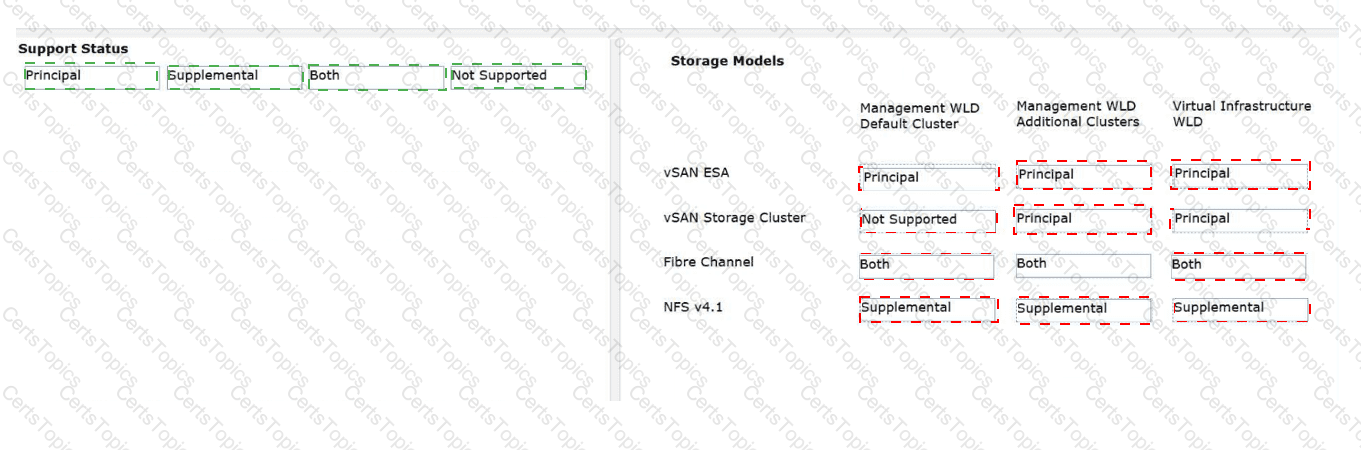
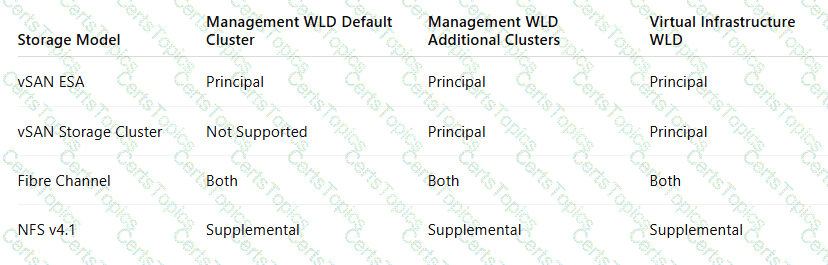
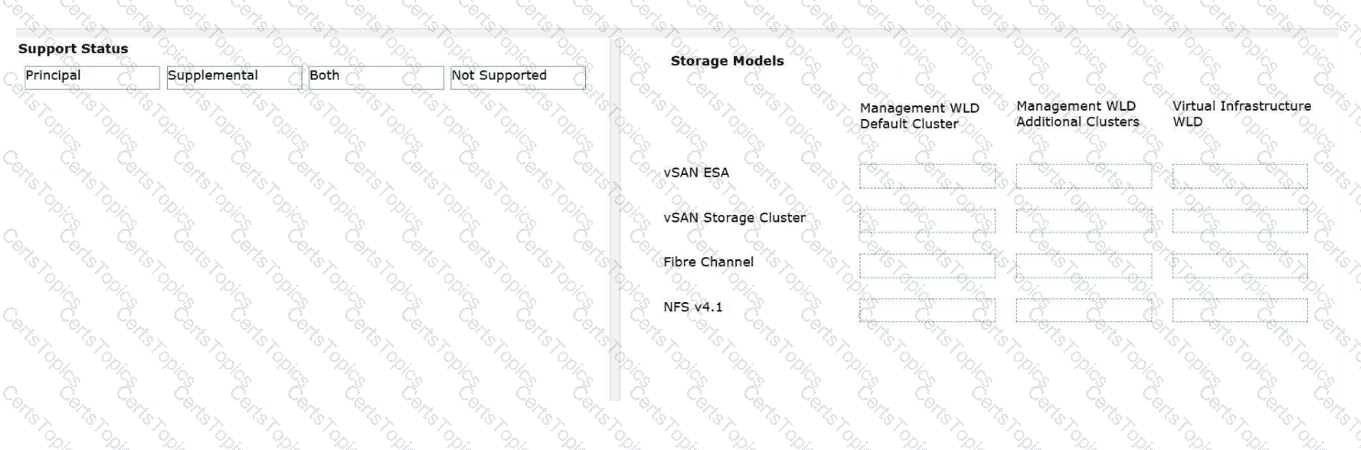
An architect is describing the for a client which storage platforms are supported in which types of Domains for automated installation in VMware Cloud Foundation (VCF) Private Clouds.
Drag and drop the Support Status of each storage model on the left to each type of Workload Domain on the right.
An administrator is deploying a vSphere Supervisor Cluster on a VMware Cloud Foundation (VCF) Workload Domain that uses NFS storage. As part of the configuration, the administrator must define separate storage policies for container images, ephemeral volumes, and persistent volumes within the vSphere Namespace.
The solution must align with vSphere Storage Policy Based Management (SPBM) and Broadcom TechDocs recommendations for supported Supervisor configurations.
Which configuration meets these requirements?
An administrator reports that after rebooting one host in a vSAN cluster configured with Data-at-Rest Encryption using an external Key Management Server (KMS), the host shows all vSAN disk groups as unmounted.
The KMS is online and reachable from all hosts.
In vCenter, the host displays the following event:
“Failed to retrieve encryption key from KMS.”
Key ID:
All other hosts in the cluster remain healthy and show “Encryption: Enabled.”
Why did the encryption key retrieval fail for this host?
An administrator is tasked with setting up immutable snapshots for recovery in case of a cyber-attack.
Which two limitations apply when configuring immutable snapshots? (Choose two.)
A firm is migrating to VMware Cloud Foundation (VCF) and will leverage its existing enterprise Fibre Channel SAN for workload domain storage.
Their priorities include seamless integration into VCF, automated lifecycle management via VCF Operations, consistent VM-level performance control, and alignment with best practices for large-scale VI environments. Management does not require vSAN, and operational simplicity is critical.
Which design meets all of the specified requirements?
An administrator has been tasked with recommending a principal storage type for a new cluster within an existing VMware Cloud
Foundation (VCF) Workload Domain.
The following information has been provided:
• The customer has a 25GbE capable network.
• The customer has an existing 3rd party storage solution that supports connectivity by either FibreChannel and NFS
• The new cluster will consist of two host servers that will be recycled from a previous project.
• Each of the host servers have the following configuration:
o One 500GB Enterprise-grade SSD drive.
o Two 2-Port IOGbE network cards.
• There is no budget for additional hardware.
Which approach should the administrator recommend for the principal storage type?
The Windows team is planning to deploy a Windows Server Failover Cluster. This requires a disk shared between all members of the cluster.
Which two options are available to fulfill this requirement on a vSAN ESA cluster? (Choose two.)
An administrator attempts to enable vSAN Data-at-Rest Encryption on a cluster but receives the following error message:
“Key provider < vSphere Native Key Provider > is not available on host.”
The administrator configured the vSphere Native Key Provider (NKP) using the default settings.
What should the administrator validate before enabling vSAN Data-at-Rest Encryption?
An administrator is working on a VMware Cloud Foundation (VCF) Workload Domain that was configured to use vSAN for principal storage. The administrator wishes to create and configure a datastore cluster to host tenant VMs using that vSAN backed storage across multiple clusters, mixed OSA and ESA, in the domain.
What should the administrator consider?
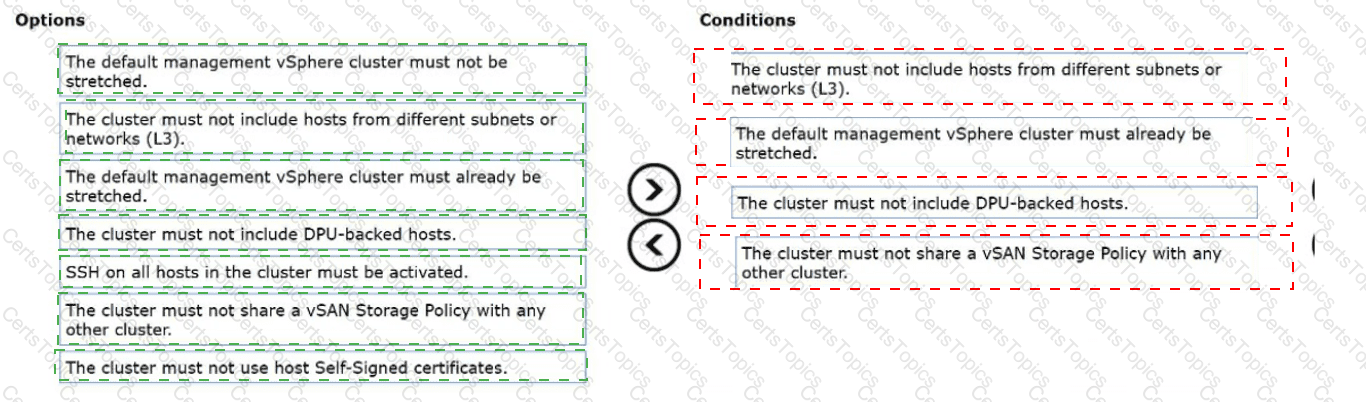
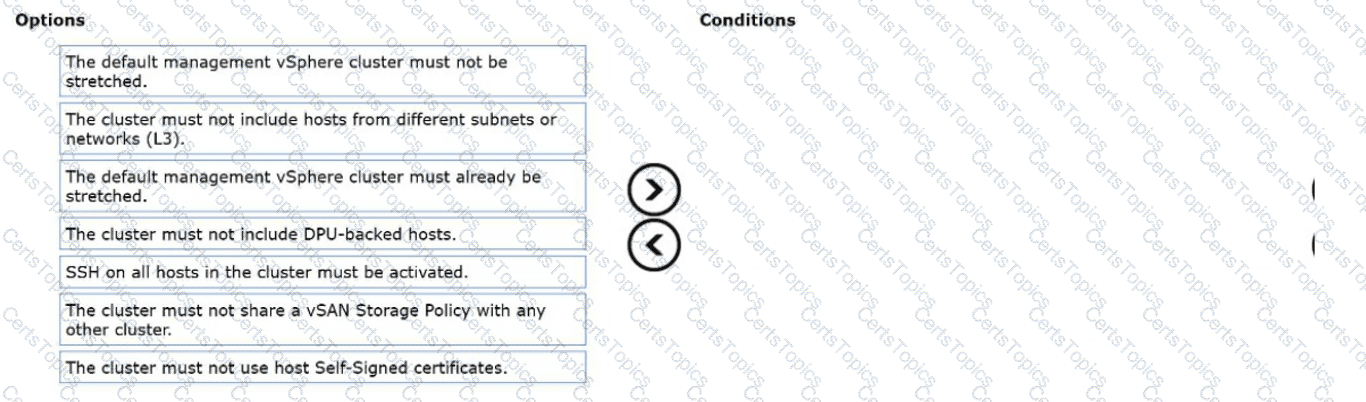
An administrator is tasked with stretching a vSAN cluster in a VMware Cloud Foundation (VCF) Workload Domain across two availability zones within a region. Both availability zones contain an equal number of hosts.
What four Conditions must also be met in order to stretch the cluster?
Drag and drop the four correct options from the Options list on the left and place them into the Conditions on the right in any order. (Choose four.)
An agency is designing its secure private cloud on VMware Cloud Foundation with the following requirements:
• Strict data segregation between the management and workload domains.
• Company policy prevents using vSAN as a storage solution.
• Data encryption at rest is mandatory for both the management and workload domains.
• Data encryption in transit is mandatory for the workload domains.
• Data-at-rest encryption must be performed by the storage array and not rely on VMware native or vSAN-specific mechanisms.
• Allow for automated VM placement, operational integrity with VCF Operations, and assurance that file-based workloads scale efficiently.
Which storage architecture fulfills these technical and regulatory requirements?
During maintenance on hosts in a four-node vSAN cluster, a host is placed in maintenance mode with the “Ensure Accessibility” option.
All VMs are running with the Default Storage Policy (RAID-1, FTT=1) which has not been modified from the default settings.
While one of the hosts in the cluster is down for firmware upgrade, a second host in the cluster loses network connectivity.
How will the cluster be affected?
An administrator has been tasked with suggesting storage models for a new VMware Cloud Foundation (VCF) Private Cloud. The following information has been provided:
• All existing implementations of VMware vSphere use the existing third-party block-based storage solution.
• The block-based storage solution only has sufficient scale, capacity and IOPS to cater for the new workload storage requirements.
• There is a dedicated and highly resilient storage area network connecting hosts to the provided block-based storage.
• There are 5 existing hosts with enough CPU and RAM resources and resilient Host Bus Adapters (HBAs) to cater for the new workload resource requirements only.
• There is sufficient budget to purchase some hardware, however the solution must re-use the existing hardware where possible.
The administrator suggests the following high-level solution:
• Single VCF Instance with a single Workload Domain.
• Deploy 4 new servers to create a Management Domain.
• Repurpose the 5 existing servers to create a single cluster in the Workload Domain.
Which two storage models should the administrator recommend? (Choose two.)
An enterprise is planning to deploy a new vSAN ESA enabled cluster to their existing VMware Cloud Foundation (VCF) Private Cloud Workload Domain. The following requirements have been given:
• 2 x 4 TB NVMe disks per host
• FTT=1/RAID-5 for all deployed Virtual Machines
• Expected dedupe/compression ratio = 1.5 (50%)
• Reserve enough capacity to rebuild a host completely in case of a failure (Host Rebuild Reservation)
• Operational Reserve of 10%
• Expected overhead for filesystem, object, etc. of 25%
How many hosts are required to meet a minimum usable capacity of 12 TB?
An architect is presented with the following requirements for the storage solution in a VMware Cloud Foundation (VCF) Workload Domain.
The solution must:
• Allow for rapid recovery in case of an availability zone failure.
• Provide an extremely high amount of IOPS to all applications.
• Allow for additional storage to be added as application needs grow.
• Provide the lowest latency possible for configured applications.
• Provide recovery in case of datastore failure.
• Encrypt data in transit and at rest.
What two vSAN advanced technologies must be deployed to meet these requirements? (Choose two.)
As part of standard operating procedures, when an administrator leaves the organization, a shallow rekey operation must be performed on a vSAN ESA cluster with vSAN Data-at-Rest Encryption enabled.
Which key is rotated during a shallow rekey operation?
Copyright © 2021-2026 CertsTopics. All Rights Reserved