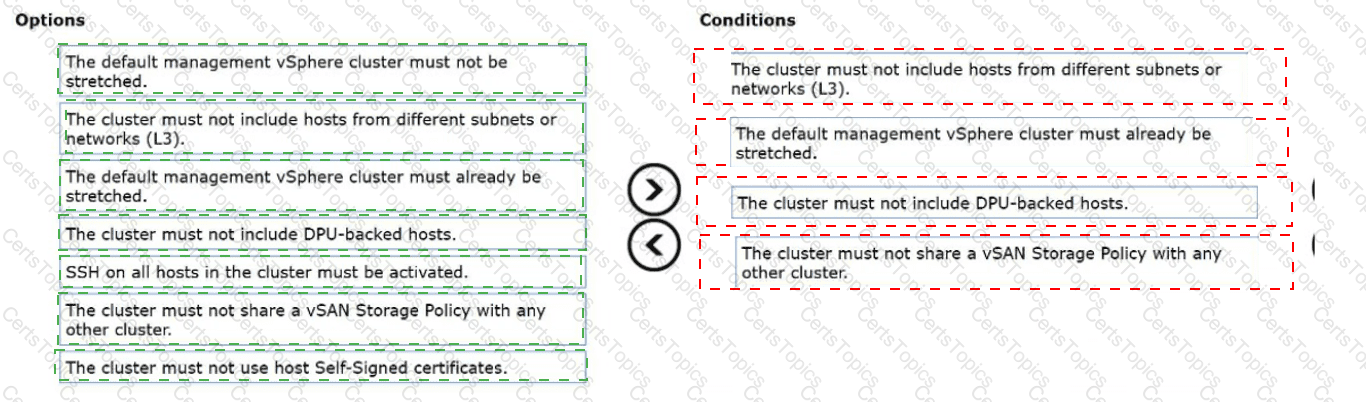
An administrator is tasked with stretching a vSAN cluster in a VMware Cloud Foundation (VCF) Workload Domain across two availability zones within a region. Both availability zones contain an equal number of hosts.
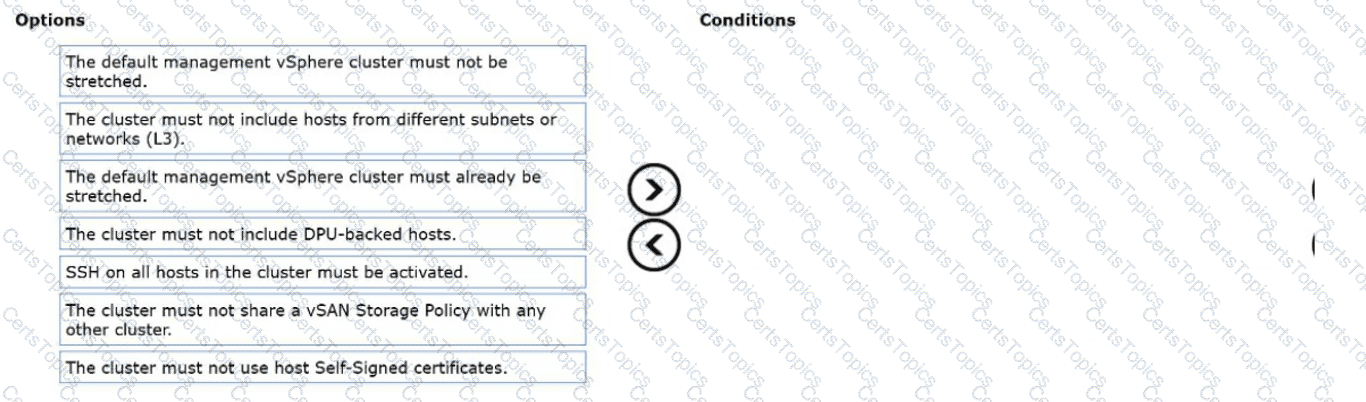
What four Conditions must also be met in order to stretch the cluster?
Drag and drop the four correct options from the Options list on the left and place them into the Conditions on the right in any order. (Choose four.)
An agency is designing its secure private cloud on VMware Cloud Foundation with the following requirements:
• Strict data segregation between the management and workload domains.
• Company policy prevents using vSAN as a storage solution.
• Data encryption at rest is mandatory for both the management and workload domains.
• Data encryption in transit is mandatory for the workload domains.
• Data-at-rest encryption must be performed by the storage array and not rely on VMware native or vSAN-specific mechanisms.
• Allow for automated VM placement, operational integrity with VCF Operations, and assurance that file-based workloads scale efficiently.
Which storage architecture fulfills these technical and regulatory requirements?
During maintenance on hosts in a four-node vSAN cluster, a host is placed in maintenance mode with the “Ensure Accessibility” option.
All VMs are running with the Default Storage Policy (RAID-1, FTT=1) which has not been modified from the default settings.
While one of the hosts in the cluster is down for firmware upgrade, a second host in the cluster loses network connectivity.
How will the cluster be affected?
An administrator has been tasked with suggesting storage models for a new VMware Cloud Foundation (VCF) Private Cloud. The following information has been provided:
• All existing implementations of VMware vSphere use the existing third-party block-based storage solution.
• The block-based storage solution only has sufficient scale, capacity and IOPS to cater for the new workload storage requirements.
• There is a dedicated and highly resilient storage area network connecting hosts to the provided block-based storage.
• There are 5 existing hosts with enough CPU and RAM resources and resilient Host Bus Adapters (HBAs) to cater for the new workload resource requirements only.
• There is sufficient budget to purchase some hardware, however the solution must re-use the existing hardware where possible.
The administrator suggests the following high-level solution:
• Single VCF Instance with a single Workload Domain.
• Deploy 4 new servers to create a Management Domain.
• Repurpose the 5 existing servers to create a single cluster in the Workload Domain.
Which two storage models should the administrator recommend? (Choose two.)
Copyright © 2021-2026 CertsTopics. All Rights Reserved