Spring Sale 70% Discount Offer - Ends in 0d 00h 00m 00s - Coupon code: save70

Juniper JN0-351 Online Access

Page: 4 / 8
Total 107 questions

Enterprise Routing and Switching Specialist (JNCIS-ENT) Questions and Answers

Question 13

You are an operator for a network running 1S-IS. Two routers are failing to form an adjacency. What are two reasons for this problem? (Choose two.)

Options:

A.

There are mismatched router IDs on the L2 routers.

B.

There is no configured ISO address on any IS-IS interface.

C.

There is a mismatched area ID between the L2 routers.

D.

The family iso configuration is missing from the adjacency interface.

Question 14

Which two statements about MACsec are true? (Choose two.)

Options:

A.

MACsec functions on point-to-point connections.

B.

MACsec does not provide data integrity.

C.

MACsec is an IEEE standard.

D.

MACsec functions on point-to-multipoint connections.

Question 15

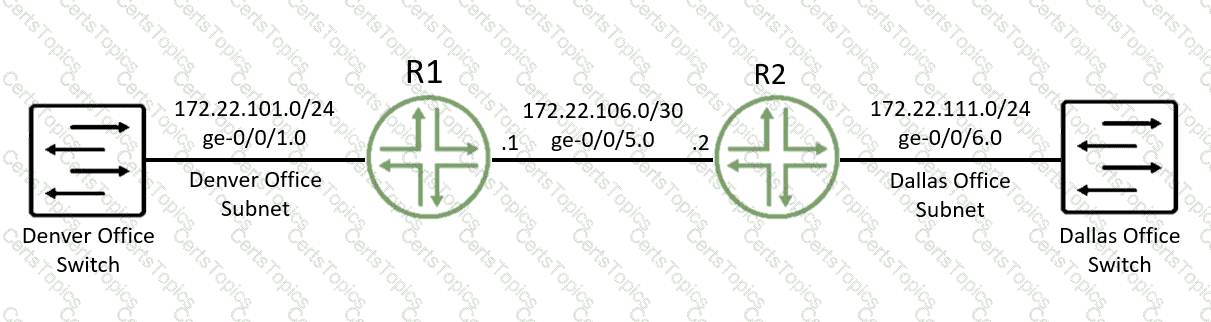
Exhibit.

You are using OSPF to advertise the subnets that are used by the Denver and Dallas offices. The routers that are directly connected to the Dallas and Denver subnets are not advertising the connected subnets.

Referring to the exhibit, which two statements are correct? (Choose two.)

Options:

A.

Create static routes on the switches using the local vMX router ' s loopback interface for the next hop.

B.

Configure and apply a routing policy that redistributes the Dallas and Denver subnets using Type 5 LSAs.

C.

Configure and apply a routing policy that redistributes the connected Dallas and Denver subnets.

D.

Enable the passive option on the OSPF interfaces that are connected to the Dallas and Denver subnets.

Question 16

Which statement about aggregate routes is correct?

Options:

A.

Aggregate routes can only be used for static routing but not for dynamic routing protocols.

B.

Aggregate routes are automatically generated for all of the subnets in a routing table.

C.

Aggregate routes are always preferred over more specific routes, even when the specific routes have a better path.

D.

Aggregate routes are used for advertising summarized network prefixes.

Page: 4 / 8
Total 107 questions