
A customer wants to avoid using RadSec between AOS-CX switches and ClearPass Policy Manager (CPPM) in order to reduce the need to manage switch certificates. Given this condition, what can you recommend to enhance security?
Refer to the scenario.
A customer has AOS-CX switches with this configuration on their edge ports:
port-access onboarding-method concurrent enable
aaa authentication port-access mac-auth enable
quiet-period 60
aaa authentication port-access dot1x authenticator enable
The switch authenticates clients to HPE Aruba Networking ClearPass Policy Manager (CPPM), which has these services:
An 802.1X service that uses an EAP-TLS method for most clients
A MAC-Auth service that uses the [MAC-Auth] method for devices such as printers imported from an inventory manager
The customer now wants to give limited access to wired guest devices and new devices that must be enrolled with certificates. You have configured these rights in an AOS-CX role named "guest-login."
How should the "guest-login" role be applied on the switches?
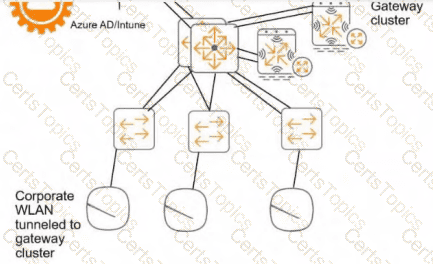
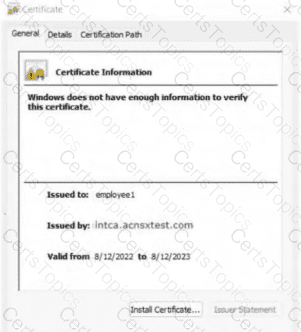
Introduction to the customer
You are assisting a company with adding HPE Aruba Networking ClearPass to its network, which uses HPE Aruba Networking network-infrastructure devices.
The company already has a Windows domain and Windows CA. The Windows CA issues certificates to domain computers, domain users, and servers such as domain controllers.
ClearPass cluster IP addressing and hostnames
Publisher = 10.47.47.5
Subscriber 1 = 10.47.47.6
Subscriber 2 = 10.47.47.7
Virtual IP with Subscriber 1 and Subscriber 2 = 10.47.47.8
Refer to the scenario.
You created a role-mapping policy as displayed in the exhibits below.
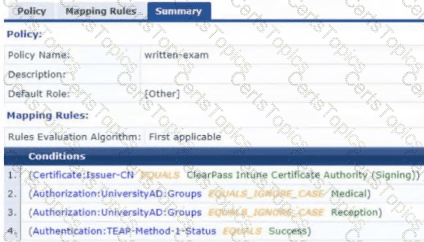
Policy Name: written-exam
Rules Evaluation Algorithm: First applicable
Conditions:
1. (Certificate:Issuer-CN EQUALS ClearPass Intune Certificate Authority (Signing))
2. (Authorization:UniversityAD:Groups EQUALS_IGNORE_CASE Medical)
3. (Authorization:UniversityAD:Groups EQUALS_IGNORE_CASE Reception)
4. (Authentication:TEAP-Method-1-Status EQUALS Success)
What one change must you make to this policy?
A customer has an AOS-10 architecture managed by HPE Aruba Networking Central. HPE Aruba Networking infrastructure devices authenticate clients against an HPE Aruba Networking ClearPass cluster.
In HPE Aruba Networking Central, you are reviewing network traffic flows for a wireless IoT device categorized as a “Raspberry Pi” client. You observe SSH traffic. You then review several additional wireless IoT clients and find that they are also sending SSH.
Refer to the scenario.
You are assisting the customer in assessing ways to mitigate the potential threat detected. For the foreseeable future, until the security team has addressed the threat, the company wants to block most traffic from any IoT client detected sending SSH traffic. The company does want to allow limited access for these clients so that administrators can remediate them remotely.
What action should you take?
Copyright © 2021-2026 CertsTopics. All Rights Reserved
