
Refer to the exhibit.
An administrator has configured a remote mirror between an AOS-CX switch and a station running a protocol analyzer. The exhibit displays a sample of the packet capture.
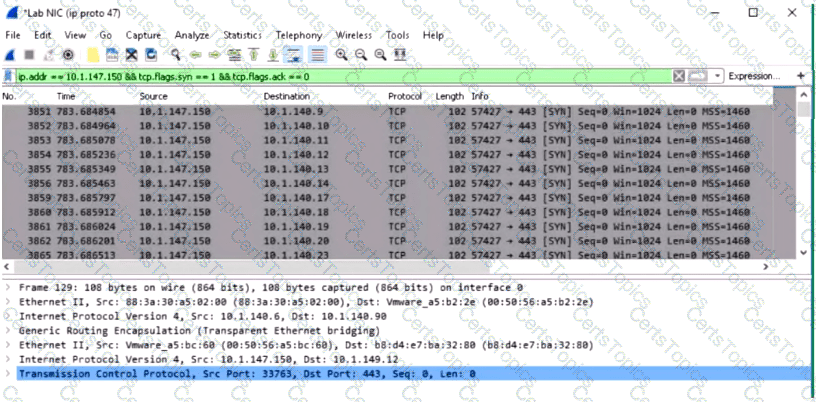
Packet trace details:
Source: 10.1.147.150 - > Destination: 10.1.140.9 TCP 57427 - > 443 [SYN] Seq=0 Len=0
Source: 10.1.147.150 - > Destination: 10.1.140.10 TCP 57427 - > 443 [SYN] Seq=0 Len=0
Source: 10.1.147.150 - > Destination: 10.1.140.11 TCP 57427 - > 443 [SYN] Seq=0 Len=0
Source: 10.1.147.150 - > Destination: 10.1.140.12 TCP 57427 - > 443 [SYN] Seq=0 Len=0
Source: 10.1.147.150 - > Destination: 10.1.140.13 TCP 57427 - > 443 [SYN] Seq=0 Len=0
Packet encapsulation tree shows Generic Routing Encapsulation (Transparent Ethernet bridging).
Which characteristic is suspicious?
A customer has an HPE Aruba Networking ClearPass cluster. The customer has AOS-CX switches that use 802.1X authentication with HPE Aruba Networking ClearPass Policy Manager (CPPM).
The switches use local port-access policies. The customer wants to begin tunneling wired clients that pass user authentication only to an HPE Aruba Networking gateway cluster. The gateway cluster must assign these clients the eth-internet role. The gateway must also assign the clients to VLAN 20.
The planned enforcement policy and profiles are shown below:
* Policy: `written-exam-3`
* Profile: `written-exam-b`
The gateway cluster contains two gateways with these IP addresses:
Gateway 1: VLAN 4085 (system IP) = 10.20.4.21 | VLAN 20 (users) = 10.20.20.1 | VLAN 4094 (WAN) = 198.51.100.14
Gateway 2: VLAN 4085 (system IP) = 10.20.4.22 | VLAN 20 (users) = 10.20.20.2 | VLAN 4094 (WAN) = 198.51.100.12 | VRRP on VLAN 20 = 10.20.20.254
The customer requires high availability for tunnels between the switches and the gateway cluster. If one gateway fails, the other gateway must take over its tunnels. The switch must also be able to discover the gateway cluster whether either gateway is in the cluster.
Refer to the scenario.
What is one change that should be made to the solution?
A customer uses an AOS-10 architecture that includes HPE Aruba Networking APs. Administrators recently enabled WIDS at the High level and also enabled alerts and email notifications for several events.
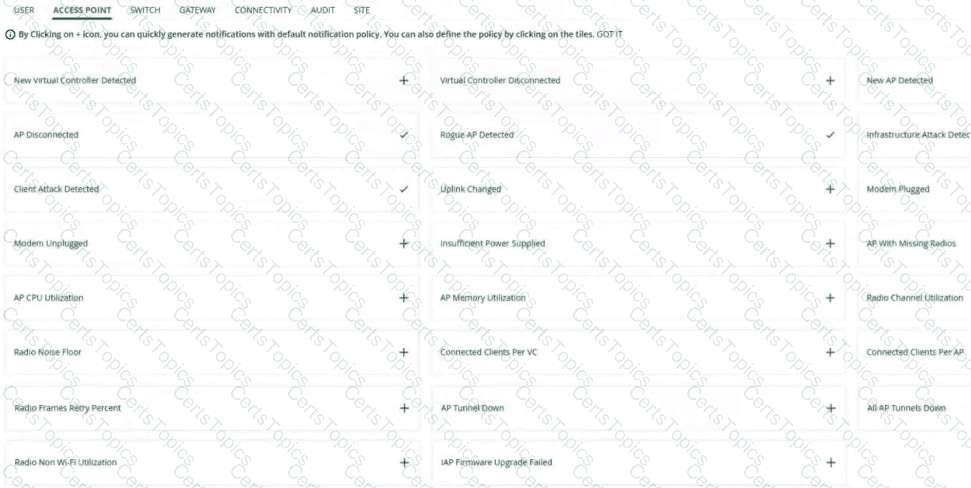
Administrators report receiving so many emails that they must ignore them and are considering disabling all notifications. What is one step you could recommend trying first?
An HPE Aruba Networking Mobility Controller is configured with the following commands:
`aaa rfc-3576-server 10.1.2.3 key mysecretkey & ^%!7531 replay-protection window-duration 300`
Later, this output is displayed:
`(host)#show aaa rfc-3576-server statistics`
`RADIUS RFC 3576 Statistics - 10.1.2.3`
`Disconnect Requests: 2534 | Disconnect Accepts: 2534 | Disconnect Rejects: 0`
`No Secret: 0 | No Session ID: 0 | Bad Authenticator: 0 | Invalid Request: 0`
`Packets Dropped: 1431 | Unknown service: 0`
`CoA Requests: 2453 | CoA Accepts: 1022 | CoA Rejects: 0 | No permission: 0`
What should be investigated?
Copyright © 2021-2026 CertsTopics. All Rights Reserved
