
The customer needs a secure wireless solution that lets users onboard new wireless clients. You are recommending a new WLAN that will give users limited access for this process.
Which WLAN security should you recommend, assuming users have a mixture of WPA2- and WPA3-capable devices?
A customer has an AOS-10 architecture managed by HPE Aruba Networking Central. HPE Aruba Networking infrastructure devices authenticate clients against an HPE Aruba Networking ClearPass cluster.
In HPE Aruba Networking Central, you are reviewing network traffic flows for a wireless IoT device categorized as "Raspberry Pi" clients. You observe SSH traffic. You then review several additional wireless IoT clients and find that they are also sending SSH.
Refer to the scenario.
You are assisting the customer in evaluating ways to mitigate the potential threat detected. The customer wants to temporarily block misbehaving clients for a penalty period. If a client reconnects and no longer sends SSH traffic, it should be permitted to stay connected.
What approach should you take?
A company uses an HPE Aruba Networking EdgeConnect SD-Branch solution. The customer wants to integrate the solution with HPE Aruba Networking SSE.
What is one step that must be completed in HPE Aruba Networking SSE and is not automated as part of the typical setup?
Refer to the exhibit, which depicts the topology for an HPE Aruba Networking network.
* Gateways: GW1 (10.1.30.2 / 10.1.36.2), GW2 (10.1.30.3 / 10.1.36.3), VRRP: 10.1.36.1
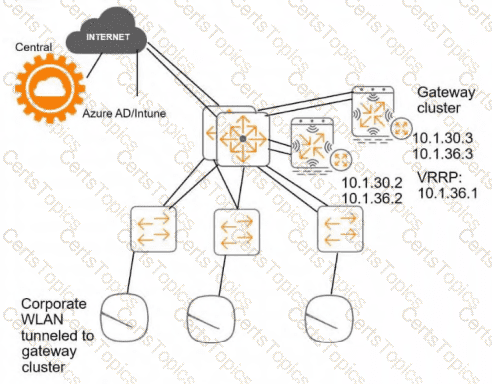
The gateways have sent the following logs to your Syslog server:
```text
< 142 > Jan 9 18:01:15 GW1 authmgr[6118]: < 124039 > < 6118 > Time-range night-hours activated
< 142 > Jan 9 18:01:15 GW1 authmgr[6118]: < 124040 > < 6118 > Time-range working-hours deactivated
< 142 > Jan 9 18:13:07 GW2 authmgr[6159] : < 124709 > < 6159 > Drop ARP-packet with unknown-IP: smac:a0:e7:7b:97:a2:98 sender-mac: a0:e7:7b:97:a2:98 sender-ip:10.1.30.2
< 142 > Jan 9 18:13:38 GW2 authmgr[6159]: < 124709 > < 6159 > Drop ARP-packet with unknown-IP: smac: a0:e7:7b:97:a2:98 sender-mac: a0:e7:7b:97:a2:98 sender-ip:10.1.30.2
< 142 > Jan 9 18:21:24 GW2 isakmpd[6132]: < 103076 > < 6132 > IKEv2 IPSEC Tunnel created for peer 10.1.30.2:500
< 142 > Jan 9 18:21:24 GW2 isakmpd[6132]: < 103101 > < 6132 > IPSEC SA deleted for peer 10.1.30.2
< 142 > Jan 9 18:21:24 GW2 isakmpd[6132]: < 103078 > < 6132 > IKEv2 CHILDSA successful for peer 10.1.30.2:500
< 142 > Jan 9 18:21:26 GW1 isakmpd[6091]: < 103076 > < 6091 > IKEv2 IPSEC Tunnel created for peer 10.1.30.3:500
< 142 > Jan 9 18:21:26 GW1 isakmpd[6091]: < 103101 > < 6091 > IPSEC SA deleted for peer 10.1.30.3
< 142 > Jan 9 18:21:26 GW1 isakmpd[6091]: < 103078 > < 6091 > IKEv2 CHILDSA successful for peer 10.1.30.3:500
```
What potential security issue can be identified from these logs?
A customer wants to avoid using RadSec between AOS-CX switches and ClearPass Policy Manager (CPPM) in order to reduce the need to manage switch certificates. Given this condition, what can you recommend to enhance security?
Refer to the scenario.
A customer has AOS-CX switches with this configuration on their edge ports:
port-access onboarding-method concurrent enable
aaa authentication port-access mac-auth enable
quiet-period 60
aaa authentication port-access dot1x authenticator enable
The switch authenticates clients to HPE Aruba Networking ClearPass Policy Manager (CPPM), which has these services:
An 802.1X service that uses an EAP-TLS method for most clients
A MAC-Auth service that uses the [MAC-Auth] method for devices such as printers imported from an inventory manager
The customer now wants to give limited access to wired guest devices and new devices that must be enrolled with certificates. You have configured these rights in an AOS-CX role named "guest-login."
How should the "guest-login" role be applied on the switches?
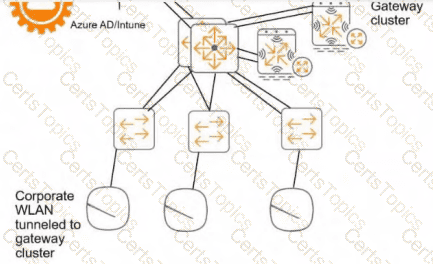
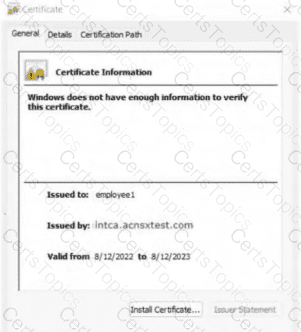
Introduction to the customer
You are assisting a company with adding HPE Aruba Networking ClearPass to its network, which uses HPE Aruba Networking network-infrastructure devices.
The company already has a Windows domain and Windows CA. The Windows CA issues certificates to domain computers, domain users, and servers such as domain controllers.
ClearPass cluster IP addressing and hostnames
Publisher = 10.47.47.5
Subscriber 1 = 10.47.47.6
Subscriber 2 = 10.47.47.7
Virtual IP with Subscriber 1 and Subscriber 2 = 10.47.47.8
Refer to the scenario.
You created a role-mapping policy as displayed in the exhibits below.
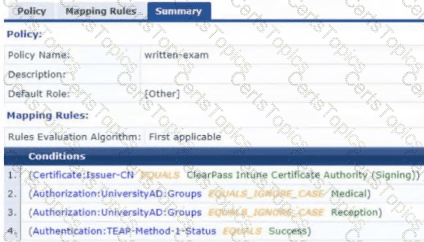
Policy Name: written-exam
Rules Evaluation Algorithm: First applicable
Conditions:
1. (Certificate:Issuer-CN EQUALS ClearPass Intune Certificate Authority (Signing))
2. (Authorization:UniversityAD:Groups EQUALS_IGNORE_CASE Medical)
3. (Authorization:UniversityAD:Groups EQUALS_IGNORE_CASE Reception)
4. (Authentication:TEAP-Method-1-Status EQUALS Success)
What one change must you make to this policy?
A customer has an AOS-10 architecture managed by HPE Aruba Networking Central. HPE Aruba Networking infrastructure devices authenticate clients against an HPE Aruba Networking ClearPass cluster.
In HPE Aruba Networking Central, you are reviewing network traffic flows for a wireless IoT device categorized as a “Raspberry Pi” client. You observe SSH traffic. You then review several additional wireless IoT clients and find that they are also sending SSH.
Refer to the scenario.
You are assisting the customer in assessing ways to mitigate the potential threat detected. For the foreseeable future, until the security team has addressed the threat, the company wants to block most traffic from any IoT client detected sending SSH traffic. The company does want to allow limited access for these clients so that administrators can remediate them remotely.
What action should you take?
Refer to the exhibit.
An administrator has configured a remote mirror between an AOS-CX switch and a station running a protocol analyzer. The exhibit displays a sample of the packet capture.
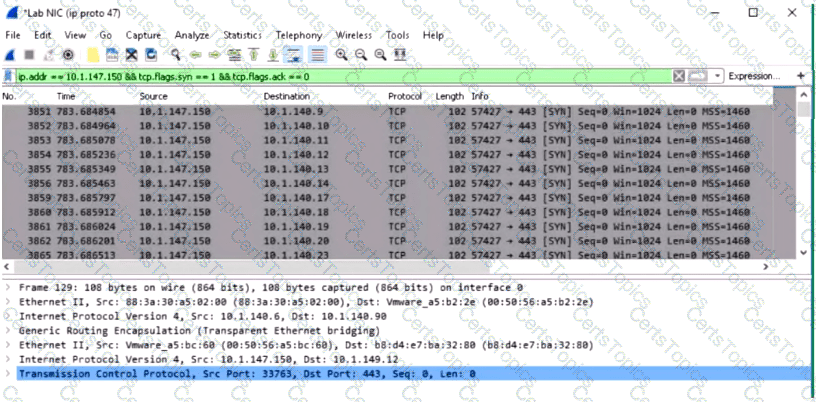
Packet trace details:
Source: 10.1.147.150 - > Destination: 10.1.140.9 TCP 57427 - > 443 [SYN] Seq=0 Len=0
Source: 10.1.147.150 - > Destination: 10.1.140.10 TCP 57427 - > 443 [SYN] Seq=0 Len=0
Source: 10.1.147.150 - > Destination: 10.1.140.11 TCP 57427 - > 443 [SYN] Seq=0 Len=0
Source: 10.1.147.150 - > Destination: 10.1.140.12 TCP 57427 - > 443 [SYN] Seq=0 Len=0
Source: 10.1.147.150 - > Destination: 10.1.140.13 TCP 57427 - > 443 [SYN] Seq=0 Len=0
Packet encapsulation tree shows Generic Routing Encapsulation (Transparent Ethernet bridging).
Which characteristic is suspicious?
A customer has an HPE Aruba Networking ClearPass cluster. The customer has AOS-CX switches that use 802.1X authentication with HPE Aruba Networking ClearPass Policy Manager (CPPM).
The switches use local port-access policies. The customer wants to begin tunneling wired clients that pass user authentication only to an HPE Aruba Networking gateway cluster. The gateway cluster must assign these clients the eth-internet role. The gateway must also assign the clients to VLAN 20.
The planned enforcement policy and profiles are shown below:
* Policy: `written-exam-3`
* Profile: `written-exam-b`
The gateway cluster contains two gateways with these IP addresses:
Gateway 1: VLAN 4085 (system IP) = 10.20.4.21 | VLAN 20 (users) = 10.20.20.1 | VLAN 4094 (WAN) = 198.51.100.14
Gateway 2: VLAN 4085 (system IP) = 10.20.4.22 | VLAN 20 (users) = 10.20.20.2 | VLAN 4094 (WAN) = 198.51.100.12 | VRRP on VLAN 20 = 10.20.20.254
The customer requires high availability for tunnels between the switches and the gateway cluster. If one gateway fails, the other gateway must take over its tunnels. The switch must also be able to discover the gateway cluster whether either gateway is in the cluster.
Refer to the scenario.
What is one change that should be made to the solution?
A customer uses an AOS-10 architecture that includes HPE Aruba Networking APs. Administrators recently enabled WIDS at the High level and also enabled alerts and email notifications for several events.
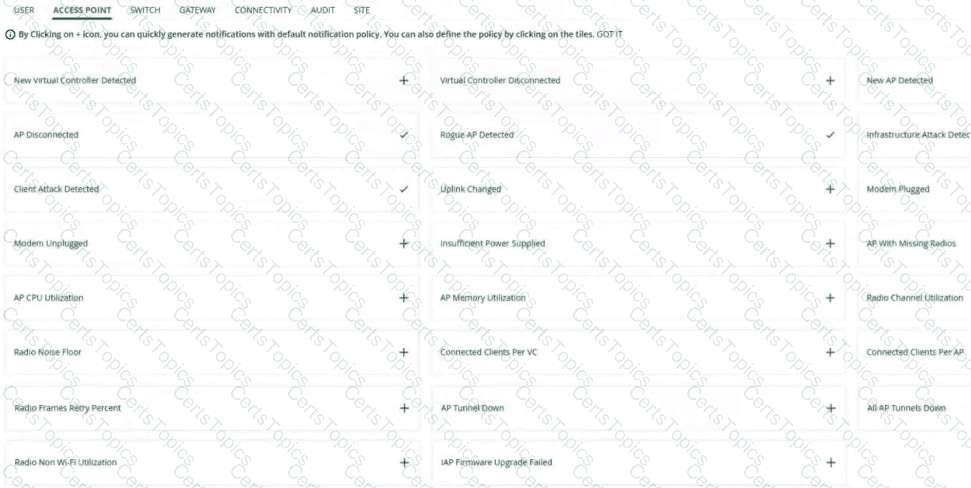
Administrators report receiving so many emails that they must ignore them and are considering disabling all notifications. What is one step you could recommend trying first?
An HPE Aruba Networking Mobility Controller is configured with the following commands:
`aaa rfc-3576-server 10.1.2.3 key mysecretkey & ^%!7531 replay-protection window-duration 300`
Later, this output is displayed:
`(host)#show aaa rfc-3576-server statistics`
`RADIUS RFC 3576 Statistics - 10.1.2.3`
`Disconnect Requests: 2534 | Disconnect Accepts: 2534 | Disconnect Rejects: 0`
`No Secret: 0 | No Session ID: 0 | Bad Authenticator: 0 | Invalid Request: 0`
`Packets Dropped: 1431 | Unknown service: 0`
`CoA Requests: 2453 | CoA Accepts: 1022 | CoA Rejects: 0 | No permission: 0`
What should be investigated?
Refer to the scenario.
A customer uses an AOS-10 architecture managed by HPE Aruba Networking Central. HPE Aruba Networking infrastructure devices authenticate clients to an HPE Aruba Networking ClearPass cluster.
In HPE Aruba Networking Central, you are reviewing network traffic flows for a wireless IoT device categorized as a “Raspberry Pi” client. You observe SSH traffic. You then examine several additional wireless IoT clients and find that they are also sending SSH.
You want a relatively easy way to communicate to HPE Aruba Networking CPPM that an IoT client has used SSH.
What is one prerequisite?
A customer is migrating from on-premises AD to Microsoft Entra ID (Azure AD) as its only domain solution. The customer also manages wired and wireless devices with Microsoft Endpoint Manager (Intune).
The customer wants to strengthen security at the network edge. You are assisting with the design of an HPE Aruba Networking ClearPass deployment for this purpose. HPE Aruba Networking devices will authenticate wired and wireless clients to a ClearPass Policy Manager (CPPM) cluster that uses version 6.10.
The customer has several authentication requirements. Clients must pass EAP-TLS authentication only when a Microsoft Entra ID (Azure AD) query confirms that they have Microsoft Entra ID (Azure AD) accounts. To further refine client privileges, ClearPass must also use information gathered by Intune to make access-control decisions.
Refer to the scenario.
Assume that the Microsoft Entra ID (Azure AD) deployment has the required prerequisites in place.
You are planning the CPPM authentication source that you will use as the authentication source in 802.1X services. How should you configure this authentication source?
A company wants its AOS-CX switches to obtain certificates from ClearPass Onboard and use those certificates to implement RadSec with ClearPass Policy Manager (CPPM).
ClearPass Onboard has a CA with EST enabled and this EST URL:
ClearPass Guest has an account whose username is `switchcorp123`. (Assume CPPM also has a valid service to authenticate users who access the EST application.)
CPPM has a network-device account for the switches with RadSec enabled. The RadSec settings validate by CN or SAN using this regex: `switchcorp123`
ClearPass has these certificates:
* HTTPS certificate signed by DigiCert
* RadSec certificate signed by DigiCert
* RADIUS/EAP certificate signed by MyDomainCA
This configuration is on the AOS-CX switches:
```text
crypto pki est-profile est1
url
username switchcorp123
password plaintext %FY212h & zaTk
vrf default
exit
crypto pki certificate cert1
subject switchcorp123
enroll est-profile onboard
crypto pki application radsec-client certificate cert1
```
The switches’ TA-profile list includes DigiCert.
Assume you have obtained the correct password associated with the indicated username. What error or errors are present?
A customer has an AOS-10 architecture managed by HPE Aruba Networking Central. HPE Aruba Networking infrastructure devices authenticate clients against an HPE Aruba Networking ClearPass cluster.
In HPE Aruba Networking Central, you are reviewing network traffic flows for a wireless IoT device categorized as "Raspberry Pi" clients. You observe SSH traffic. You then review several additional wireless IoT clients and find that they are also sending SSH.
Refer to the scenario.
You are helping the customer evaluate ways to mitigate the potential threat that was detected. The customer suggests simply adding a rule that denies SSH traffic to the IoT client’s AOS user role.
What is the security drawback of this approach?
A hospital uses an AOS-10 architecture managed through HPE Aruba Networking Central. The customer has deployed a pair of HPE Aruba Networking 9000 Series gateways with Security licenses at every clinic. The gateways run IDS/IPS in IDS mode.
The Security Dashboard displays several recent events with the same signature, as shown below:
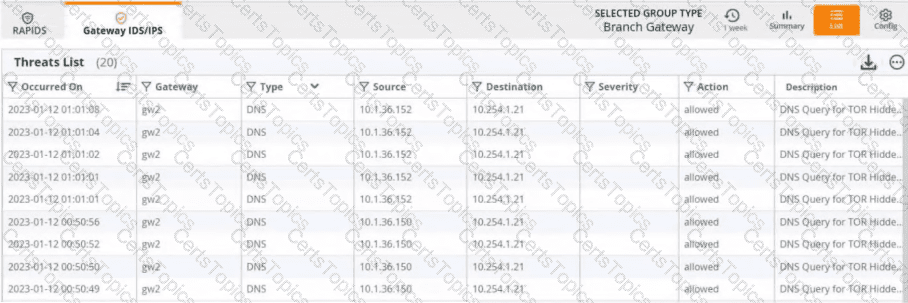
Occurred On: 2023-01-12 | Gateway: gw2 | Type: DNS | Source: 10.1.36.152 | Destination: 10.254.1.21 | Action: allowed | Description: DNS Query for TOR Hidden...
Which action could provide valuable context about the incident?
You want to use HPE Aruba Networking ClearPass Device Insight tags as conditions in CPPM role-mapping or enforcement-policy rules.
Which guidelines should you follow?
You are helping a company add HPE Aruba Networking ClearPass to its network, which uses HPE Aruba Networking infrastructure devices.
The company already has a Windows domain and Windows CA. The Windows CA issues certificates to domain computers, domain users, and servers such as domain controllers.
ClearPass cluster IP addressing and hostnames
Publisher = 10.47.47.5
Subscriber 1 = 10.47.47.6
Subscriber 2 = 10.47.47.7
Virtual IP with Subscriber 1 and Subscriber 2 = 10.47.47.8
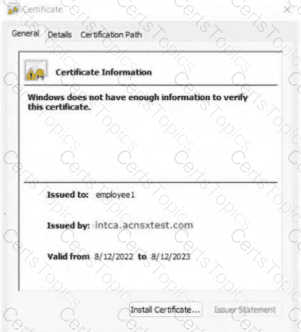
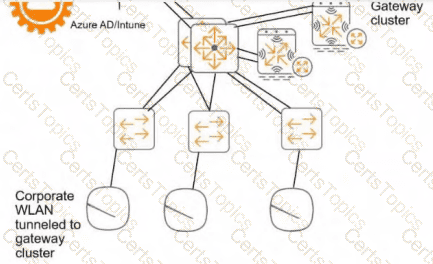
Refer to the scenario.
You have begun creating a CA to meet the customer's requirements for issuing certificates to mobile clients, as shown in the exhibit below.
Certificate Authority Settings:
Name: Exam Onboard CA
Mode: Root CA
Authority Info Access: Do not include OCSP Responder URL
Validity Period: 365 days
Clock Skew Allowance: 15
Subject Alternative Name: [X] Include device information in TLS client certificates
Digest Algorithm: SHA-512
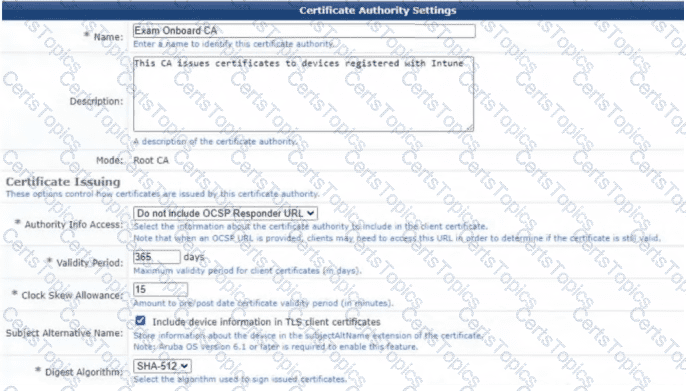
What change will help meet those requirements and the requirements for authenticating clients?
A company has HPE Aruba Networking gateways and plans to begin implementing gateway IDS/IPS. The customer has chosen Block as the Fail Strategy.
What could you recommend to help reduce unexpected outages caused by this particular fail strategy?
Introduction to the customer
You are assisting a company with adding HPE Aruba Networking ClearPass to its network, which uses HPE Aruba Networking network-infrastructure devices.
The company already has a Windows domain and Windows CA. The Windows CA issues certificates to domain computers, domain users, and servers such as domain controllers.
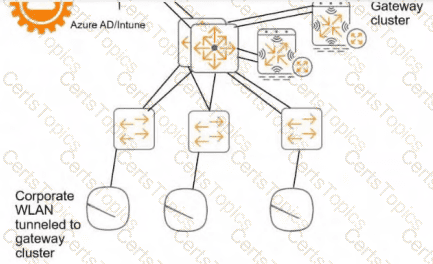
ClearPass cluster IP addressing and hostnames
Publisher = 10.47.47.5
Subscriber 1 = 10.47.47.6
Subscriber 2 = 10.47.47.7
Virtual IP with Subscriber 1 and Subscriber 2 = 10.47.47.8
Refer to the scenario.
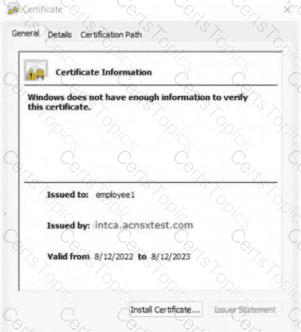
You imported the root certificate for the Windows CA into the ClearPass CA Trust list. Based on the scenario requirements, which usages should be added to it?
A company uses an HPE Aruba Networking AOS-10 mobility infrastructure. Network administrators recently enabled wireless detection on the APs, which checks for all infrastructure and client threats. However, the administrators quickly became overwhelmed and now want to disable most checks.
They want a recommendation for the checks most likely to indicate genuine threats.
Which one should be mentioned?
Copyright © 2021-2026 CertsTopics. All Rights Reserved
