New Year Sale 70% Discount Offer - Ends in 0d 00h 00m 00s - Coupon code: save70

Fortinet Certified Solution Specialist FCSS_NST_SE-7.6 Book

Fortinet NSE 6 - Network Security 7.6 Support Engineer Questions and Answers

Question 21

Refer to the exhibits.

FGT-1 is an area border router (ABR) that has interfaces in OSPF areas 0.0.0.0 and 0.0.0.5. FGT-3 acts as an autonomous system border router (ASBR), importing static routes into OSPF. FGT-2 is an internal router with all its interfaces belonging to area 0.0.0.5. FGT-1 is receiving all advertised routes from FGT-2, however, FGT-3 is not receiving any of the advertised routes from FGT-1. What is the most likely reason for this? (Choose one answer)

Options:

A.

Area 0.0.0.5 is configured not to propagate type 5 LSAs.

B.

FGT-2 is configured with a distribution list to block all advertised routes from FGT-3.

C.

FGT-3 and FGT-2 have not formed an OSPF adjacency yet.

D.

IP protocol 89 is blocked between FGT-1 and FGT-3.

Question 22

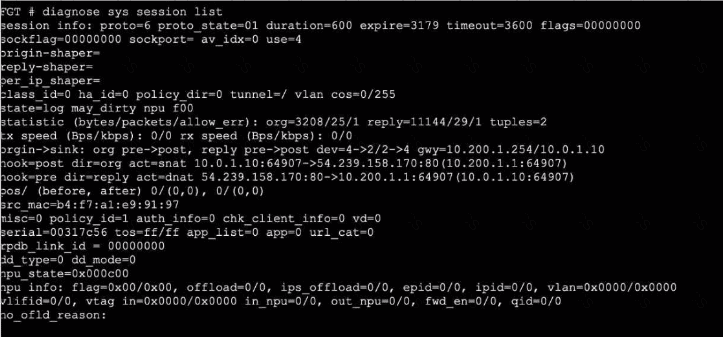
Refer to the exhibit, which shows the partial output of a diagnose command.

Which two conclusions can you draw from the output shown in the exhibit? (Choose two.)

Options:

A.

FortiGate will drop the expected traffic if it does not arrive within 23 seconds.

B.

Clearing the master session has no impact on the expectation session.

C.

This is a pinhole session to allow traffic for a TCP protocol that dynamically assigns TCP ports.

D.

The session is checked against firewall policy ID 25.

Question 23

Refer to the exhibit, which shows the output o! the BGP database.

Which two statements are correct? (Choose two.)

Options:

A.

The advertised prefix of 10.20.30.0/24 was configured using the network command.

B.

The first four prefixes are being advertised using a legacy route advertisement.

C.

The advertised prefix of 10.20.30.0/24 is being advertised through the redistribution of another routing protocol.

D.

The output shows all prefixes advertised by all neighbors as well as the local router.

Question 24

Refer to the exhibit.

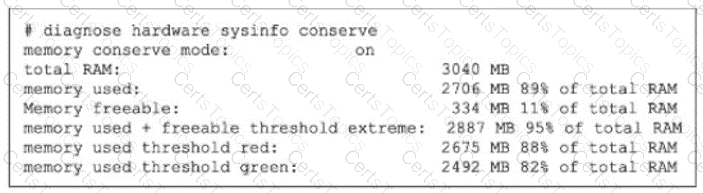
Partial output of diagnose sys session stat command is shown.

An administrator has noticed unusual behavior from FortiGate. It appears that sessions are randomly removed. Which two reasons could explain this? (Choose two.)

Options:

A.

FortiGate is deleting sessions because the kernel cannot allocate more memory pages

B.

FortiGate is dropping all TCP sessions with incomplete three-way handshakes.

C.

FortiGate is not accepting sessions because the device has been down 10 out of 120 seconds.

D.

FortiGate is flushing sessions because of high memory usage.