Which three end user logs does FortiAnalyzer use to identify possible IOC compromised hosts? (Choose three answers)
Exhibit:
Which observation about this FortiAnalyzer Fabric deployment architecture is true?
Review the incident report:
An attacker identified employee names, roles, and email patterns from public press releases, which were then used to craft tailored emails.
The emails were directed to recipients to review an attached agenda using a link hosted off the corporate domain.
Which two MITRE ATT & CK tactics best fit this report? (Choose two answers)
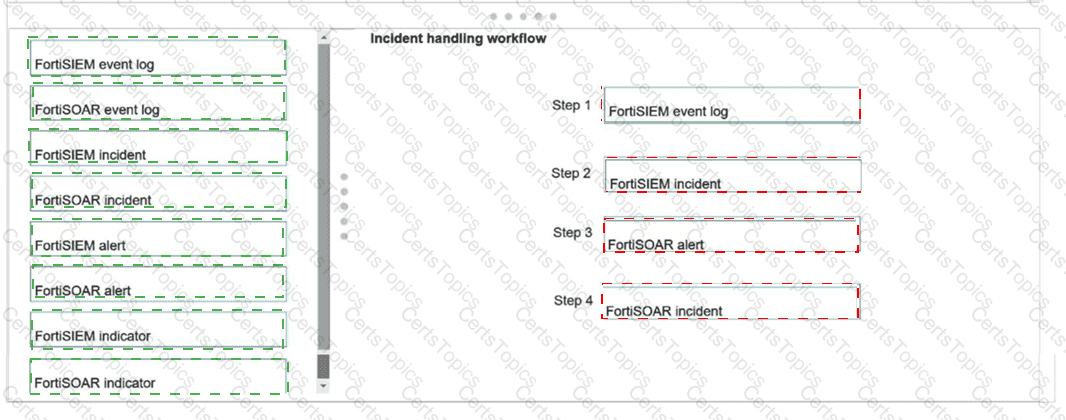
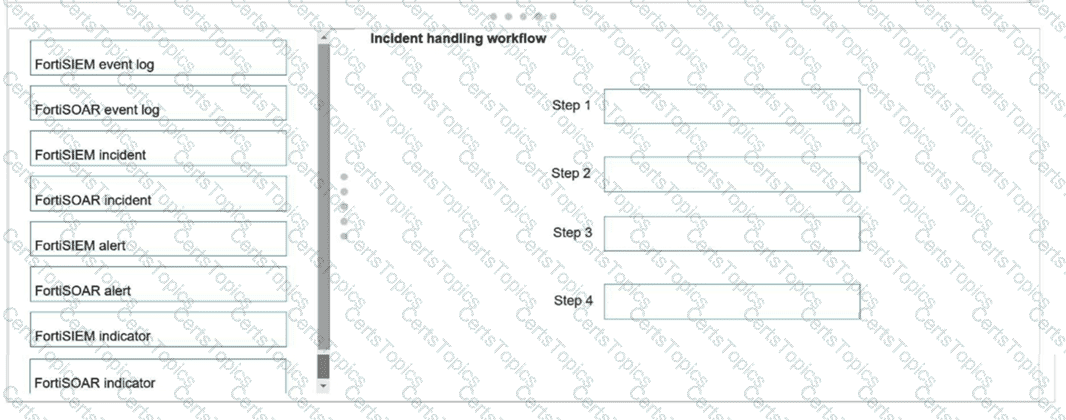
Using the default data ingestion wizard in FortiSOAR, place the incident handling workflow from FortiSIEM to FortiSOAR in the correct sequence. Select each workflow component in the left column, hold and drag it to a blank position in the column on the right. Place the four correct workflow components in order, placing the first step in the first position at the top of the column.
Refer to the exhibit.
You notice that the custom event handler you configured to detect SMTP reconnaissance activities is creating a large number of events. This is overwhelming your notification system.
How can you fix this?
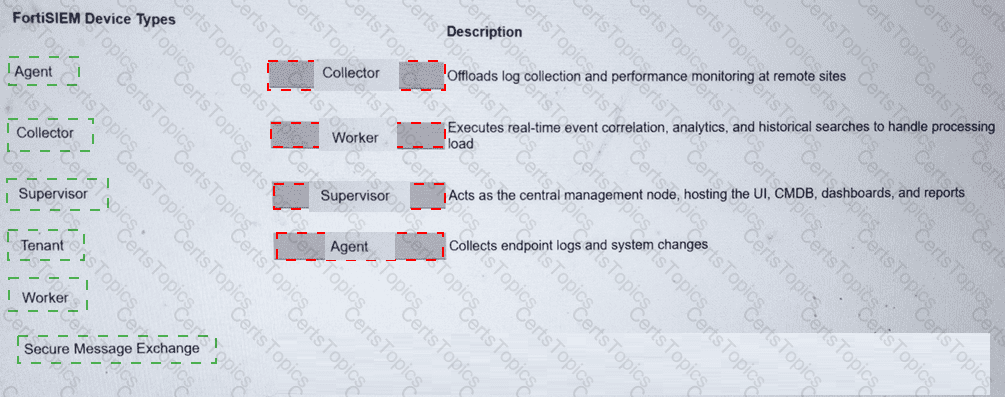
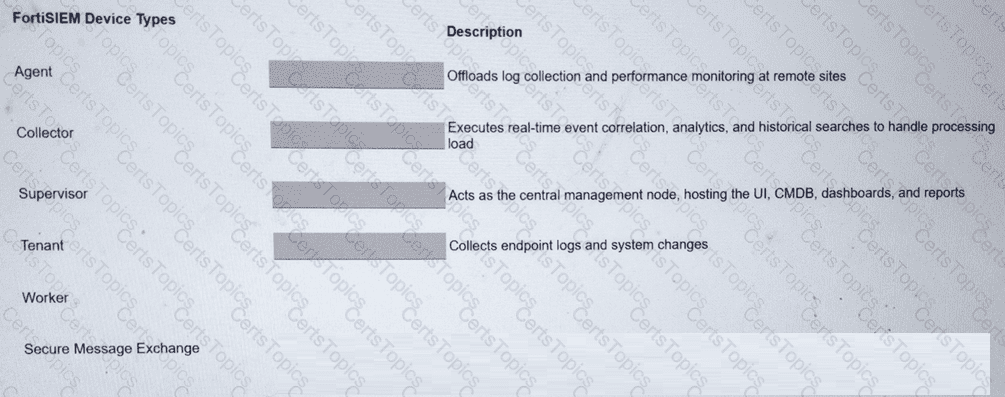
Match the FortiSIEM device type to its description. Select each FortiSIEM device type in the left column, hold and drag it to the blank space next to its corresponding description in the column on the right.
Which two statements accurately describe the Custom API Endpoint playbook trigger? Choose two answers.
Refer to the exhibit.
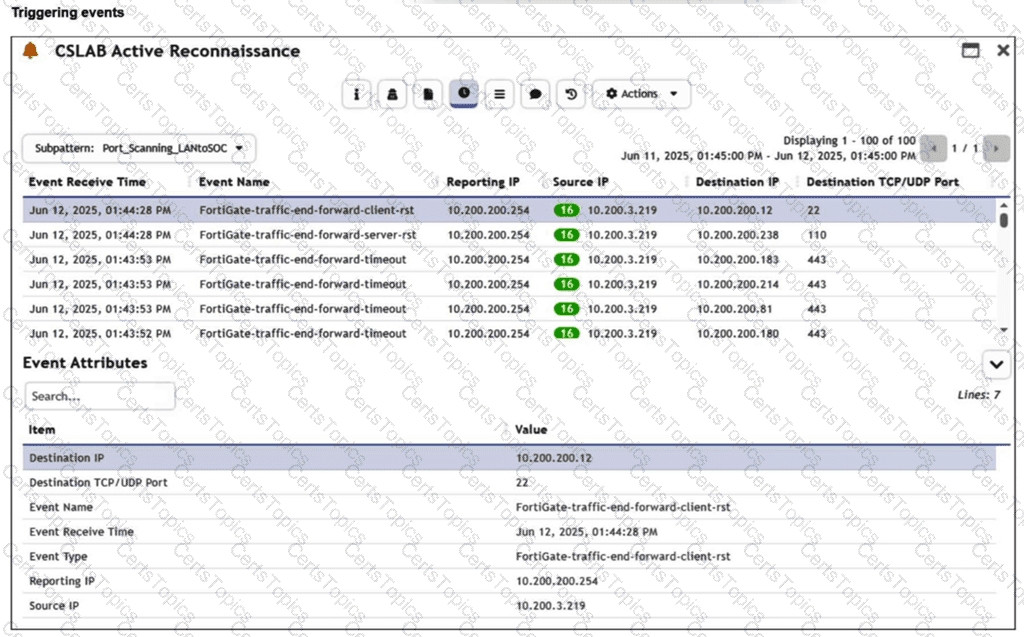
You are reviewing the Triggering Events page for a FortiSIEM incident. You want to remove the Reporting IP column because you have only one firewall in the topology. How do you accomplish this? (Choose one answer)
Refer to the exhibit,
which shows the partial output of the MITRE ATT & CK Enterprise matrix on FortiAnalyzer.
Which two statements are true? (Choose two.)
Refer to the exhibits.
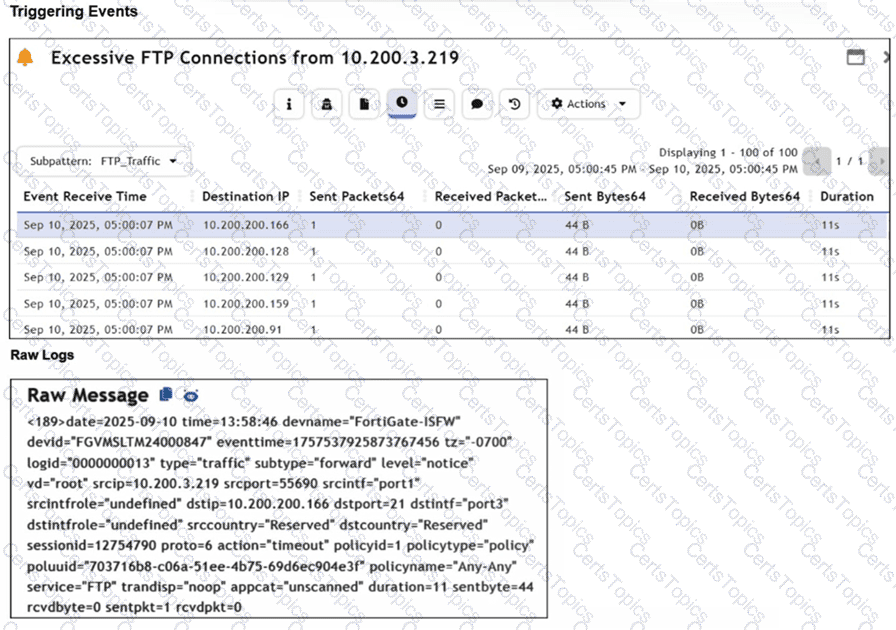
Assume that the traffic flows are identical, except for the destination IP address. There is only one FortiGate in network address translation (NAT) mode in this environment.
Based on the exhibits, which two conclusions can you make about this FortiSIEM incident? (Choose two answers)
Refer to the exhibit.
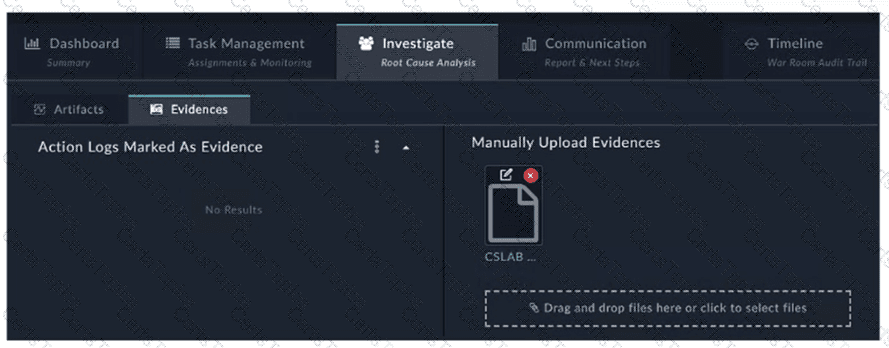
How do you add a piece of evidence to the Action Logs Marked As Evidence area? (Choose one answer)
A FortiSOAR playbook includes a Wait step that is configured to pause execution after initiating a reputation lookup on an indicator. Which two configurations of the Wait step are valid? Choose two answers.
Review the following incident report:
Attackers leveraged a phishing email campaign targeting your employees.
The email likely impersonated a trusted source, such as the IT department, and requested login credentials.
An unsuspecting employee clicked a malicious link in the email, leading to the download and execution of a Remote Access Trojan (RAT).
The RAT provided the attackers with remote access and a foothold in the compromised system.
Which two MITRE ATT & CK tactics does this incident report capture? (Choose two.)
Refer to the exhibit.
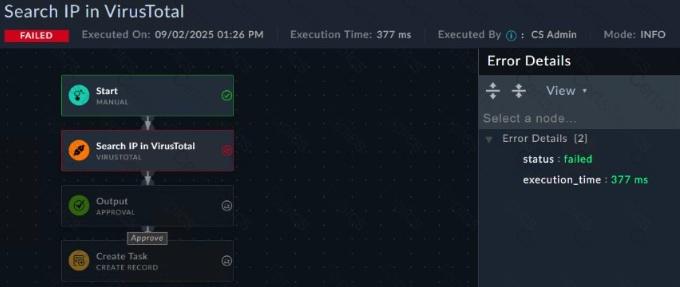
You created a new playbook and executed it as a test. However, it failed to run. You want to investigate, but you do not see details about the error. What is the reason for the lack of details?
What are three capabilities of the built-in FortiSOAR Jinja editor? (Choose three answers)
Which FortiAnalyzer connector can you use to run automation stitches9
When does FortiAnalyzer generate an event?
Refer to the Exhibit:
An analyst wants to create an incident and generate a report whenever FortiAnalyzer generates a malicious attachment event based on FortiSandbox analysis. The endpoint hosts are protected by FortiClient EMS integrated with FortiSandbox. All devices are logging to FortiAnalyzer.
Which connector must the analyst use in this playbook?
You configured a new module named Users . Next, you want to configure a playbook that creates users from ingested data. When new records are created, you want to ensure that duplicate users do not overwrite existing user records and their fields. However, you also want the playbook to continue running even if duplicates are encountered so that any non-duplicate records are still created. Which two actions fulfill the requirements? Choose two answers.
Review the incident report. Shortly after being compromised, an infected host collected its own network configuration and connection details, then began sending low-volume connection attempts to multiple internal addresses to identify responding hosts. Which two MITRE ATT & CK techniques best describe this activity? Choose two answers.
Which three factors does the FortiSIEM rules engine use to determine the count when it evaluates the aggregate condition COUNT (Matched Events) on a specific subpattern? (Choose three answers)
When configuring an Ingest Bulk Feed playbook step, which two restrictions must you consider? Choose two answers.
Which role does a threat hunter play within a SOC?
Which two best practices should be followed when exporting playbooks in FortiAnalyzer? (Choose two answers)
Which two ways can you create an incident on FortiAnalyzer? (Choose two.)
Which three statements accurately describe step utilities in a playbook step? (Choose three answers)
Refer to this partial incident output:
Condition: if this pattern occurs within any 1800-second time window.
Host Interface Name: Red Hat VirtIO Ethernet Adapter
Recv Packet Errors: 0
Sent Packet Errors: 0
Recv Packet Discards: 37
Sent Packet Discards: 0
Recv Packet Error Pct: 0.00
Sent Packet Error Pct: 0.00
Recv Packet Discard Pct: 7.17
Sent Packet Discard Pct: 0.00
Avg Recv Interface Error: 0.00
Avg Sent Interface Error: 0.00
Avg Recv Interface Discard: 16.45
Avg Sent Interface Discard: 0.00
Which conclusion can you make about this incident? Choose one answer.
Copyright © 2021-2026 CertsTopics. All Rights Reserved