Winter Sale - Limited Time 65% Discount Offer - Ends in 0d 00h 00m 00s - Coupon code: top65certs

Free and Premium Snowflake DAA-C01 Dumps Questions Answers

Page: 1 / 5
Total 65 questions

SnowPro Advanced: Data Analyst Exam Questions and Answers

Question 1

A Data Analyst created a cost overview dashboard in Snowsight. Management has asked for a system date filter to easily change the time period and refresh the data in all dashboard tiles with a single filter selection.

The system date filter is shown below:
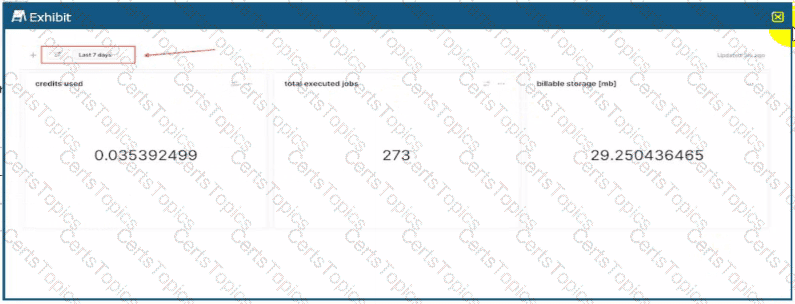
The Analyst wants to apply the filter onto individual dashboard components.

Adding which where clause to the queries will apply the filter as required?

Options:

A.

Where start_time >= dateadd('days', -7, SYSDATE())

B.

Where start_time >= dateadd('days', -7, CURRENT_TIMESTAMP())

C.

Where start_time = :date_filter

D.

Where start_time = :daterange

Buy Now
Question 2

Table TB_A with column COL_B contains an ARRAY. Which statement will select the last element of the ARRAY?

Options:

A.

SELECT GET(COL_B, ARRAY_SIZE(COL_B)-1) FROM TB_A;

B.

SELECT COL_B[ARRAY_SIZE(COL_B)] FROM TB_A;

C.

SELECT COL_B[-1] FROM TB_A;

D.

SELECT LAST_VALUE(COL_B) FROM TB_A;

Question 3

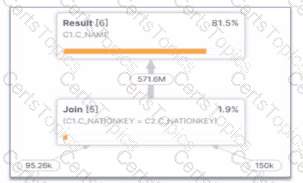
What potential problem can be identified in the Query profile below?
Options:

A.

There is query spilling.

B.

There is an exploding join

C.

There Is inefficient pruning.

D.

The query is not using a foreign Key.

Question 4

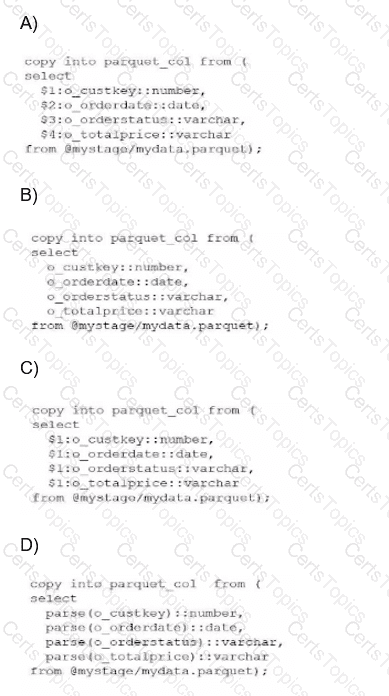
A Data Analyst has a Parquet file stored in an Amazon S3 staging area. Which query will copy the data from the staged Parquet file into separate columns in the target table?
Options:

A.

Option A

B.

Option B

C.

Option C

D.

Option D

Question 5

A Data Analyst wants to transform query results. Which transformation option will incur compute costs?

Options:

A.

Showing a thousand separator for numeric columns.

B.

Sorting a column by using the column options.

C.

Increasing or decreasing decimal precision.

D.

Formatting date and timestamp columns.

Question 6

What will the following query return?

SELECT * FROM testtable SAMPLE BLOCK (0.012) REPEATABLE (99992);

Options:

A.

A sample of a table in which each block of rows has a 1.2% probability of being included in the sample where repeated elements are allowed.

B.

A sample of a table in which each block of rows has a 0.012% probability of being included in the sample, with the seed set to 99992.

C.

A sample of a table in which each block of rows has a 1.2% probability of being included in the sample, with the seed set to 99992.

D.

A sample containing 99992 records of a table in which each block of rows has a 0.012% probability of being included in the sample.

Question 7

What functionalities are available when a Snowflake worksheet is shared with other users? (Select TWO).

Options:

A.

Users with edit permissions can view past versions of the worksheet.

B.

Collaborators can share the worksheet across Snowflake accounts.

C.

If multiple users edit and run a shared worksheet at the same time, each run of the worksheet will create a new version.

D.

If the worksheet is being edited, the collaborators will be able to see these edits in real-time.

E.

Whenever a user with permissions runs a worksheet, the existing version history of the worksheet will be overwritten.

Question 8

A Data Analyst wants to use pandas code they have previously written to process a column of text and return multiple rows of parsed output for each input value. The Analyst wants to be able to join these results with other tables in a single transaction. Which type of extensibility feature should the Analyst use?

Options:

A.

User-Defined Function (UDF)

B.

Vectorized User-Defined Table Function (UDTF)

C.

External function

D.

Stored procedure

Question 9

There are two similarly-structured and sized tables, Table_a and Table_b, in a schema with data populated in both tables. A Data Analyst is running queries as part of a preliminary analysis of the data to check the MAX value of a numeric column named num which is present in both the tables:

    Query 1: SELECT MAX(num) FROM Table_a;

    Query 2: SELECT MAX(num) FROM Table_b;

After running the queries, the Analyst observed that Query 2 ran significantly slower than Query 1. Why is this occurring?

Options:

A.

Table_b has more rows than Table_a.

B.

Table_b has a row-access policy defined.

C.

A multi-cluster warehouse was used to run Query 1.

D.

The USE_CACHED_RESULT was set to FALSE before running Query 2.

Question 10

Given the following data:

This SELECT statement is executed:

What will be the result?

Options:

A.

200

B.

2.0

C.

1.84

D.

1.8

Question 11

A Data Analyst has been analyzing customer data in several worksheets. Each worksheet contains a complex query that provides clean and prepared data for visualizations. The Analyst has also created a Customer Overview dashboard in Snowsight. How should the Analyst add the worksheets in the Customer Analysis database to the dashboard, using the LEAST amount of operational overhead?

Options:

A.

Move the worksheets into the dashboard.

B.

Copy and paste the worksheets into the dashboard.

C.

Open each worksheet, copy the query, then paste the query into the dashboard.

D.

Query the QUERY_HISTORY view to find those queries, then add the queries into the dashboard.

Question 12

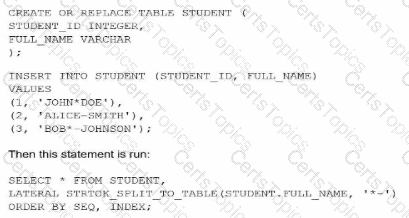
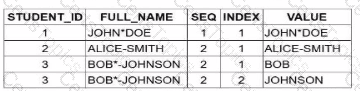
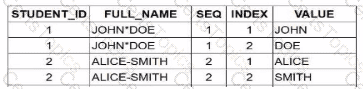
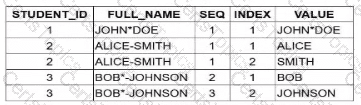
A table named STUDENT is created:

What will be the output?

A)

B)
C)
D)
Options:

A.

Option A

B.

Option B

C.

Option C

D.

Option D

Question 13

A Data Analyst is creating a Snowsight dashboard from a shared worksheet. What happens to the access and permissions of the users who initially had sharing privileges on the worksheet?

Options:

A.

The original users retain access and permissions on the worksheet.

B.

The original users gain additional access to the worksheet.

C.

The original users temporarily lose access but regain it once the dashboard is created.

D.

The original users lose access to the worksheet, their permissions on the worksheet are revoked.

Question 14

A large, complicated query is used to generate a data set for a report on the most recent month. It is taking longer than expected. A review of the Query Profile shows excessive spilling. How can the performance of the query be improved WITHOUT increasing costs?

Options:

A.

Run the query against zero-copy clones of the source tables to avoid contention with other queries.

B.

Create a materialized view clustered on a date column, on the table that is causing the spilling.

C.

Change the source tables into external tables to establish and take advantage of custom partitioning.

D.

Split the query into multiple steps, replacing Common Table Expressions (CTEs) with temporary tables to process the data in smaller batches.

Question 15

How can a Data Analyst automatically create a table structure for loading a Parquet file?

Options:

A.

Use the INFER_SCHEMA together with the CREATE TABLE LIKE command.

B.

Use INFER_SCHEMA together with the CREATE TABLE USING TEMPLATE command.

C.

Use the GENERATE_COLUMN_DESCRIPTION with the CREATE TABLE USING TEMPLATE command.

D.

Use the GENERATE_COLUMN_DESCRIPTION with the CREATE TABLE LIKE command.

Question 16

A Data Analyst has been asked to predict sales revenue through the end of the year. Which function will provide this information?

Options:

A.

CORR

B.

REGR_SLOPE

C.

COVAR_SAMP

D.

VARIANCE

Question 17

A Data Analyst has a very large table with columns that contain country and city names. Which query will provide a very quick estimate of the total number of different values of these two columns?

Options:

A.

SELECT DISTINCT COUNT(country, city) FROM TABLE1;

B.

SELECT HLL(country, city) FROM TABLE1;

C.

SELECT COUNT(DISTINCT country, city) FROM TABLE1;

D.

SELECT COUNT(country, city) FROM TABLE1;

Question 18

Which Snowflake feature or object can be used to dynamically create and execute SQL statements?

Options:

A.

User-Defined Functions (UDFs)

B.

System-defined functions

C.

Stored procedures

D.

Tasks

Question 19

A Data Analyst is working with three tables:
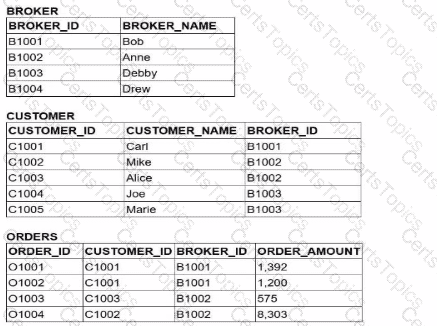
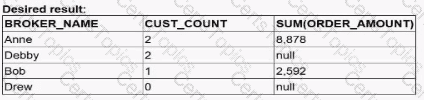
Which query would return a list of all brokers, a count of the customers each broker has. and the total order amount of their customers (as shown below)?
A)

B)
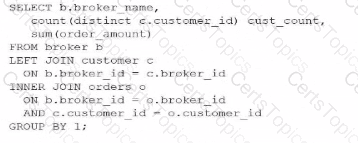
C)
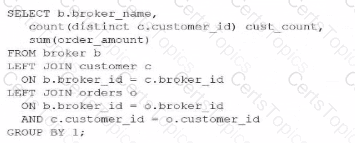
D)
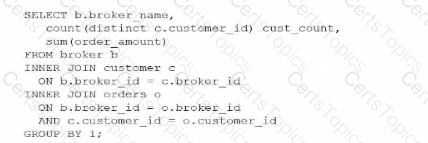
Options:

A.

Option A

B.

Option B

C.

Option C

D.

Option D

Page: 1 / 5
Total 65 questions