
Spring Sale 70% Discount Offer - Ends in 0d 00h 00m 00s - Coupon code: save70

Vce NCP-CN Questions Latest

Page: 7 / 8
Total 108 questions

Nutanix Certified Professional - Cloud Native (NCP-CN-6.10) Questions and Answers

Question 25

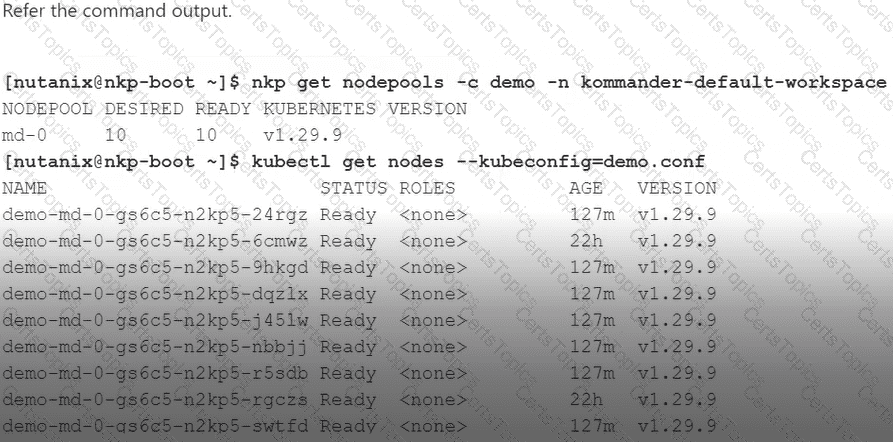
The Platform Engineer needs to expand an NKP Pro demo cluster due to workload capacity constraints. The demo cluster has 150 vCPUs available to it from a licensing standpoint. Each worker node has 8 vCPUs and each control plane node has 4 vCPUs.

Which two options are valid for expanding the demo cluster and remaining compliant with licensing? (Choose two.)

Options:

A.

Add 6 additional control planes.

B.

Expand the original worker nodepool by up to 8 nodes.

C.

Create a new worker nodepool consisting of 10 nodes with 8 vCPUs per node.

D.

Expand the original worker nodepool by up to 4 nodes and create a new worker nodepool consisting of 6 nodes with 4 vCPUs/node.

Question 26

A Platform Engineer has been tasked with backing up and restoring a production environment to ensure persistent data is available during a disaster at a primary site. What is recommended for backup and restore production use cases?

Options:

A.

Protection Domain

B.

Rook Ceph

C.

External Storage Class

D.

S3-compatible API

Question 27

A Platform Engineer needs to utilize the Konvoy Image Builder for building a custom operating system image. This image will be used to deploy clusters on various platforms. The engineer has been tasked with creating an OS image compatible with Konvoy’s requirements. In order to successfully build a compatible image using the Konvoy Image Builder, the engineer needs to ensure that a development environment meets the necessary prerequisites.

Which system is required to create a compatible OS image with the Konvoy Image Builder?

Options:

A.

A lambda instance within an AWS account

B.

A virtualized arm64 environment using KVM

C.

A 32-bit Windows machine with a USB connection

D.

An x86_64-based Linux or MacOS Machine

Question 28

A Platform Engineer is deploying an NKP cluster within an air-gapped AWS environment. However, after an infrastructure planning session with the network team, it’s been determined that the default CIDR block range that is used by pods on NKP clusters is already in use in their environment.

How can the engineer ensure there are no collisions between NKP pod traffic and the existing network using that subnet range?

Options:

A.

Because the environment is air-gapped, there will be no network traffic collision concerns and no adjustment needs to be made to the pod network CIDR block range.

B.

Create an NKP infrastructure provider for AWS in the NKP UI.

Select the Advanced Options button from the Network section of the Create Cluster page and specify a unique CIDR block range within the pod network field.

C.

Create the NKP cluster’s manifest using the nkp create cluster command set and include the pod CIDR block range parameter when generating the cluster manifest.

Deploy the NKP cluster manifest.

D.

Create an NKP infrastructure provider for AWS in the NKP UI.

When deploying the NKP cluster through the UI, specify a unique CIDR block range for the pod network field in the Network section of the Create Cluster page.

Page: 7 / 8
Total 108 questions
