
Pre-Winter Sale 70% Discount Offer - Ends in 0d 00h 00m 00s - Coupon code: save70

Last Attempt CCAR-P Questions

Page: 9 / 10
Total 129 questions

Claude Certified Architect - Professional Questions and Answers

Question 33

You are reviewing a peer’s end-to-end design for a Claude-based platform expected to scale to thousands of concurrent users.

For each statement, indicate Yes if it reflects sound architectural practice. Otherwise, select No.
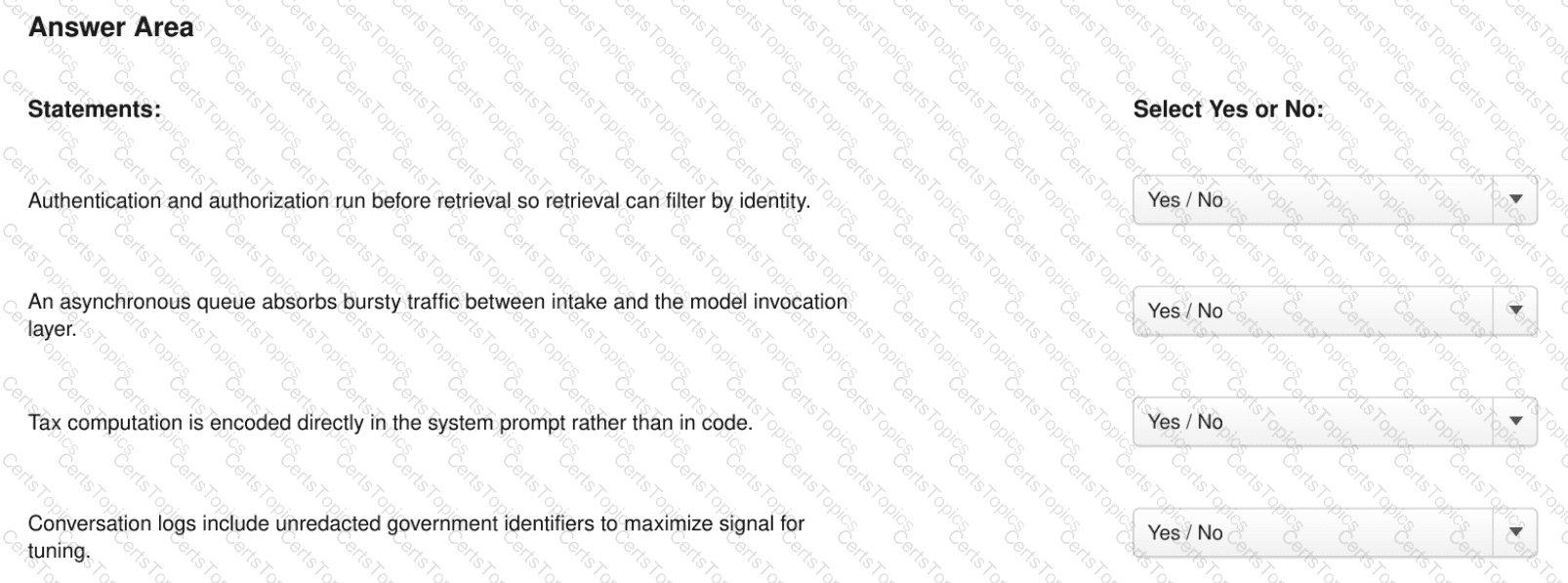
Options:

Question 34

You are designing the prompt for a ticket-triage classifier with thirty well-defined categories and clear category descriptions in the prompt.

Which technique is most appropriate as the starting point?

Options:

A.

A chain-of-thought prompt for a routing decision that does not require multi-step reasoning.

B.

A zero-shot prompt that specifies the categories with their descriptions and the required output format.

C.

A prompt that demands the model invent new categories when the supplied ones do not fit.

D.

A prompt with no category descriptions, expecting the model to infer the category set.

Question 35

A senior architect is preparing briefing materials on a new retrieval architecture. The executive sponsor has requested a summary of the architectural decision. Which framing is most appropriate for that audience?

Options:

A.

Technical alternatives evaluated, implementation implications, and component-level consequences.

B.

Business outcomes achieved, trade-offs accepted, and high-level risks acknowledged.

C.

Capabilities delivered, scope implications, and feature-level dependencies on the roadmap.

D.

Threat model, control mappings, residual-risk acceptance, and audit traceability.

Question 36

You are compiling team-setup practices for a Claude Code rollout across an engineering organization.

Which two practices belong on the list? (Select two.)

Each correct answer presents a complete solution.

Options:

A.

Use project scope for team-shared Model Context Protocol (MCP) servers and permission rules under version control.

B.

Apply managed configuration centrally for security-critical settings that must not be overridden by individual engineers.

C.

Use local scope for security-critical permission rules so each engineer can adapt them to ongoing work.

D.

Use user scope for team-shared MCP servers so every engineer on the team has consistent access.

E.

Use project scope for personal editor preferences so the preferences apply consistently within the project.

Page: 9 / 10
Total 129 questions
