Weekend Special - 75% Discount Offer - Ends in 0d 00h 00m 00s - Coupon code: big75certs

Sure Pass Exam CCAR-P PDF

Page: 2 / 9
Total 114 questions

Claude Certified Architect - Professional Questions and Answers

Question 5

You are designing a content moderation classifier that processes high volumes of user-generated comments under a tight per-message latency budget using well-defined classification labels.

Which model selection best aligns with the workload?

Options:

A.

Opus, because every moderation decision requires maximum reasoning depth regardless of classification complexity.

B.

Haiku, because its latency and cost profile align with high-volume classification workloads that require limited reasoning depth.

C.

Sonnet, because larger general-purpose models are preferred even when workload latency requirements are strict.

D.

Sonnet with extended thinking enabled, because deeper reasoning should be applied to every moderation request to improve edge-case handling.

Question 6

A loan pre-qualification assistant shows 94 percent approval recommendations that match the human underwriter decision. The fairness team has reviewed approval rate parity across protected groups and reported no significant difference. A board member has asked whether this evidence is sufficient to declare the assistant fair.

Which two Discernment-competency findings should you report? (Select two.)

Each correct answer presents part of the solution.

Options:

A.

Approval rate parity does not by itself assess error rate parity across protected groups.

B.

Match with human underwriters does not establish freedom from underwriter-introduced bias.

C.

The 94 percent match rate is sufficient evidence of fairness for the assistant’s decisions.

D.

The fairness team’s review process likely missed at least some of the protected groups studied.

E.

A larger sample is needed before any meaningful fairness claim can be made about the model.

Question 7

You are evaluating prompting claims in a peer’s design document.

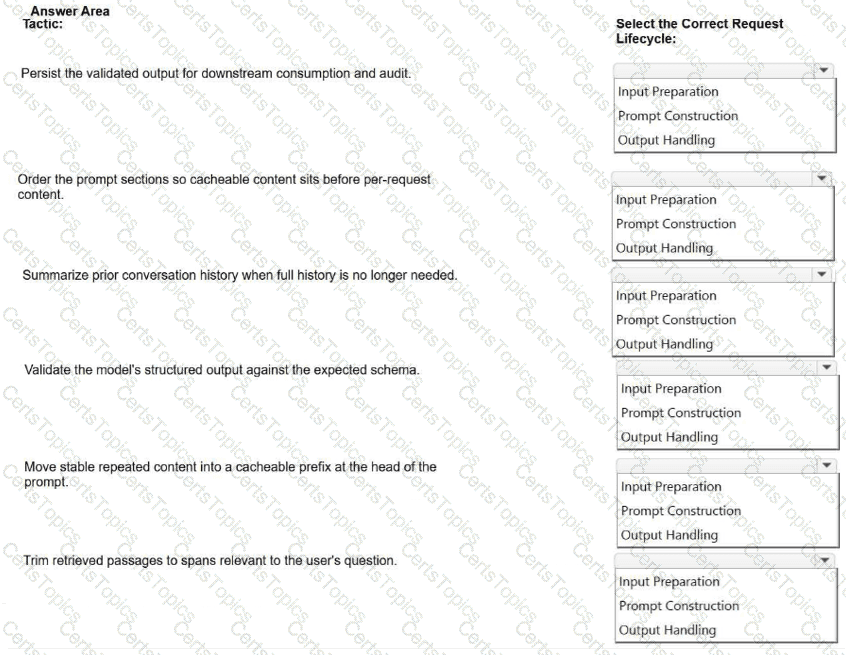
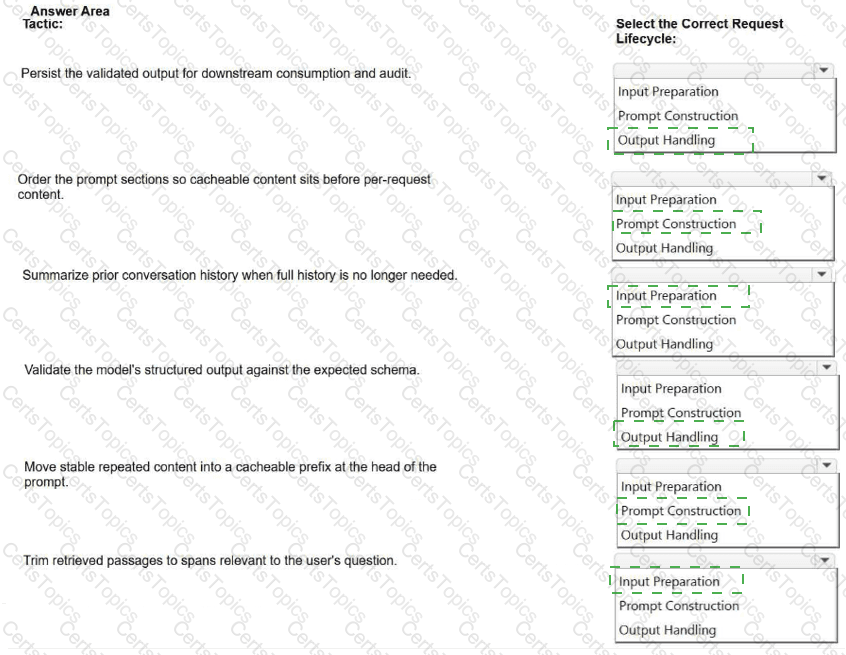
For each claim, select yes if the claim reflects sound practice. Otherwise, select no.

Options:

Question 8

You are a solution architect designing a Claude-based assistant with access to 60 internal tools across multiple business domains. Loading every tool definition on every request increases token usage and time to first response.

Which design pattern best addresses this issue without sacrificing capability breadth?

Options:

A.

Apply progressive tool discovery so a curated initial subset is exposed and additional tools are loaded on demand based on the task.

B.

Use a separate model call to summarize all 60 tool definitions before each user turn.

C.

Increase the maximum context length and load all 60 tool definitions on every request, accepting the higher token cost and latency as necessary for full capability.

D.

Hard-code a fixed set of five tools per request to reduce token usage, regardless of whether those tools are relevant to the current task.

Page: 2 / 9
Total 114 questions